Infection Prevention, Isolation and PPE Nursing Guide
Learn Standard and Transmission-Based Precautions, hand hygiene, PPE, aseptic technique, sharps safety and exposure prevention.
1. Quick Answer and Essential Facts
Direct answer: Infection prevention combines Standard Precautions for every patient with additional Contact, Droplet or Airborne Precautions when needed, plus reliable hand hygiene, risk-based PPE, aseptic technique, safe injections, sharps safety, environmental cleaning and prompt removal of unnecessary invasive devices.
Infection Prevention, Isolation Precautions and PPE: The Complete Nursing Guide is designed as a practical reference for nursing students and new nurses. It explains the topic in plain language, then connects that knowledge to assessment, safety, clinical judgment, documentation and patient teaching. The goal is not to replace an instructor, drug reference, institutional policy or clinical guideline. The goal is to help the learner understand why a safe nurse makes one decision rather than another.
-
Start with the patient, not the task. A technically correct action can still be unsafe if the patient is unstable, the order is unclear, the route is wrong, or the situation has changed.
-
Use trends and the whole clinical picture. One number, one symptom or one device alarm should rarely be interpreted in isolation.
-
Verify unfamiliar information in a current authoritative source. Nursing practice changes, products differ and local policies may be more restrictive than a general study guide.
-
Document what you assessed, what you did, how the patient responded and what you communicated when those details are clinically relevant.
NCLEX-RN® connection: This topic is directly tested in Safety and Infection Prevention and Control and is integrated throughout clinical judgment, medication administration, procedures and device care in the April 2026 NCLEX-RN® Test Plan.
Go deeper: Use active learning methods to turn reading into recall and application.
2. How this topic fits the April 2026 NCLEX-RN® Test Plan
The 2026 NCLEX-RN® Test Plan is effective from April 1, 2026 through March 31, 2029. The examination organizes nursing practice around Client Needs, while six integrated processes run through every content area: caring, clinical judgment, communication and documentation, culture and spirituality, nursing process, and teaching/learning. Most questions require application or higher-level thinking rather than simple recall.
-
Safety and Infection Prevention and Control: hand hygiene, isolation, PPE, sterile/aseptic technique, environmental safety and exposure prevention.
-
Pharmacological and Parenteral Therapies: safe injections and IV/device infection prevention.
-
Reduction of Risk Potential: prevent complications of devices and procedures.
-
Communication and Documentation: handoff of isolation status, exposures and infection findings.
Practical check: A good study method therefore asks more than 'What is the fact?' Ask: What is the important cue? What could harm the patient? What additional assessment is needed? What can the nurse do now? What requires an order or escalation? What outcome would show improvement?
NCLEX-RN® connection: Expect the same fact to appear in different forms: a stand-alone question, a priority question, a calculation, a medication-safety question, a matrix or multiple-response item, or an unfolding clinical-judgment case.
Go deeper: Connect these topics to the 2026 NCLEX-RN® test plan.
3. A simple clinical-judgment method to use throughout the guide
Direct answer: Use the six clinical-judgment steps as a mental safety loop: recognize cues, analyze cues, prioritize hypotheses, generate solutions, take action, and evaluate outcomes.
Clinical judgment is not a separate subject that begins only when a case study appears. It is the way a nurse connects information to safe action. The 2026 NCLEX-RN® Test Plan names six measurable steps. Learners should practise using them during routine topics so that the process becomes automatic.
-
Recognize cues: identify the data that matter now, including symptoms, vital signs, laboratory results, medications, devices and trends.
-
Analyze cues: connect the findings. Decide which findings support the same problem and which may be unrelated.
-
Prioritize hypotheses: compare possible explanations by urgency, likelihood and risk if care is delayed.
-
Generate solutions: identify reasonable nursing actions, expected outcomes and people who may need to be involved.
-
Take action: choose the safest action that addresses the highest-priority problem within scope and policy.
-
Evaluate outcomes: reassess. Improvement, deterioration or no change tells the nurse whether the plan is working.
Avoid this mistake: Do not force every question into a rigid mnemonic. Airway, breathing and circulation are powerful priorities when they are truly threatened, but an immediate safety threat, severe bleeding, hypoglycemia, seizure activity or another time-sensitive problem may demand action first.
NCLEX-RN® connection: In case studies, new information can change the priority. Re-read the current data rather than staying attached to an earlier hypothesis.
Go deeper: Build your reasoning with the clinical judgment guide.
4. Why infection prevention is a nursing priority
Direct answer: Infection prevention means interrupting the transmission of microorganisms while preserving safe, respectful patient care. Standard Precautions apply to every patient; Transmission-Based Precautions are added when the route or suspected organism requires more protection.
The nurse combines hand hygiene, risk-based PPE, safe injection practices, respiratory hygiene, aseptic technique, environmental controls, sharps safety and appropriate isolation. The exact room, PPE and duration requirements depend on the organism, clinical syndrome and current local policy.
-
Use Standard Precautions for all patients based on anticipated exposure to blood, body fluids, non-intact skin and mucous membranes.
-
Add Contact, Droplet or Airborne Precautions when indicated.
-
Perform hand hygiene at the moments required by the care activity; gloves do not replace hand hygiene.
-
Use aseptic technique for invasive devices and medication preparation.
-
Remove unnecessary invasive devices promptly because device days create infection opportunity.
Practical check: The safest response is based on transmission route and the planned task, not merely on the diagnosis label.
Avoid this mistake: Do not assume that one disease always has one precaution in every circumstance; procedures, symptoms and local public-health directions may change requirements.
NCLEX-RN® connection: Safety and Infection Prevention and Control is a major 2026 Client Needs subcategory and includes hand hygiene, isolation, PPE, sterile technique and exposure prevention.
5. The chain of infection and how nurses break it
-
Infection requires a connected sequence: infectious agent, reservoir, portal of exit, mode of transmission, portal of entry and susceptible host. Nursing interventions work by breaking one or more links.
-
Reduce the reservoir through cleaning, disinfection, source control and appropriate treatment.
-
Block exit with respiratory hygiene, dressings, containment of drainage and appropriate PPE.
-
Interrupt transmission with hand hygiene, environmental cleaning, safe equipment handling and isolation.
-
Protect portals of entry with aseptic technique and device care.
-
Reduce susceptibility through vaccination, nutrition, mobility and management of underlying risk when appropriate.
Practical check: Thinking in links helps when the exact organism is not yet known.
Avoid this mistake: Do not focus only on PPE. Hand hygiene, device care, environmental cleaning and safe injection practices are equally important barriers.
Chain of infection: break any link
- Infectious agent
- Reservoir
- Portal of exit
- Mode of transmission
- Portal of entry
- Susceptible host
6. Standard Precautions: the baseline for every patient
Direct answer: Standard Precautions are used for all patient care, regardless of known infection status. PPE is selected according to the anticipated exposure.
-
Hand hygiene before and after indicated patient/contact moments.
-
Gloves when contact with blood, body fluids, mucous membranes, non-intact skin or contaminated items is anticipated.
-
Gown when clothing or skin may be exposed.
-
Mask and eye/face protection when splashes or sprays are possible.
-
Safe injection, sharps and medication-preparation practices.
-
Respiratory hygiene/cough etiquette and appropriate patient placement.
-
Cleaning and reprocessing of reusable equipment according to its intended use.
Avoid this mistake: Wearing gloves continuously from task to task can spread organisms. Change gloves and perform hand hygiene as indicated.
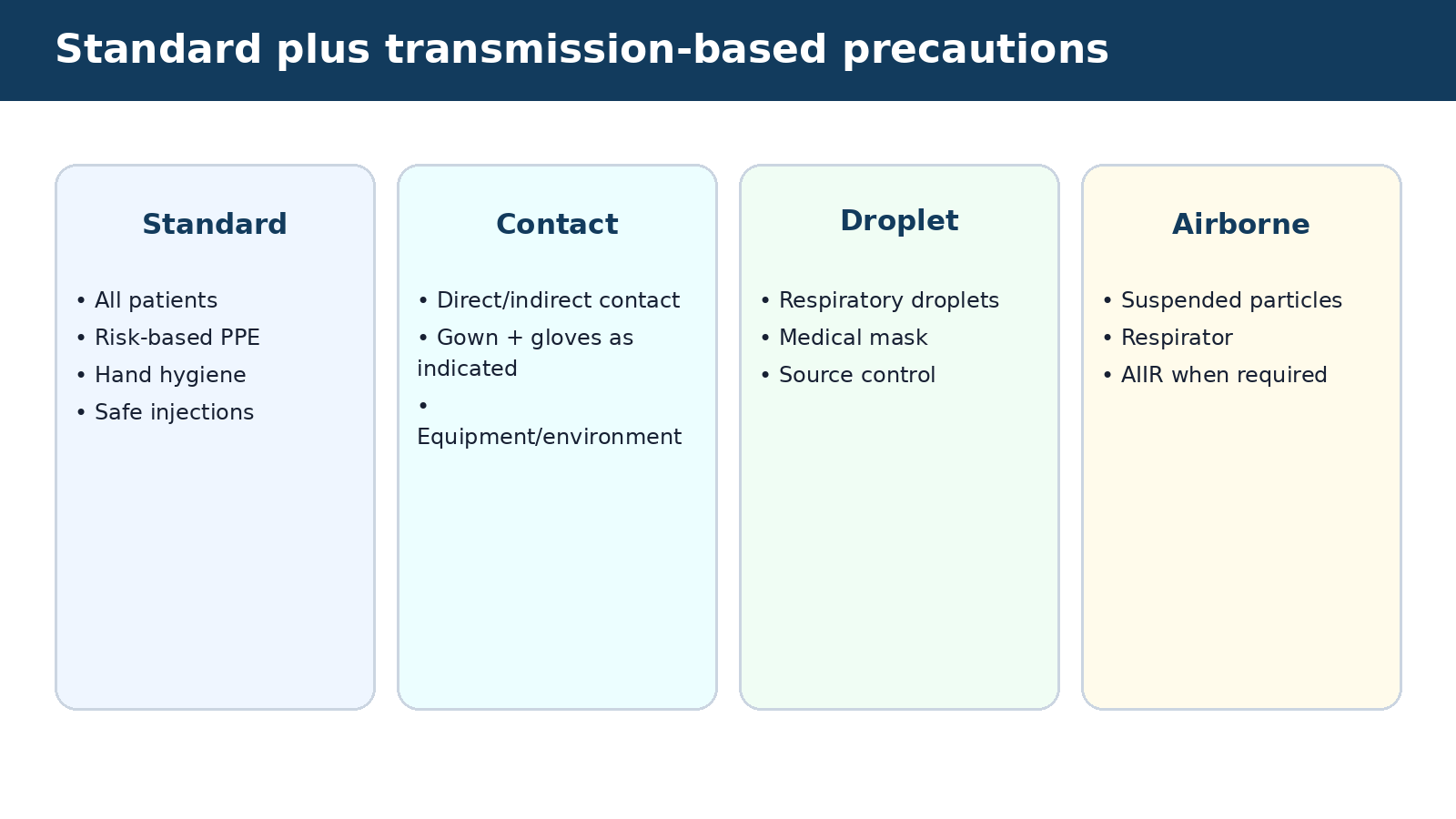
7. Contact, Droplet and Airborne Precautions
Transmission-Based Precautions are used in addition to Standard Precautions. Exact PPE, room type, transport precautions and duration should follow current CDC/local guidance for the suspected or confirmed condition.
Practical check: When the organism is unknown, syndrome-based precautions may be started while evaluation is underway.
Avoid this mistake: Do not use a memorized disease list as the only decision tool; consult current isolation guidance.
| Precaution | Main transmission concept | Typical controls |
|---|---|---|
| Contact | Direct or indirect contact with patient/environment | Gown and gloves on entry for required Contact Precautions; dedicated/cleaned equipment; appropriate room placement |
| Droplet | Larger respiratory particles over short range | Medical mask on entry to the patient room or space; source control and placement per guidance |
| Airborne | Small particles that can remain suspended | Respiratory protection such as fit-tested N95 or higher-level respirator and airborne-infection isolation room when required |
8. Hand hygiene: soap and water versus alcohol-based hand rub
Direct answer: Alcohol-based hand rub is preferred for many routine clinical situations when hands are not visibly soiled. Soap and water are required when hands are visibly dirty and in situations where local guidance calls for mechanical removal of organisms/spores.
CDC prefers alcohol-based hand rub for most clinical care when hands are not visibly soiled, including routine care of patients with C. difficile. Use soap and water when visibly soiled and follow additional soap-and-water guidance during C. difficile or norovirus outbreaks. Gloves, gowns and environmental cleaning remain essential. See CDC clinical hand hygiene.
-
Clean hands before touching a patient when indicated.
-
Clean hands before aseptic tasks.
-
Clean after body-fluid exposure risk, after touching a patient and after touching the patient environment when indicated.
-
Perform hand hygiene after glove removal.
-
Keep artificial nails/jewelry practices consistent with institutional infection-control policy.
Avoid this mistake: Do not rely on gloves as a substitute for hand hygiene.
Hand hygiene decision
- Visibly soiled hands: use soap and water
- Most other clinical care: alcohol-based hand rub is preferred
- During C. difficile or norovirus outbreaks: follow soap-and-water and local infection-prevention guidance
- Perform hand hygiene after glove removal; gloves do not replace it
9. PPE selection, donning and doffing
-
PPE should match the exposure risk. The sequence matters most during removal because contaminated surfaces can transfer organisms to clothing, skin, eyes or mucous membranes.
-
Before entry: know the precaution sign and planned tasks.
-
Choose gown, gloves, mask/respirator and eye protection according to risk and policy.
-
Fit-check a respirator each time it is worn; formal fit testing follows occupational requirements.
-
Remove PPE without touching contaminated surfaces and perform hand hygiene at required points.
-
Know which items must be removed inside the room and which are removed after exit according to the local protocol.
Practical check: If PPE becomes torn, heavily contaminated or compromises safe care, stop and replace it using a safe process.
Avoid this mistake: A single universal donning/doffing sequence should not override the current facility protocol, especially for high-consequence pathogens.
PPE decision sequence
- Identify precautions and the planned task
- Anticipate exposure and select required PPE
- Perform hand hygiene and don PPE using the local sequence
- Provide care while avoiding contamination
- Remove PPE safely and perform hand hygiene
10. Aseptic technique and sterile technique
-
Asepsis reduces the chance that microorganisms enter vulnerable sites. Sterile technique is required for procedures and fields that must remain sterile; clean technique may be appropriate for other tasks.
-
Prepare a clean workspace before opening sterile supplies.
-
Keep sterile items in view and above waist level.
-
Treat a wet, torn, contaminated or out-of-view sterile field as compromised.
-
Avoid reaching across a sterile field.
-
If sterility is uncertain, replace the questionable item or field.
Practical check: The exact procedure standard comes from current institutional policy and device/manufacturer guidance.
Avoid this mistake: Do not “save” a questionable sterile field because supplies are limited or the procedure has already started.
Aseptic field safety
- Prepare a clean area and sterile supplies
- Create and protect the sterile field
- Use aseptic technique throughout the procedure
- If contamination occurs, stop and replace the affected item or field
11. Safe injections, medication preparation and multidose vials
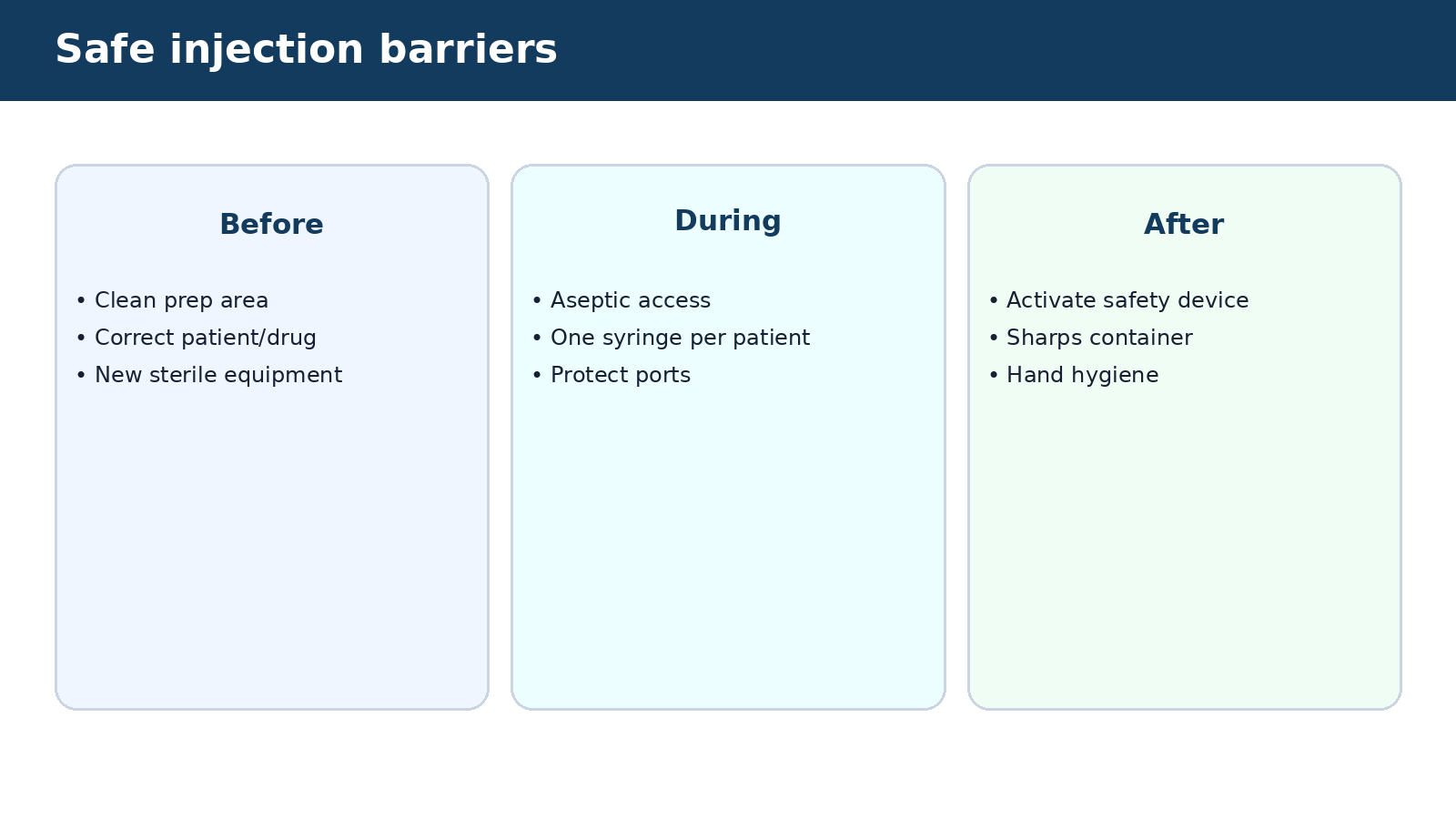
Direct answer: A new sterile needle and syringe are used for every injection and every entry into a medication container intended to maintain sterility. Never reuse a syringe for more than one patient, even if the needle is changed.
-
Prepare injections in a clean medication-preparation area away from contamination.
-
Use single-dose/single-use vials for one patient whenever applicable.
-
Follow current rules for multidose vials and dedicate them to one patient whenever possible.
-
Disinfect vial septa/access ports according to product and facility guidance.
-
Do not administer medication from a syringe that cannot be reliably identified.
Avoid this mistake: Changing only the needle does not make a used syringe safe for another patient.
12. Sharps safety and occupational exposure
-
Preventing needlestick and sharps injuries protects staff and patients. Engineering controls and safe work practices are preferred over risky manual handling.
-
Activate safety devices immediately after use.
-
Dispose of sharps promptly in approved containers.
-
Avoid recapping unless a specific procedure requires it and a safe technique/device is used.
-
After an exposure, wash/flush the affected area, report immediately and follow the occupational-exposure pathway without delaying evaluation.
Practical check: Post-exposure management is time-sensitive and pathogen-specific; use the current employee-health or emergency protocol.
Avoid this mistake: Do not wait for symptoms before reporting an exposure.
Exposure response
- Perform immediate first aid for the exposure
- Report immediately through the occupational exposure process
- Obtain urgent risk evaluation and indicated testing or prophylaxis
- Complete required follow-up; do not delay reporting while waiting for symptoms
13. Device-associated infection prevention
-
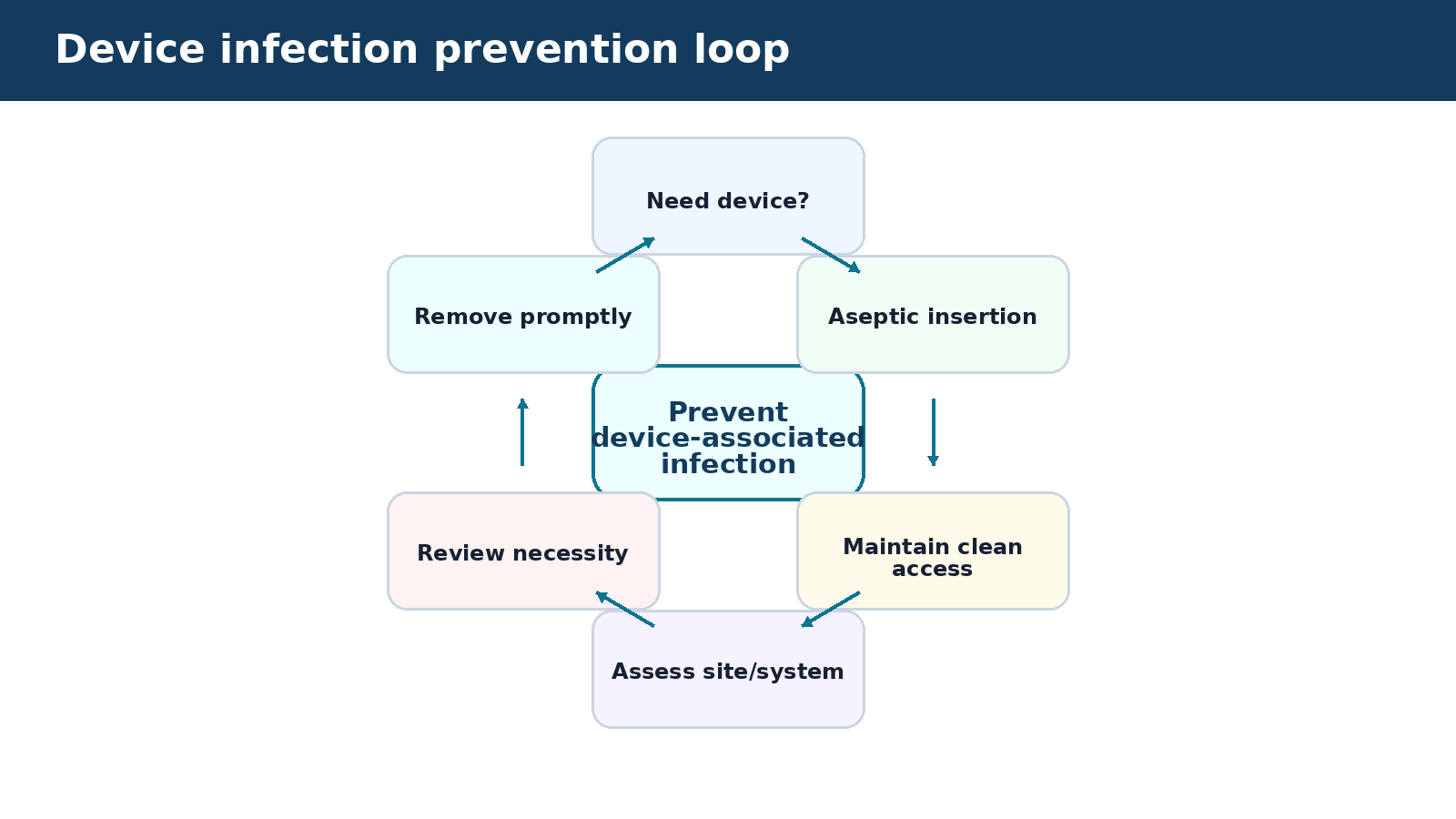
Urinary catheters, peripheral and central vascular catheters, ventilators and other invasive devices create portals of entry. Prevention begins with avoiding unnecessary placement and removing devices promptly when no longer needed.
-
Use aseptic insertion and maintenance technique.
-
Keep closed systems closed when appropriate.
-
Assess device necessity every day.
-
Monitor insertion sites and systemic signs of infection.
-
Access hubs/connectors aseptically and disinfect as required.
-
Escalate unexplained fever, drainage, tenderness, hemodynamic change or other concerning findings.
Avoid this mistake: Do not culture or treat devices solely because they are present; interpret findings in the clinical context.
14. Environmental cleaning, equipment and linen
-
Frequently touched surfaces and shared equipment can transmit organisms. Nursing care includes preventing cross-contamination.
-
Clean/disinfect shared equipment between patients according to manufacturer and facility instructions.
-
Keep clean supplies separate from used equipment.
-
Handle soiled linen with minimal agitation and appropriate containment.
-
Do not place contaminated equipment on clean medication-preparation surfaces.
-
Follow sporicidal or enhanced-cleaning procedures when the organism requires them.
15. Respiratory hygiene, source control and transport
-
Patients with respiratory symptoms should be identified early and offered source-control measures consistent with current guidance. Movement outside the room should be limited when isolation is required.
-
Teach cough etiquette and provide tissues/hand hygiene access.
-
Apply source-control masking when indicated and tolerated.
-
Communicate required precautions before transport.
-
Cover/contain infected wounds or drainage during transport when feasible.
-
Receiving departments should know the necessary precautions before arrival.
Isolation transport checklist
- Confirm transport is necessary
- Apply appropriate source control and cover infectious sites
- Notify the receiving team before transport
- Use clean equipment and maintain precautions throughout transfer
16. Specimen collection without contaminating the result
-
A contaminated specimen can cause false diagnoses, unnecessary antibiotics and missed true infections. Collection technique matters.
-
Confirm the correct patient, specimen, container, site and timing.
-
Use aseptic technique where required.
-
Avoid collecting cultures from contaminated surfaces unless the test specifically calls for it.
-
Label at the bedside according to policy.
-
Transport promptly under the required temperature/time conditions.
Practical check: If the specimen quality is doubtful, clarify rather than treating an unreliable result as truth.
Specimen quality pathway
- Verify patient, specimen site and required test
- Use the correct container and collection technique
- Label at the bedside after collection
- Transport promptly under test-specific conditions
- Interpret results with the clinical picture
17. Antimicrobial stewardship and nursing responsibilities
-
Nurses support antimicrobial stewardship by obtaining ordered cultures correctly, administering antimicrobials on time, monitoring response/adverse effects, documenting allergies accurately and helping clarify unnecessary or duplicate therapy.
-
Do not delay urgent antimicrobials solely to obtain a culture when doing so would be unsafe; follow the clinical protocol.
-
Distinguish allergy, intolerance and expected side effects when possible.
-
Monitor renal/hepatic function and drug levels when relevant.
-
Teach patients why antibiotics do not treat viral illness and why prescribed courses should be used as directed.
18. Patient and family teaching
-
Isolation can be confusing and stigmatizing. Explain the purpose in plain language and preserve dignity.
-
Explain why hand hygiene matters and when visitors should perform it.
-
Demonstrate PPE if visitors are expected to use it.
-
Explain whether items can leave the room and how equipment is cleaned.
-
Teach signs of infection that require medical review after discharge.
-
Use teach-back to confirm understanding.
19. A bedside infection-prevention safety check
-
What transmission route or exposure risk is present?
-
Are Standard Precautions enough, or are additional precautions required?
-
What PPE is needed for this specific task?
-
Have I performed hand hygiene and prepared a clean/sterile field correctly?
-
Are invasive devices still needed and being maintained safely?
-
Could my equipment, clothing, hands or workflow carry organisms to another patient?
-
What needs to be documented or communicated at handoff?
20. Clinical judgment cases
How to use the cases: Read the scenario once for the big picture. Then identify the most important cues, the priority concern, the safest immediate nursing actions, and the findings that would show whether the plan worked. These cases are original educational examples, not official examination items.
Case 1: New cough and fever before diagnosis is known
A patient arrives with fever, cough and shortness of breath. The cause is not yet known.
| Clinical-judgment step | Reasoning |
|---|---|
| Recognize cues | Respiratory syndrome with possible transmissible infection. |
| Analyze cues | Staff and other patients may be exposed before a final diagnosis. |
| Prioritize hypotheses | Source control, appropriate empiric precautions and clinical assessment. |
| Generate solutions | Mask/source control as indicated, separate/place patient per policy, perform hand hygiene, use task-appropriate PPE and notify infection-control/clinical team as needed. |
| Take action | Do not wait for a final laboratory result before protecting others when syndrome-based precautions are indicated. |
| Evaluate outcomes | Confirm required testing, respiratory status, isolation plan and communication. |
Case 2: Diarrhea after recent antibiotics
A hospitalized patient develops frequent watery diarrhea after several days of antibiotics.
| Clinical-judgment step | Reasoning |
|---|---|
| Recognize cues | New diarrhea with risk for transmissible enteric infection. |
| Analyze cues | C. difficile is one possible cause; environmental contamination risk is high. |
| Prioritize hypotheses | Clinical assessment, appropriate contact precautions per local protocol and correct specimen testing if ordered. |
| Generate solutions | Use gown/gloves as indicated, emphasize handwashing with soap/water when required, dedicate/clean equipment and use sporicidal environmental cleaning if confirmed/required. |
| Take action | Protect others while evaluating dehydration and illness severity. |
| Evaluate outcomes | Trend stool frequency, hydration, test results and symptom response. |
Case 3: Needlestick after an injection
A nurse sustains a puncture from a used hollow-bore needle.
| Clinical-judgment step | Reasoning |
|---|---|
| Recognize cues | Potential occupational blood/body-fluid exposure. |
| Analyze cues | Risk depends on source, device, depth and pathogen factors; post-exposure decisions can be time-sensitive. |
| Prioritize hypotheses | Immediate first aid and prompt exposure evaluation. |
| Generate solutions | Wash the area, report immediately, follow employee-health/exposure protocol and obtain source/exposed-person testing and prophylaxis decisions as directed. |
| Take action | Do not delay reporting while trying to estimate risk independently. |
| Evaluate outcomes | Complete follow-up testing and prophylaxis monitoring per protocol. |
Case 4: Break in sterile urinary catheter insertion
During catheter insertion, the sterile catheter touches the bed linen before entering the urethra.
| Clinical-judgment step | Reasoning |
|---|---|
| Recognize cues | The sterile device is contaminated. |
| Analyze cues | Continuing would introduce organisms into the urinary tract. |
| Prioritize hypotheses | Restore sterility before insertion. |
| Generate solutions | Stop, discard contaminated equipment as appropriate and restart with sterile supplies/technique. |
| Take action | Do not proceed because the catheter “only touched briefly.” |
| Evaluate outcomes | Complete insertion aseptically and monitor ongoing catheter necessity. |
Case 5: Shared glucose meter not disinfected
A glucose meter is used on one patient and is about to be used on another without cleaning.
| Clinical-judgment step | Reasoning |
|---|---|
| Recognize cues | Shared equipment can transmit bloodborne and other pathogens. |
| Analyze cues | Gloves do not make contaminated equipment safe. |
| Prioritize hypotheses | Prevent cross-patient transmission. |
| Generate solutions | Stop use, disinfect according to manufacturer/facility protocol or use dedicated equipment. |
| Take action | Do not wipe it with an unapproved product or skip required contact time. |
| Evaluate outcomes | Confirm equipment-cleaning workflow and staff understanding. |
Case 6: Central-line patient develops fever and hypotension
A patient with a central venous catheter develops fever, chills and falling blood pressure.
| Clinical-judgment step | Reasoning |
|---|---|
| Recognize cues | Possible bloodstream infection/sepsis with hemodynamic deterioration. |
| Analyze cues | The line is one potential source, but the immediate threat is systemic instability. |
| Prioritize hypotheses | Sepsis assessment and urgent escalation. |
| Generate solutions | Assess ABCs, obtain help, follow sepsis protocol, obtain cultures as ordered and evaluate all possible sources including the line. |
| Take action | Do not focus on dressing change while ignoring hypotension. |
| Evaluate outcomes | Trend perfusion, lactate/diagnostics as ordered, cultures and response to treatment. |
Go deeper: Apply the same approach to Next Generation NCLEX® case studies.
21. Practice questions with answers and rationales
Important: These are original RN Clarity practice questions. They are not copied from, endorsed by or affiliated with NCSBN® or the NCLEX® examination.
Question 1: Which statement about Standard Precautions is correct?
-
A. They are used only for known infections.
-
B. They apply to all patients based on anticipated exposure.
-
C. They replace Transmission-Based Precautions.
-
D. They require an N95 respirator for every patient.
Answer and rationale: B. Standard Precautions are the baseline for all patient care; additional precautions are added when indicated.
Question 2: A nurse removes gloves after wound care. What should happen next?
-
A. Hand hygiene
-
B. Put on another pair of gloves immediately without cleaning hands
-
C. Touch the computer first
-
D. No action if gloves were intact
Answer and rationale: A. Gloves are not a substitute for hand hygiene.
Question 3: What is the safest response if a sterile field is accidentally touched by a nonsterile item?
-
A. Continue if the touch was brief
-
B. Consider the affected area/item contaminated and replace it
-
C. Wipe it with alcohol
-
D. Ask another nurse to decide later
Answer and rationale: B. When sterility is compromised, replace the contaminated item/field rather than guessing.
Question 4: Which practice is unsafe?
-
A. New sterile needle and syringe for each injection
-
B. Reusing a syringe for a second patient after changing the needle
-
C. Preparing medication in a clean area
-
D. Disinfecting vial access points as required
Answer and rationale: B. A syringe must never be reused for another patient, even if the needle is changed.
Question 5: Why is daily review of catheter necessity important?
-
A. To make documentation longer
-
B. Unnecessary device days create infection risk
-
C. To avoid all specimen collection
-
D. Because every catheter must be replaced daily
Answer and rationale: B. Removing unnecessary invasive devices reduces opportunities for infection.
Question 6: A patient on airborne precautions must leave the room for an essential test. What is best?
-
A. Transport without telling anyone
-
B. Follow source-control/transport requirements and notify the receiving area
-
C. Cancel all tests automatically
-
D. Remove precautions during transport
Answer and rationale: B. Communication and appropriate transport precautions reduce exposure risk.
Question 7: Which action is appropriate after a needlestick?
-
A. Wait for symptoms
-
B. Wash/flush the area and report immediately
-
C. Squeeze the wound aggressively for 10 minutes
-
D. Post the event on social media
Answer and rationale: B. Occupational exposure evaluation can be time-sensitive.
Question 8: Which PPE principle is most accurate?
-
A. More PPE is always safer
-
B. PPE should match the exposure and transmission risk
-
C. Gloves replace hand hygiene
-
D. An N95 is required for all droplet precautions
Answer and rationale: B. PPE is risk-based and used with Standard/Transmission-Based Precautions.
Question 9: What is a key reason specimen technique matters?
-
A. Contamination can create misleading results
-
B. It changes the patient’s diagnosis automatically
-
C. Labels are optional
-
D. All cultures should be taken from drainage bags
Answer and rationale: A. Poor collection can cause false or misleading microbiology results.
Question 10: Which action supports antimicrobial stewardship?
-
A. Document every nausea episode as an antibiotic allergy
-
B. Clarify allergy history and monitor response
-
C. Skip cultures before every antibiotic regardless of clinical context
-
D. Stop antibiotics independently when the patient feels better
Answer and rationale: B. Accurate allergy information and monitoring help optimize antimicrobial use.
Go deeper: Continue with NCLEX-RN® practice questions.
22. Frequently asked questions
What are Standard Precautions?
The baseline infection-prevention practices used for all patients, selected according to the anticipated exposure.
What are Transmission-Based Precautions?
Additional Contact, Droplet or Airborne measures used when a suspected or confirmed infection requires extra controls.
Do gloves replace hand hygiene?
No. Perform hand hygiene at the indicated moments, including after glove removal.
When is soap and water preferred?
Use soap and water when hands are visibly soiled, after using the restroom, before eating, and as directed during C. difficile or norovirus outbreaks. Alcohol-based hand rub remains preferred for most other clinical care; follow current facility infection-prevention guidance.
What is the difference between Droplet and Airborne Precautions?
They address different respiratory transmission patterns and therefore differ in respiratory protection and room requirements.
Can a syringe be reused if the needle is changed?
No. Never reuse a syringe for another patient.
What should happen after a needlestick?
Perform immediate first aid and report promptly through the occupational-exposure process.
Why remove unnecessary catheters?
Each unnecessary device day creates avoidable infection and complication risk.
Is one isolation table enough for every hospital?
No. Use current CDC/local public-health and institutional guidance because pathogens and situations differ.
How does infection prevention appear on NCLEX-RN® 2026?
Through hand hygiene, isolation, PPE, sterile technique, device safety, environmental hazards, safe injections, sharps and clinical-judgment scenarios.
23. Official and primary references
Sources checked September 10, 2026. Use the linked guidance for the full context and follow patient-specific orders, scope of practice and local policy.
-
2026 NCLEX-RN® Test Plan — Official Safety and Infection Prevention and Control activities.
-
CDC Standard Precautions — Baseline precautions for all patient care.
-
CDC Transmission-Based Precautions — Contact, Droplet and Airborne principles.
-
CDC Isolation Precautions Appendix A — Disease-specific precaution guidance.
-
CDC Hand Hygiene in Healthcare Settings — Clinical hand-hygiene recommendations.
-
CDC Safe Injection Practices — Injection and medication-preparation safety.
-
CDC Sharps Safety — Occupational sharps-injury prevention.
24. Educational, clinical-safety and trademark disclaimer
Educational and clinical-safety disclaimer: This guide is provided by RN Clarity for general educational and informational purposes. It does not replace the official 2026 NCLEX-RN® Test Plan, nursing-school instruction, a current drug or clinical reference, provider orders, nursing regulator requirements, institutional policy, manufacturer instructions, local infection-control guidance or professional clinical judgment. Real patients may have conditions, medications, allergies, laboratory results, age-related needs or other factors that require a different approach. When a patient may be deteriorating, follow local emergency and escalation procedures. Use of this guide does not guarantee examination success or clinical competence. Non-affiliation and trademark notice: RN Clarity is an independent educational resource and is not affiliated with, endorsed by, sponsored by, approved by or officially connected with the National Council of State Boards of Nursing, Inc. NCLEX®, NCLEX-RN®, NCLEX-PN® and NCSBN® are registered trademarks of the National Council of State Boards of Nursing, Inc. All trademarks belong to their respective owner. Their use here is for identification, commentary and educational reference only.
Continue your study: Sepsis and Septic Shock. Each guide includes assessment, nursing actions, original cases and linked references.