NCLEX-RN® Dosage Calculations Guide: Methods, IV Rates and Exam Strategy
Master nursing dosage calculations for the NCLEX-RN®: metric conversions, three calculation methods, oral and injectable doses, weight-based and pediatric dosing, IV pump rates, gravity drip rates, titrated infusions, insulin and heparin calculations, and a ten-step exam strategy.
1. Quick Answer and Learning Goals
Dosage calculations are a required competency on the NCLEX-RN® and a daily clinical skill. The April 2026 test plan places Pharmacological and Parenteral Therapies at 13–19% of scored items, and calculation items appear throughout that category. Every calculation item on the examination provides an on-screen calculator, so the goal is not arithmetic speed — it is the ability to set up equations correctly, cancel units systematically and check whether a result is clinically reasonable.
After working through this guide you should be able to:
- Convert between metric units (kg, g, mg, mcg) and between pounds and kilograms without a reference sheet.
- Use all three calculation methods — formula, ratio-proportion and dimensional analysis — and produce identical results with each.
- Calculate oral, injectable, reconstituted, weight-based and pediatric doses.
- Calculate IV pump rates in mL/hr, gravity drip rates in gtt/min, infusion times and titrated infusion rates.
- Apply safe-dose range reasoning and recognize when a correct calculation still requires clinical judgment.
- Describe the special calculation requirements for insulin, heparin and concentrated electrolytes.
- Apply a ten-step NCLEX® item strategy to every calculation question.
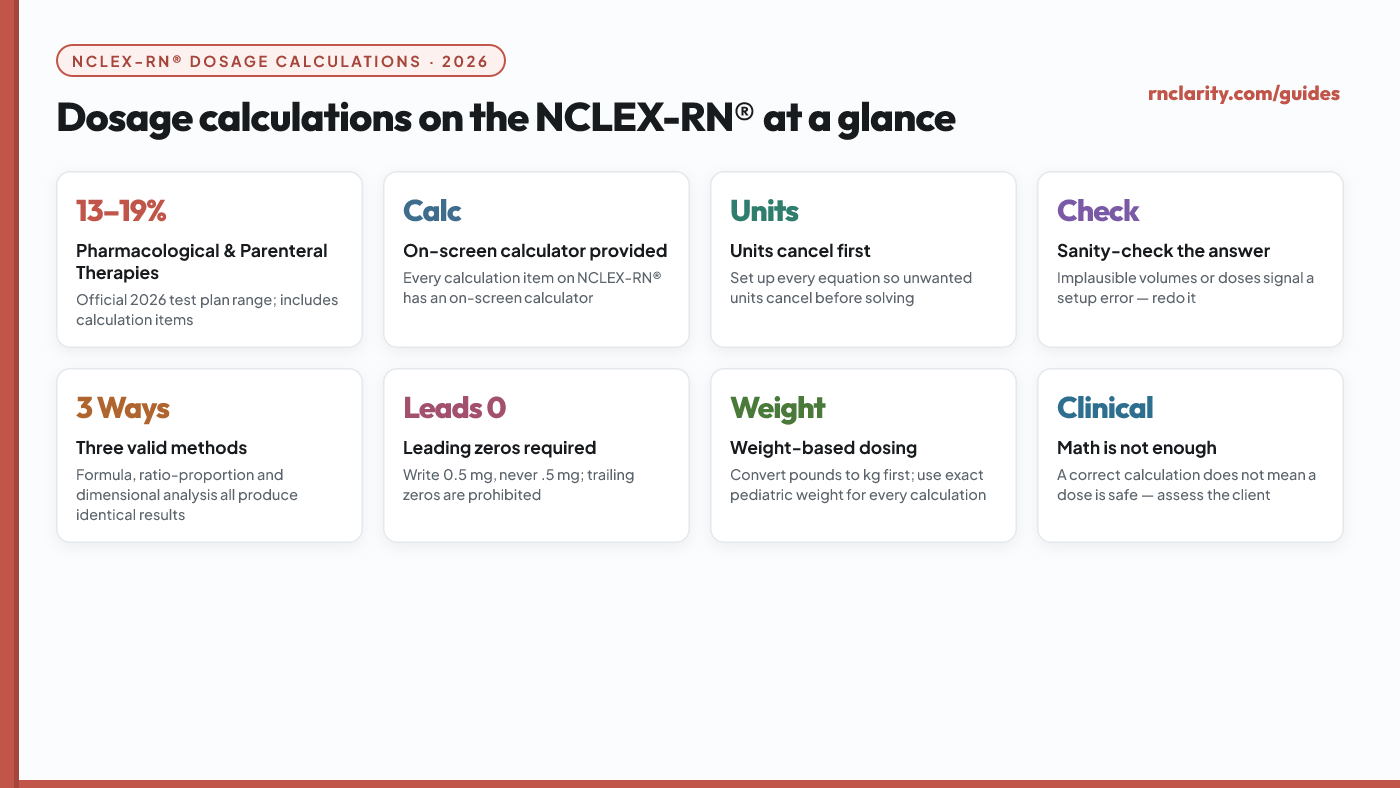
Remember: The calculator is on screen so the examination tests your ability to set up a correct equation — not your ability to do arithmetic in your head.
2. Alignment with the April 2026 NCLEX-RN® Test Plan
The 2026 test plan, effective April 1, 2026, lists dosage and rate calculations explicitly under Pharmacological and Parenteral Therapies activities, including administering medications safely, calculating medication dosages, monitoring IV therapy, and administering blood products and parenteral nutrition. The integrated nursing processes of Safety and Infection Prevention and Control also generate calculation items, for example when a candidate must verify that a weight-based dose falls within a stated safe range.
Key 2026 test-plan facts for calculation items:
- An on-screen calculator is provided for every numerical item — never attempt mental arithmetic under time pressure when a tool is available.
- Laboratory values are presented with reference ranges, eliminating the need to memorize normal values.
- Case-study (NGN) items may include multiple exhibit tabs — an order, a client weight, a medication record and a laboratory result — and the correct answer may depend on information from more than one tab.
- Partial-credit scoring applies to some multi-response items; however, calculation fill-in-the-blank items are scored as correct or incorrect based on the exact value and format requested.
Go deeper: For the full breakdown of the 2026 test plan, Client Needs percentages and adaptive scoring, see the NCLEX-RN® test plan explained.
3. Why Nursing Math Is a Clinical Judgment Skill
The NCLEX-RN® does not test calculation ability in isolation. Items frequently combine a numerical calculation with a clinical decision. A candidate may calculate a dose correctly and then face the actual question: should this dose be administered, held, clarified or reported?
A mathematically correct result can still be unsafe if:
- The dose exceeds a stated maximum or falls outside a safe-dose range.
- A laboratory value (potassium level, renal function, coagulation) makes administration inappropriate.
- The client's weight, age or diagnosis changes the therapeutic window.
- The concentration on the available supply differs from what the order assumes.
- The route or timing specified in the order is incompatible with the client's current status.
The National Council of State Boards of Nursing Clinical Judgment Measurement Model (CJMM) six steps — Recognize Cues, Analyze Cues, Prioritize Hypotheses, Generate Solutions, Take Action and Evaluate Outcomes — apply directly to dosage-calculation scenarios. Recognizing that a calculation result is outside the expected range is a Recognize Cues step. Analyzing whether a dose is appropriate for this specific client is an Analyze Cues step. Deciding to hold and clarify before administering is a Take Action step.
Go deeper: For a detailed walkthrough of all six CJMM steps with clinical examples, see the clinical judgment guide.
4. Core Math Foundations
4.1 Place value and decimals
The decimal point separates whole numbers from fractions. In medication calculations, a misplaced decimal point is a tenfold error. Moving the decimal one place to the right multiplies by ten; moving it one place to the left divides by ten.
Safe decimal practices:
- Always use a leading zero before a decimal point less than one: write 0.5 mg, never .5 mg.
- Never add a trailing zero after a whole number: write 5 mg, never 5.0 mg.
- When the on-screen calculator returns a long decimal, round only at the final step and only to the precision specified in the item.
4.2 Fractions
A fraction represents division of one quantity by another. In dosage calculations, fractions appear when the desired dose divided by the available dose gives a result less than one. For example, if 500 mg is available and 250 mg is ordered, the fraction 250/500 = 0.5. The nurse gives half of the available unit.
4.3 Ratios and proportions
A ratio compares two quantities, such as 250 mg in 5 mL. A proportion states that two ratios are equal. If 250 mg is contained in 5 mL, then 375 mg is contained in x mL. Cross-multiplication gives: 250x = 375 × 5 = 1,875, so x = 7.5 mL.
Cross-multiply only after confirming that equivalent units occupy matching positions in the proportion.
4.4 Percentages
Percent means per one hundred. A 1% weight/volume solution contains 1 g in 100 mL, which is 10 mg/mL. Because percentage labels can be misread, translate the percentage into the exact mass per volume before calculating. Use the product label as the source of truth.
4.5 Estimation
Estimation is an error-detection tool. If 250 mg is available in 5 mL and 375 mg is ordered, the volume must be more than 5 mL but less than 10 mL. An answer of 75 mL or 0.75 mL should immediately trigger a review. Estimation does not replace the exact calculation; it tests whether the result belongs in the correct range.
5. Units, Labels and Medication-Language Safety
A number without a unit is incomplete. The unit tells the nurse what the number measures.
| Type | Common units | Meaning |
|---|---|---|
| Mass | kg, g, mg, mcg | Amount of substance by weight |
| Volume | L, mL | Amount of liquid |
| Time | hr, min | Duration or rate period |
| Body weight | kg | Basis for weight-dependent dose |
| Biologic activity | units, IU, mEq | Standardized pharmacologic activity |
Prohibited abbreviations (The Joint Commission Do Not Use list):
- Write units in full — never "U" (U can be misread as 0, turning 8 U into 80 units).
- Write international units in full — never "IU" (IU can be misread as IV).
- Write 0.5 mg with a leading zero — never .5 mg.
- Write 5 mg without a trailing zero — never 5.0 mg.
- Use mL not cc (they are numerically equal, but mL is the standard).
6. Metric Conversions
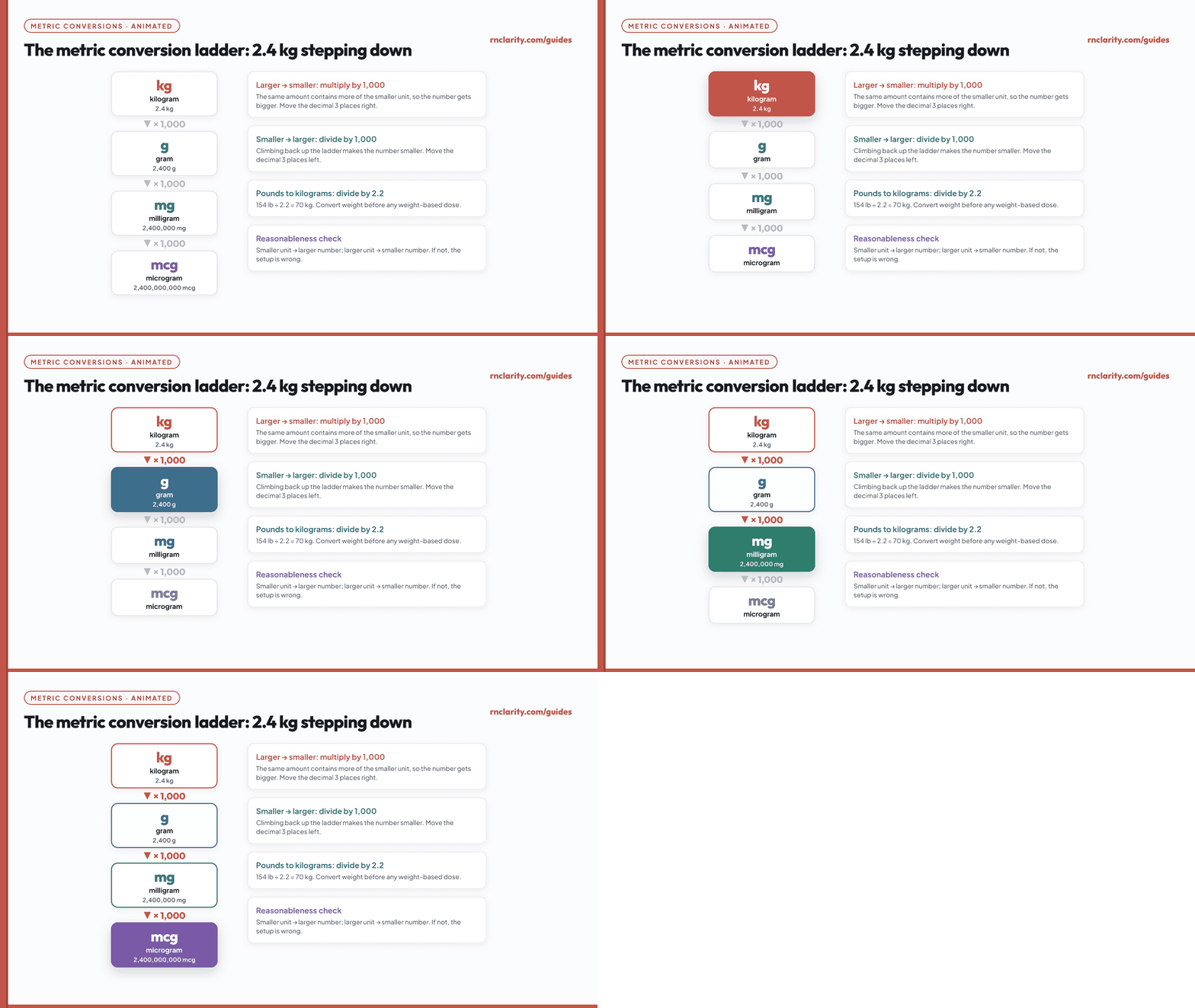
The metric system uses powers of ten. Moving between adjacent prefixes always involves multiplying or dividing by 1,000.
kilo (k) → base → milli (m) → micro (mc/μ): each step moves the decimal 3 places.
6.1 Larger unit to smaller unit — multiply
Multiply when converting a larger unit into a smaller unit because the same physical amount contains more of the smaller units.
- 0.25 g × 1,000 = 250 mg
- 1.5 mg × 1,000 = 1,500 mcg
- 2.4 kg × 1,000 = 2,400 g
Reasonableness check: the numerical value becomes larger when the unit becomes smaller.
6.2 Smaller unit to larger unit — divide
Divide when converting a smaller unit into a larger unit.
- 750 mg ÷ 1,000 = 0.75 g
- 500 mcg ÷ 1,000 = 0.5 mg
Reasonableness check: the numerical value becomes smaller when the unit becomes larger.
6.3 Converting pounds to kilograms
Divide pounds by 2.2 to obtain kilograms.
- 154 lb ÷ 2.2 = 70 kg
- 110 lb ÷ 2.2 = 50 kg
For pediatric calculations, use the most recently recorded weight in kilograms. Do not round a child's weight before using it in a weight-based formula.
7. Household and Other Conversions
Household measures appear in teaching scenarios and oral liquid calculations. The examiner provides any necessary conversion factor in the item; do not memorize obscure equivalents. The following appear most frequently:
| Household | Metric equivalent |
|---|---|
| 1 teaspoon (tsp) | 5 mL |
| 1 tablespoon (tbsp) | 15 mL |
| 1 fluid ounce (oz) | 30 mL |
| 1 cup | 240 mL |
| 1 pint | 480 mL |
8. The Six-Step Nursing Math Safety Workflow
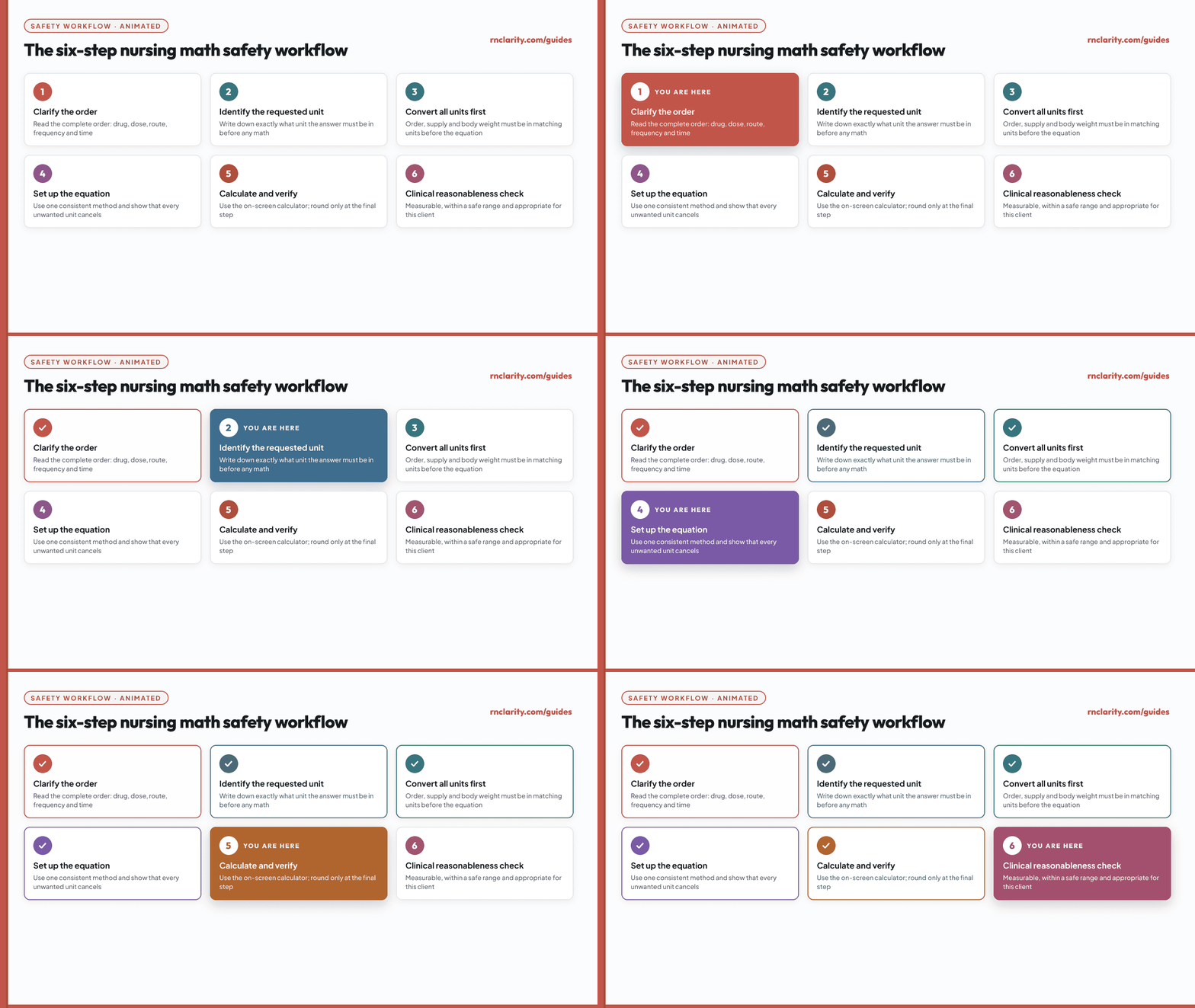
Applying the same workflow to every calculation problem eliminates the errors that stem from rushing.
- Clarify the order. Read the complete medication order: drug name, dose, route, frequency and any instructions (give with food, rate limits, weight-based parameter).
- Identify the requested unit. Read the final question or response field first and write down exactly what unit the answer must be in — tablets, mL, mL/hr, gtt/min, mcg/kg/min.
- Convert all units first. Ensure the ordered dose, the available supply and any body weight are expressed in matching units before writing the equation. Do not mix milligrams and micrograms in the same equation.
- Set up the equation. Use one consistent method and arrange the conversion factors so every unwanted unit cancels. The remaining unit should be the unit requested.
- Calculate and verify. Use the on-screen calculator. Round only at the final step, to the precision specified in the item or dictated by the device. Gravity drip rates are whole numbers; pump rates may carry one decimal.
- Clinical reasonableness check. Confirm the result is measurable with available equipment, within any stated safe range and clinically appropriate given the client's condition, weight, organ function and current assessment.
Go deeper: For strategies to apply this workflow to every question format on the exam, see the practice questions guide.
9. Three Calculation Methods
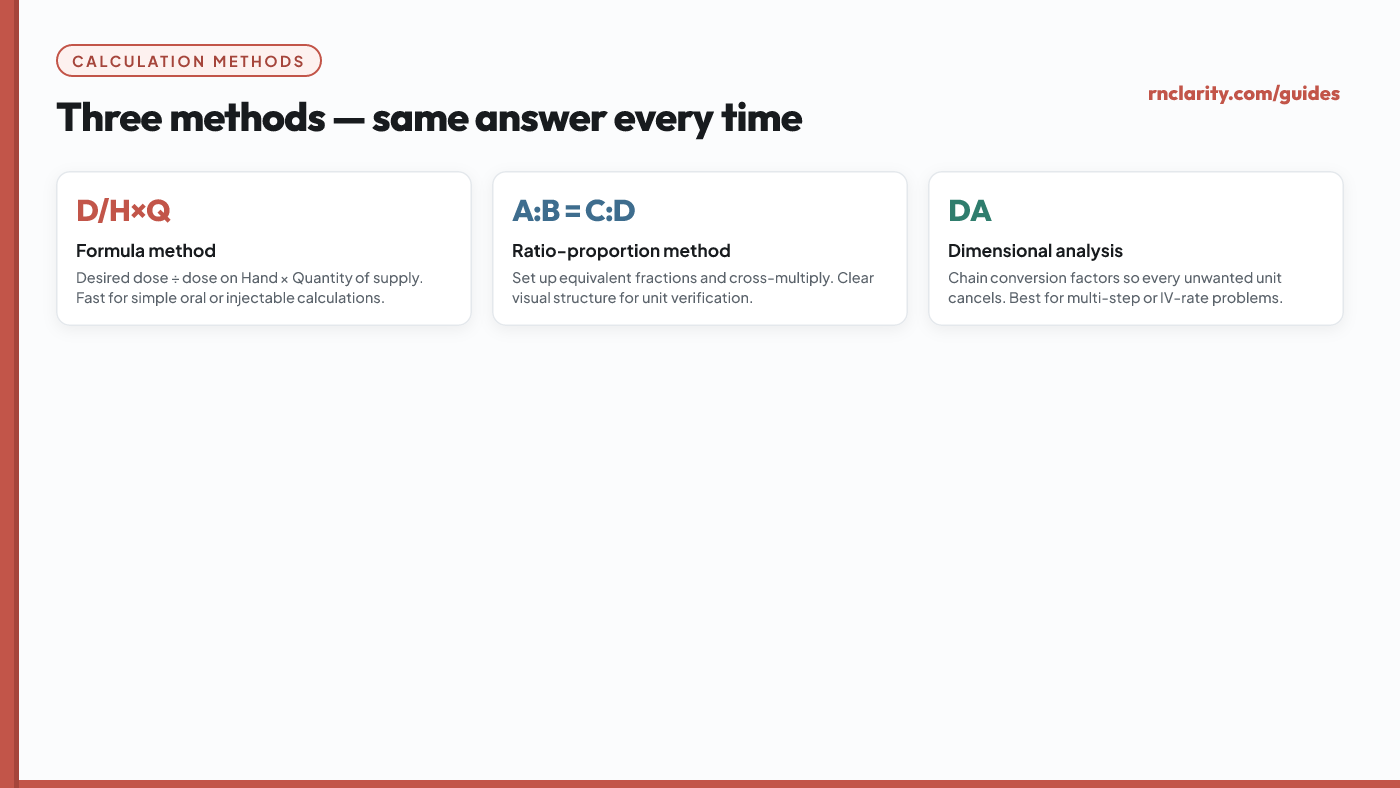
All three methods produce the same correct answer when set up correctly. Choose one, learn it thoroughly, and apply it identically every time. Switching methods mid-examination introduces error.
9.1 Formula method
Desired ÷ Have × Quantity
(D ÷ H) × Q = volume or number of units to give
The Desired dose is what the order says. The Have dose is what is in each unit of supply (tablet, capsule, mL). The Quantity is how many mL or tablets contain the Have amount.
Example: Order 500 mg; have 250 mg per tablet.
(500 mg ÷ 250 mg) × 1 tablet = 2 tablets
Example: Order 375 mg; have 250 mg per 5 mL.
(375 mg ÷ 250 mg) × 5 mL = 7.5 mL
9.2 Ratio-proportion method
Set up two equivalent fractions and cross-multiply.
Have/Quantity = Desired/x
Example: 250 mg/5 mL = 375 mg/x mL
250x = 375 × 5 = 1,875 → x = 7.5 mL
Confirm that equivalent units are in matching positions before cross-multiplying.
9.3 Dimensional analysis
Chain conversion factors as fractions so that every unit you do not want cancels.
Example: Order 375 mg; have 250 mg/5 mL.
375 mg × (5 mL / 250 mg) = 7.5 mL
The mg in the numerator of the first fraction cancels the mg in the denominator of the conversion factor; mL remains.
Dimensional analysis is particularly powerful for multi-step problems such as weight-based IV titrations, where several unit conversions occur in sequence.
10. Oral Solid Medication Calculations
Oral solids include tablets, capsules and caplets. Key rules:
- Capsules are never split or crushed. If the calculation yields a fraction of a capsule, clarify the order.
- Extended-release, enteric-coated and film-coated tablets are not split unless the tablet is scored and the manufacturer permits splitting.
- Scored tablets may be split in half; splitting into smaller fractions is not recommended.
- A result of more than 3 tablets for a single dose is unusual and warrants review before administration.
Example: Order 0.75 mg; have 0.25 mg per tablet.
(0.75 ÷ 0.25) × 1 = 3 tablets (at the acceptable limit — confirm the dose)
Example: Order 1 g; have 500 mg per tablet.
Convert 1 g to 1,000 mg. (1,000 ÷ 500) × 1 = 2 tablets
11. Oral Liquid Medication Calculations
Oral liquids are measured with an oral syringe or calibrated cup. Use the smallest device that accurately measures the volume.
- Oral syringes are designed for enteral use; they do not fit IV or parenteral connections.
- Never round up a small pediatric liquid volume to make it easier to measure. Select a syringe with the appropriate minimum calibration.
- Suspensions must be shaken to distribute the drug evenly before measuring.
Example: Order 400 mg; have 200 mg/5 mL.
(400 ÷ 200) × 5 mL = 10 mL
Example: Order 125 mg; have 250 mg/5 mL.
(125 ÷ 250) × 5 mL = 2.5 mL
12. Injectable Medication Calculations
Injectable medications are available in:
- Single-dose vials: one dose, no preservative, discard after use.
- Multi-dose vials: multiple doses, preservative added, document opened date.
- Ampules: single use, glass container, filter needle required for withdrawal.
- Prefilled syringes: verify dose matches the order; may need to expel excess volume.
Use the smallest syringe that accurately measures the volume.
| Dose range | Recommended syringe |
|---|---|
| < 1 mL | 1-mL syringe (0.01-mL calibration) |
| 1–3 mL | 3-mL syringe |
| 3–5 mL | 5-mL syringe |
| Subcutaneous insulin | Calibrated insulin syringe only |
Example: Order 0.4 mg IM; have 0.5 mg/mL.
(0.4 ÷ 0.5) × 1 mL = 0.8 mL (use a 1-mL syringe)
Example: Order 75 mg IM; have 100 mg/2 mL.
(75 ÷ 100) × 2 mL = 1.5 mL (use a 3-mL syringe)
13. Reconstitution Calculations
Powdered medications are reconstituted by adding a specified volume of diluent — sterile water, normal saline or bacteriostatic water — to the vial. The final concentration depends on both the amount of powder and the diluent volume added. Always follow the manufacturer's label for the specific product.
Steps for reconstitution:
- Read the label for the recommended diluent type, volume and resulting concentration.
- Add the specified diluent volume.
- Mix gently until fully dissolved (or according to label directions).
- Calculate the required volume from the reconstituted concentration.
- Label the vial with the date, time, concentration, your initials and the expiration (usually 24–48 hours unless the label specifies otherwise).
Example: Reconstitute 1 g powder with 10 mL sterile water, yielding 100 mg/mL. Order: 500 mg.
(500 ÷ 100) × 1 mL = 5 mL
Example: Powder reconstituted to 250 mg/mL. Order: 1 g.
Convert 1 g to 1,000 mg. (1,000 ÷ 250) × 1 mL = 4 mL
14. Weight-Based Dosage Calculations
Many medications — especially antibiotics, oncology agents and critical-care infusions — are dosed by body weight per kilogram or per kilogram per hour. The steps are:
- Convert the client's weight to kilograms if given in pounds.
- Multiply the ordered dose (in mg/kg or mcg/kg/min) by the weight in kg.
- Calculate the volume from the resulting dose and the available concentration.
Example: Order 5 mg/kg/dose; client weighs 66 lb; have 100 mg/2 mL.
Step 1: 66 lb ÷ 2.2 = 30 kg Step 2: 5 mg/kg × 30 kg = 150 mg Step 3: (150 ÷ 100) × 2 mL = 3 mL
15. Safe-Dose Range Calculations
A safe-dose range specifies a minimum and maximum acceptable dose, usually per kilogram per dose or per kilogram per day. The nurse calculates both limits and then compares the ordered dose against the range.
Steps:
- Calculate the minimum dose: low end of range × weight (kg).
- Calculate the maximum dose: high end of range × weight (kg).
- Determine whether the order is per dose or per day; if per day, divide by the number of doses.
- Compare the ordered dose with the calculated range.
- If within range, proceed with the calculation. If outside range, hold and clarify.
Example: Order 300 mg every 8 hours (3 doses/day); child weighs 22 kg; safe range 10–20 mg/kg/day.
Minimum daily: 10 × 22 = 220 mg/day Maximum daily: 20 × 22 = 440 mg/day Ordered daily: 300 × 3 = 900 mg/day → exceeds maximum → hold and clarify
Safe-dose reasoning on the NCLEX-RN®: when a case study item asks whether a dose should be administered, calculate the full safe range first, compare the order to it, and then apply clinical judgment about the specific client before selecting your response.
16. Pediatric Dosage Calculations
Pediatric calculations require special care because small changes in weight or decimal position create large proportional changes in dose.
- Use the most recent accurate weight in kilograms. Do not round early.
- Verify whether the order is per dose or per day — these are not interchangeable.
- Always check against a stated safe range before administering.
- Use the smallest calibrated device to measure the dose.
- A dose requiring less than 0.1 mL or more than 5 mL for a single injection warrants clarification.
Example: Order 15 mg/kg/dose; child weighs 12.4 kg; have 120 mg/5 mL.
Dose: 15 × 12.4 = 186 mg Volume: (186 ÷ 120) × 5 = 7.75 mL → round to 7.8 mL at the final step
17. Body-Surface-Area Calculations
Body surface area (BSA) is used primarily for chemotherapy dosing and some critical-care agents in pediatric and oncology populations. BSA in square meters (m²) is determined from a validated formula or nomogram. The examination provides BSA or the calculation formula when it is needed.
General form: Ordered dose (per m²) × BSA (m²) = total dose.
Example: Order 50 mg/m²; BSA = 1.8 m².
50 mg/m² × 1.8 m² = 90 mg
When a cumulative lifetime maximum applies (as with certain anthracyclines), compare the calculated dose with the remaining maximum — the ability to calculate a dose does not mean it should be administered if the client has reached a cumulative limit.
18. IV Pump Rates in mL/hr
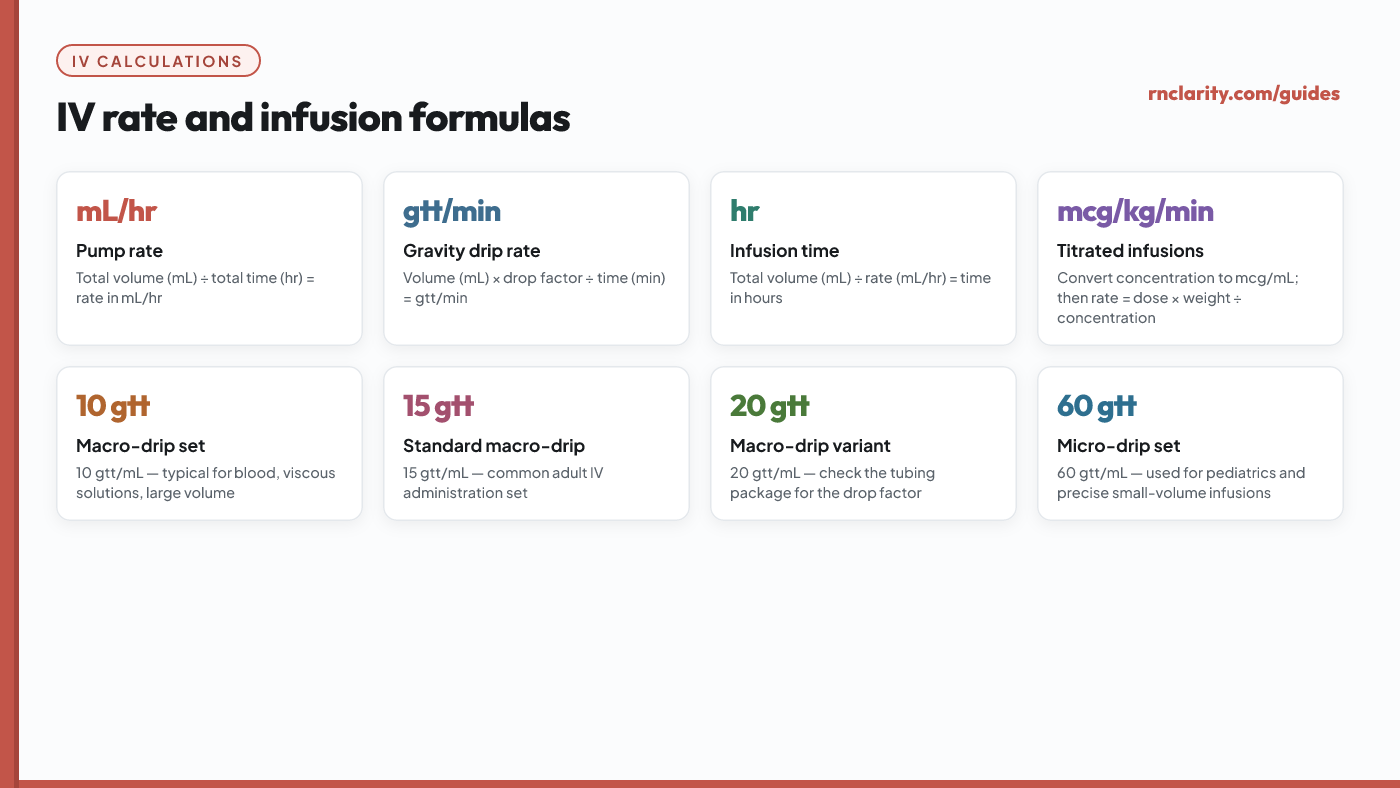
Formula: Total volume (mL) ÷ Total time (hours) = Rate (mL/hr)
Most electronic infusion pumps require the rate in mL/hr.
Example: 1,000 mL over 8 hours.
1,000 ÷ 8 = 125 mL/hr
Example: 500 mL over 4 hours.
500 ÷ 4 = 125 mL/hr
Example: 250 mL over 30 minutes.
Convert 30 min to 0.5 hr. 250 ÷ 0.5 = 500 mL/hr
When the time is given in minutes, always convert to hours before dividing. Forgetting this conversion is a classic tenfold-type error: 250 ÷ 30 = 8.3, which would be approximately 12 times too slow.
IV rate from a weight-based order in mL/hr
When a drug is ordered in mg/hr or mcg/hr and the supply has a known concentration, use dimensional analysis:
Rate (mL/hr) = Ordered dose/hr ÷ Concentration (dose/mL)
Example: Order 2 mg/hr; available 4 mg/100 mL (= 0.04 mg/mL).
2 mg/hr ÷ 0.04 mg/mL = 50 mL/hr
19. Gravity Flow Rates in gtt/min
When an IV pump is unavailable, a gravity drip chamber is used. The nurse must calculate the drop rate in drops per minute (gtt/min) and count the drops by watching the drip chamber.
Formula: Volume (mL) × Drop factor (gtt/mL) ÷ Time (min) = Rate (gtt/min)
The drop factor is printed on the IV administration set package.
| Set type | Drop factor |
|---|---|
| Macro-drip (blood, viscous, large volume) | 10 gtt/mL |
| Standard adult macro-drip | 15 gtt/mL |
| Macro-drip variant | 20 gtt/mL |
| Micro-drip (pediatric, small-volume precision) | 60 gtt/mL |
Gravity drip rates are always rounded to the nearest whole number because partial drops cannot be counted.
Example: 500 mL over 4 hours; 15 gtt/mL set.
Convert 4 hr to 240 min. 500 mL × 15 gtt/mL ÷ 240 min = 7,500 ÷ 240 = 31.25 → round to 31 gtt/min
Example: 100 mL over 30 min; 20 gtt/mL set.
100 × 20 ÷ 30 = 2,000 ÷ 30 = 66.67 → round to 67 gtt/min
20. Infusion Time and Completion Time
Infusion time formula: Total volume (mL) ÷ Rate (mL/hr) = Time (hours)
Example: 1,000 mL infusing at 125 mL/hr.
1,000 ÷ 125 = 8 hours
Completion time: Add the infusion time to the start time. Account for AM/PM when adding across noon or midnight.
Example: Infusion of 8 hours begins at 10:00 AM.
10:00 AM + 8 hours = 6:00 PM
Example: Infusion of 6 hours begins at 9:30 PM.
9:30 PM + 6 hours = 3:30 AM (next day)
When only part of a bag remains, calculate remaining time from the remaining volume:
Remaining time = Remaining volume (mL) ÷ Current rate (mL/hr)
21. Intermittent IV and Secondary Infusions
Intermittent (piggyback, IVPB) infusions are secondary medications added to a running primary line over a defined period, usually 30–60 minutes. The nurse calculates the pump rate for the piggyback infusion separately from the primary maintenance rate.
Example: 100 mL IVPB over 30 minutes.
100 ÷ 0.5 hr = 200 mL/hr for the duration of the piggyback
Before programming the secondary infusion, verify drug compatibility with the primary fluid, flush the line per policy if incompatible, and confirm the rate is consistent with any specified minimum infusion time for the drug.
22. Titrated Infusions
Titrated infusions are adjusted continuously based on client response — blood pressure, heart rate, pain level or an ordered parameter. Critical-care vasoactive agents, anticoagulants and some analgesics are examples.
Formula for mcg/kg/min to mL/hr:
- Determine concentration in mcg/mL: (total drug in mcg) ÷ (total volume in mL).
- Calculate dose per minute: ordered dose (mcg/kg/min) × weight (kg) = mcg/min.
- Convert to mcg/hr: mcg/min × 60 = mcg/hr.
- Divide by concentration: mcg/hr ÷ mcg/mL = mL/hr.
Example: Dopamine 5 mcg/kg/min; client weighs 70 kg; supply 400 mg/250 mL.
Concentration: 400 mg × 1,000 mcg/mg = 400,000 mcg ÷ 250 mL = 1,600 mcg/mL Dose: 5 mcg/kg/min × 70 kg = 350 mcg/min Per hour: 350 × 60 = 21,000 mcg/hr Rate: 21,000 ÷ 1,600 = 13.1 mL/hr
23. Insulin, Heparin and Other High-Alert Calculations
23.1 Insulin
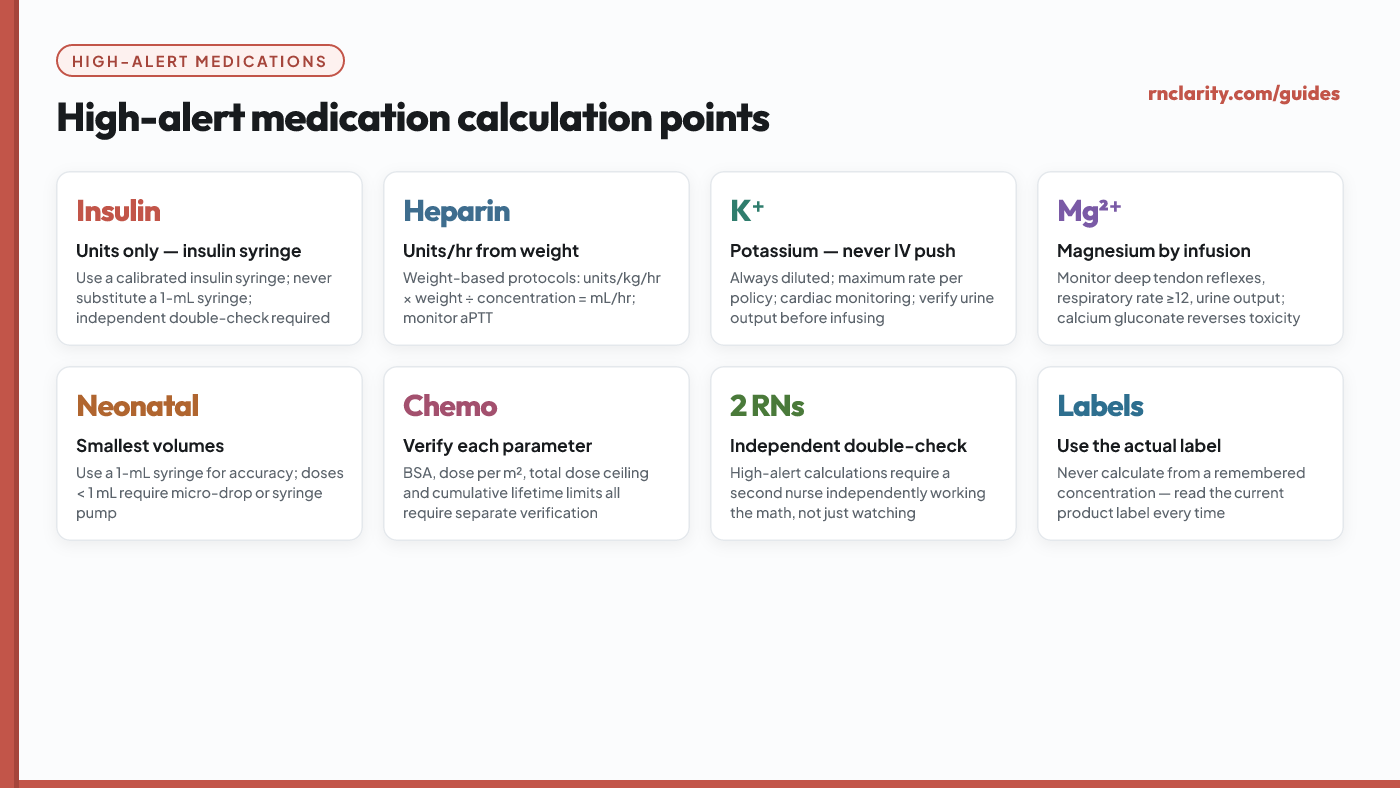
- Insulin is measured and dosed in units, not milligrams or mL.
- Use only a calibrated insulin syringe (100 units/mL standard concentration). Do not substitute a tuberculin or other syringe.
- An independent double-check by a second nurse is required by most institutional policies before insulin administration.
- Only regular insulin is administered intravenously. When an IV infusion is ordered, the concentration (units/mL) must be verified against the label and the pump must be programmed in units/hr.
Example IV insulin rate: Order 2 units/hr; supply 100 units in 100 mL (= 1 unit/mL).
2 units/hr ÷ 1 unit/mL = 2 mL/hr
Example subcutaneous dose: Order 10 units regular insulin; use a 100-unit/mL insulin syringe.
The syringe calibrations are in units — draw to the 10-unit mark.
23.2 Heparin
- Heparin is measured in units, not milligrams.
- Weight-based protocols specify units/kg as a loading bolus and units/kg/hr as the maintenance infusion.
- Calculate the loading bolus and maintenance rate separately.
- Monitor aPTT (or anti-Xa level per protocol) and adjust the infusion according to the facility's titration algorithm.
Example maintenance rate: Protocol: 18 units/kg/hr; client weighs 70 kg; supply 25,000 units/250 mL (= 100 units/mL).
Dose per hour: 18 × 70 = 1,260 units/hr Rate: 1,260 units/hr ÷ 100 units/mL = 12.6 mL/hr
Heparin-induced thrombocytopenia (HIT): a falling platelet count in a client receiving heparin is a hold-and-notify finding, regardless of the calculation result.
Go deeper: Connect laboratory results with symptoms, trends and safe escalation in the lab interpretation guide.
23.3 Concentrated electrolytes and other high-alert products
- Potassium chloride concentrate is never administered IV push. It must be diluted and infused at a controlled rate on an infusion pump with cardiac monitoring. Verify urine output before infusing.
- Magnesium sulfate infusions require continuous monitoring of deep tendon reflexes, respiratory rate (must be ≥ 12/min) and urine output. Calcium gluconate is the antidote for magnesium toxicity.
- Hypertonic sodium chloride requires central access in most protocols and neurologic monitoring; rapid correction can cause osmotic demyelination.
24. Enteral Feeding, Intake and Output Calculations
24.1 Enteral feeding rates
Continuous enteral feeding orders specify a rate in mL/hr or a total volume over a period. Cyclic feeds specify start and stop times.
Example: 1,500 mL per 24 hours as a continuous feeding.
1,500 ÷ 24 = 62.5 mL/hr (use a feeding pump that accepts 62 or 63 mL/hr per policy)
24.2 Intake and output
Intake includes all IV fluids, oral fluids, enteral feeds, blood products, flush volumes and irrigating fluids that are not collected. Output includes urine, wound drainage, emesis, nasogastric suction and output from surgical drains.
Critical thresholds to recognize:
- Urine output less than 0.5 mL/kg/hr in adults warrants assessment and notification.
- Urine output less than 1 mL/kg/hr in infants warrants assessment.
- A fluid intake significantly exceeding output requires assessment for fluid overload.
25. Percentage, Ratio and Concentration Calculations
25.1 Weight/volume concentrations
A 1% w/v solution = 1 g per 100 mL = 10 mg/mL.
| Percentage | Grams per 100 mL | mg per mL |
|---|---|---|
| 0.9% NaCl | 0.9 g/100 mL | 9 mg/mL |
| 5% dextrose | 5 g/100 mL | 50 mg/mL |
| 50% dextrose | 50 g/100 mL | 500 mg/mL |
25.2 Ratio solutions
A 1:1,000 solution contains 1 g in 1,000 mL = 1 mg/mL. A 1:10,000 solution contains 1 g in 10,000 mL = 0.1 mg/mL. Epinephrine concentrations for anaphylaxis are typically expressed as 1:1,000 for IM use and 1:10,000 for IV use — always verify the label before administration.
26. Rounding and Decimal Safety
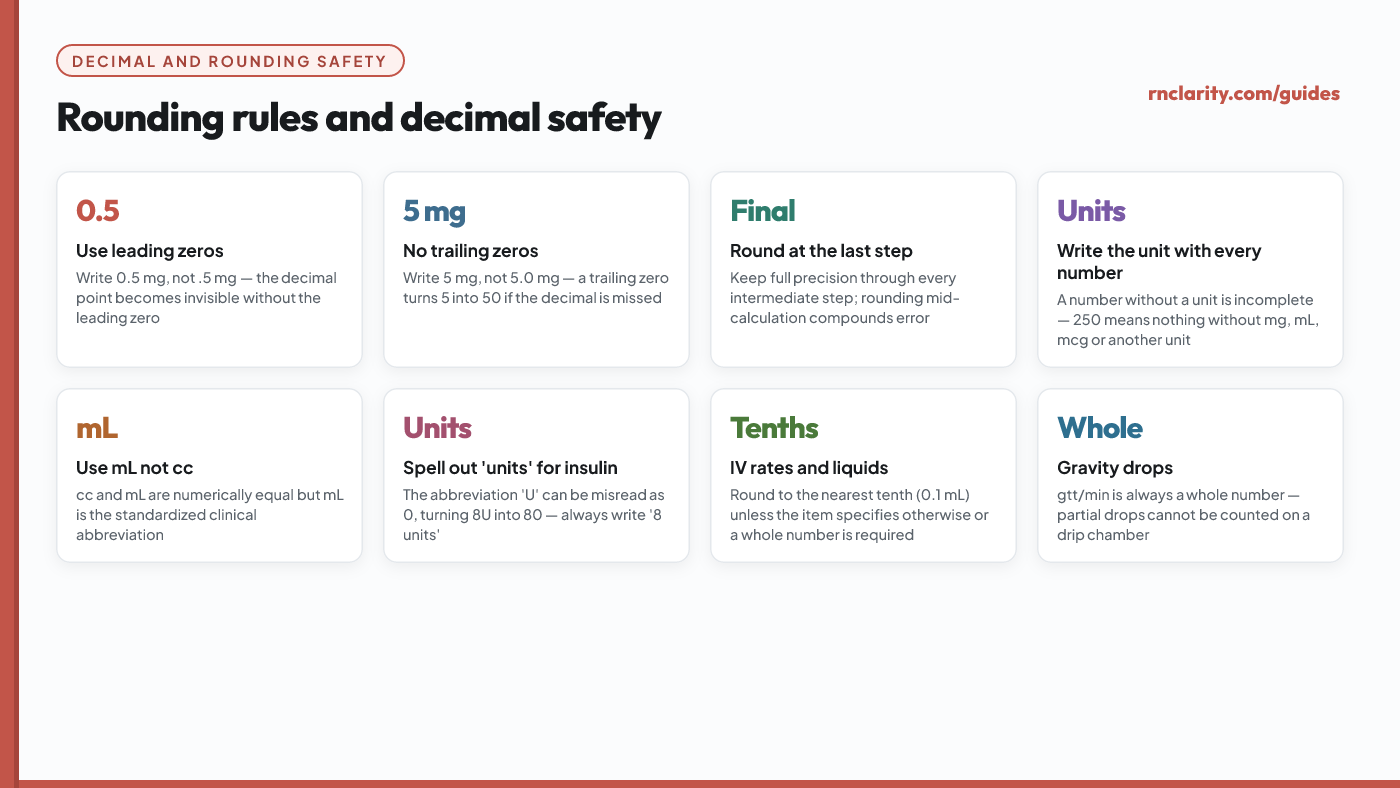
There is no universal rounding rule that applies to every medication calculation. The correct approach depends on what the item asks, what device will be used and what precision is clinically meaningful.
Guidelines by calculation type:
- Oral solids: whole tablets or fractions of scored tablets only.
- Liquid oral or injectable medications: to the nearest tenth (0.1 mL) unless the volume is less than 1 mL, in which case two decimal places (0.01 mL) may be needed.
- IV pump rates: to the nearest whole number or nearest tenth, depending on the pump and institutional policy.
- Gravity drip rates: always a whole number — partial drops cannot be counted.
- Insulin: to the nearest whole unit on an insulin syringe.
- Weight-based calculations: carry the weight in full precision through all intermediate steps before rounding the final dose.
On the NCLEX-RN® examination, follow the explicit instruction in the response field. "Round to the nearest whole number," "round to the nearest tenth" and "enter your answer to one decimal place" are different instructions; read the field before entering your answer.
27. Clinical Reasonableness and Error Prevention
The FDA defines a medication error as a preventable event that may cause or lead to inappropriate medication use or client harm. Calculation errors are one entry point for medication errors; they can also arise at prescribing, transcription, dispensing, labeling, administration and monitoring. The nurse's reasonableness check can interrupt an error before harm occurs.
Ask these questions after every calculation:
- Did the unwanted units cancel and did the requested unit remain?
- Is the answer larger or smaller than the available amount in a way that makes sense?
- Is the volume measurable with available equipment?
- Does the route permit this volume and concentration?
- Is the dose within a stated safe range and below any stated maximum?
- Does the client's age, weight, organ function or laboratory data create concern?
- Does the rate comply with the ordered infusion time and known product requirements?
- Did I use the actual product concentration rather than a remembered one?
- Does the result differ greatly from the usual or previous dose?
- Do I need pharmacist or prescriber clarification before administration?
The tenfold error pattern: the most dangerous calculation errors produce answers that are ten times too high or too low. Common causes include a misplaced decimal, confused milligrams and micrograms, pounds treated as kilograms, concentration read as total amount, and time left in minutes when the pump requires hours. Design every equation setup to make these mistakes visible.
Technology assists but does not eliminate error. Smart pumps compare programmed settings against a drug library but cannot know whether the wrong client weight or wrong concentration was entered. The nurse remains the final safety check.
28. NCLEX-RN® Dosage-Calculation Item Strategy
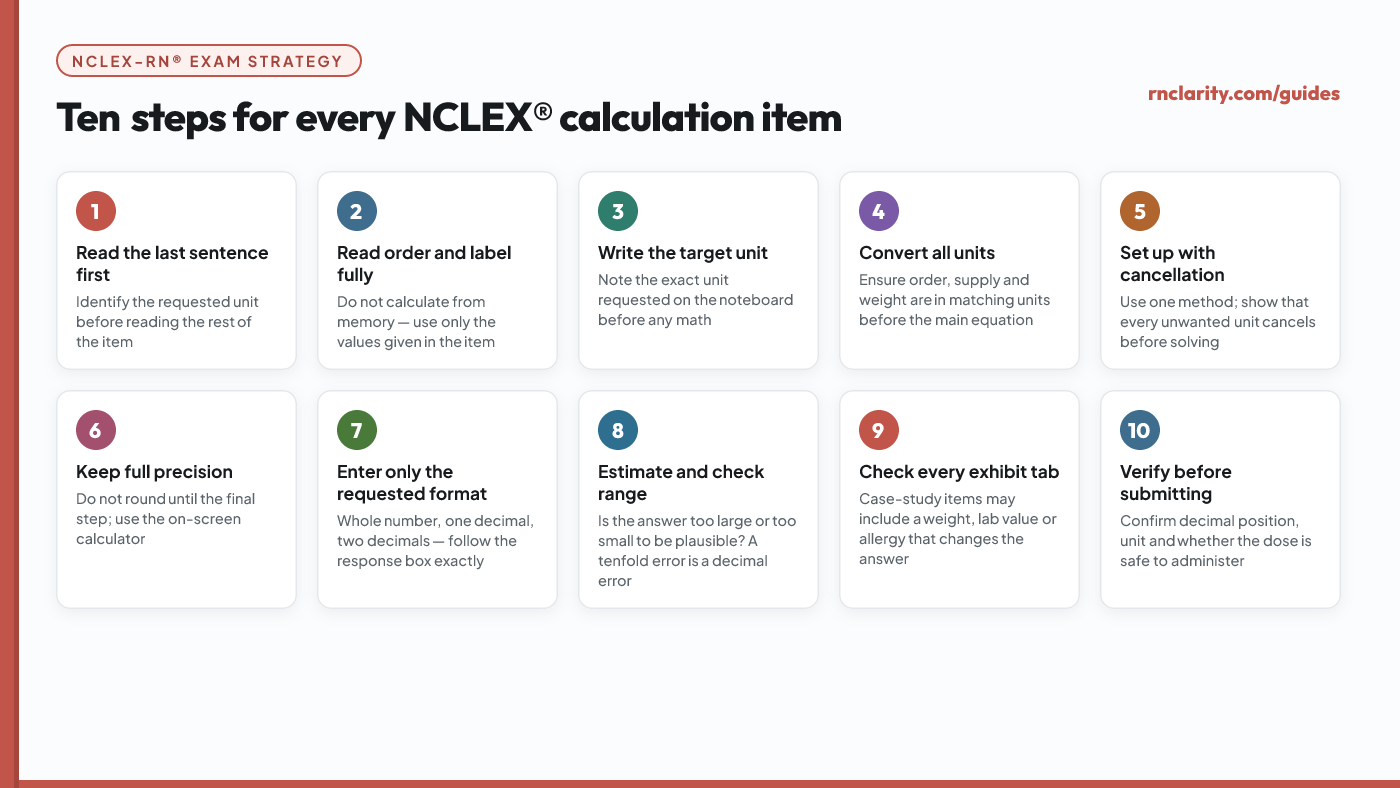
An NCLEX-RN® calculation item may provide a medication order, product label, client weight, laboratory value, infusion record or several exhibit tabs. The candidate must determine which information is relevant.
- Read the last sentence first to identify the exact unit requested.
- Read the entire order and label. Do not calculate from memory.
- Write the target unit on the noteboard.
- Convert units before inserting numbers into the main equation.
- Use one method and show cancellation.
- Keep full precision until the final step.
- Enter only the number or format requested by the response field.
- Perform an estimation and clinical safety check.
- Review every exhibit tab that could change the answer.
- Submit only after confirming decimal position, unit and clinical appropriateness.
Multiple-response or case-study items may test whether the nurse should administer, hold, clarify, reassess or monitor. A dose that can be calculated correctly may still be inappropriate for a specific client. A question may deliberately include an unsafe order to test clinical judgment, not just math competence.
Go deeper: See how to read unfolding case-study items tab by tab in the NGN case studies guide.
29. Clinical Judgment Mini-Cases
The following mini-cases demonstrate how the six CJMM steps connect to dosage calculations. They are simplified educational scenarios, not complete clinical protocols.
29.1 Pediatric antibiotic safe range
A child weighs 20 kg. The medication is prescribed as 250 mg every 6 hours. The stated safe range is 20–40 mg/kg/day.
- Recognize cues: weight 20 kg, order 250 mg every 6 hours, safe range given per day.
- Analyze cues: every 6 hours = 4 doses/day; ordered daily total = 1,000 mg/day. Safe range: 400–800 mg/day.
- Prioritize hypothesis: the ordered daily dose (1,000 mg) exceeds the maximum (800 mg) — unsafe.
- Generate solutions: calculate the safe dose range, verify the order with the provider/pharmacist.
- Take action: do not administer; hold the dose and contact the prescriber per policy.
- Evaluate outcomes: confirm the corrected order and document the outcome.
29.2 IV rate discrepancy
A medication in 100 mL is ordered over 30 minutes. The pump is currently programmed at 100 mL/hr.
- Recognize cues: 100 mL, 30-minute order, current programmed rate 100 mL/hr.
- Analyze cues: at 100 mL/hr, 100 mL would infuse over 60 minutes — half the ordered rate.
- Prioritize hypothesis: the infusion rate is too slow; the client will not receive the medication on schedule.
- Generate solutions: correct rate = 100 mL ÷ 0.5 hr = 200 mL/hr.
- Take action: correct the pump rate after completing required checks per policy.
- Evaluate outcomes: verify the new rate, document the change and monitor the client's response.
29.3 Weight discrepancy in a titrated infusion
A titrated infusion is running at a calculated rate. The client's current weight is documented as 70 kg, but the original protocol was based on 154 lb (= 70 kg). The admission weight from earlier in the shift was entered as 70 lb in the electronic record in error.
- Recognize cues: infusion running on weight-based protocol; admission weight 70 lb documented; verbal report states 154 lb.
- Analyze cues: if 70 lb were used, weight = 31.8 kg — the dose would be approximately half the intended dose.
- Prioritize hypothesis: the client may be underdosed if the protocol was programmed using 70 lb instead of 70 kg.
- Generate solutions: clarify the actual weight, recalculate both the correct rate and the amount already infused.
- Take action: verify weight immediately; correct the infusion per protocol; notify the provider.
- Evaluate outcomes: assess the client's therapeutic and adverse response; document the correction.
Go deeper: Review how the six CJMM steps apply to unfolding case studies in the clinical judgment guide.
30. Practice Questions with Answers and Rationales
All items below are original RN Clarity educational examples. They are not recalled, copied or reconstructed NCLEX-RN® examination items.
Question 1. The prescriber orders 0.5 g of a medication to be administered orally. The available tablets are 250 mg each. How many tablets should the nurse administer?
Answer: 2 tablets Rationale: Convert 0.5 g to 500 mg. (500 mg ÷ 250 mg) × 1 tablet = 2 tablets. This is within the acceptable range for a single oral dose.
Question 2. An IV of 500 mL 0.9% sodium chloride is infusing at 62.5 mL/hr. How many hours will it take for the bag to infuse completely?
Answer: 8 hours Rationale: 500 mL ÷ 62.5 mL/hr = 8 hours.
Question 3. A child weighs 44 lb and is prescribed amoxicillin 25 mg/kg/dose. The available suspension is 250 mg/5 mL. How many mL should the nurse administer?
Answer: 10 mL Rationale: 44 lb ÷ 2.2 = 20 kg. Dose: 25 mg/kg × 20 kg = 500 mg. Volume: (500 ÷ 250) × 5 mL = 10 mL.
Question 4. A gravity IV of 1,000 mL is ordered over 8 hours. The administration set delivers 15 gtt/mL. What is the correct drip rate in gtt/min?
Answer: 31 gtt/min Rationale: 8 hours = 480 minutes. (1,000 × 15) ÷ 480 = 15,000 ÷ 480 = 31.25 → round to 31 gtt/min.
Question 5. Heparin 25,000 units is diluted in 250 mL D5W. The protocol orders 1,000 units/hr. At what rate in mL/hr should the pump be set?
Answer: 10 mL/hr Rationale: Concentration = 25,000 units ÷ 250 mL = 100 units/mL. Rate = 1,000 units/hr ÷ 100 units/mL = 10 mL/hr.
Question 6. A client receives a continuous IV infusion of dopamine. The prescribed dose is 5 mcg/kg/min. The client weighs 80 kg. The available dopamine solution is 400 mg in 250 mL D5W. At what rate in mL/hr should the nurse set the pump?
Answer: 15 mL/hr Rationale: Concentration: 400 mg × 1,000 = 400,000 mcg ÷ 250 mL = 1,600 mcg/mL. Dose/min: 5 × 80 = 400 mcg/min. Per hour: 400 × 60 = 24,000 mcg/hr. Rate: 24,000 ÷ 1,600 = 15 mL/hr.
31. Four-Week Nursing Math Study Plan
Go deeper: For the retrieval-practice and spaced-repetition techniques that make this study plan effective, see the active learning guide.
Week 1 — Foundations and simple doses
- Days 1–2: place value, decimals, fractions, ratios, proportions, percentages.
- Days 3–4: metric conversions; practice converting g↔mg↔mcg and lb↔kg until automatic.
- Days 5–6: formula method, ratio-proportion and dimensional analysis — work 5 problems each with all three methods until the results agree.
- Day 7: oral solid and oral liquid calculations using all three methods; self-quiz.
Week 2 — Injections, reconstitution and safe ranges
- Days 1–2: injectable calculations; syringe selection; leading and trailing zero rules.
- Days 3–4: reconstitution calculations; diluent volumes and resulting concentrations.
- Days 5–6: weight-based dosing; convert pounds to kilograms; pediatric liquid doses.
- Day 7: safe-dose range calculations; compare ordered dose to calculated range.
Week 3 — IV calculations
- Days 1–2: IV pump rates in mL/hr; practice with times in minutes vs. hours.
- Days 3–4: gravity drip rates; commit drop factors 10, 15, 20 and 60 gtt/mL to memory.
- Days 5–6: infusion time and completion time; intermittent IVPB rates.
- Day 7: titrated infusions (mcg/kg/min → mL/hr); work 3–5 problems.
Week 4 — High-alert medications and integration
- Days 1–2: insulin calculations; heparin weight-based protocols; concentrated electrolytes.
- Days 3–4: intake/output calculations; enteral feeding rates.
- Days 5–6: NCLEX® item strategy practice — apply the ten-step approach to mixed question types.
- Day 7: full timed review of 20 mixed calculation problems; analyze any errors.
Go deeper: For complete study plan frameworks including 12-week and 6-week options, see the NCLEX-RN® study plan guide.
32. Frequently Asked Questions
Are dosage calculations included in the April 2026 NCLEX-RN® Test Plan?
Yes. Administering medications safely and calculating medication dosages are explicitly listed under Pharmacological and Parenteral Therapies in the 2026 test plan. Calculation items can also appear in other content areas.
What percentage of the examination is Pharmacological and Parenteral Therapies?
The official range is 13–19%. This is one of the two largest content areas on the 2026 test plan.
Is a calculator provided on the NCLEX-RN®?
Yes. An on-screen calculator is provided for every item that requires numerical calculation. Do not attempt mental arithmetic when the calculator is available.
Which calculation method should I use?
The method that you can apply identically every time without making an error. All three methods (formula, ratio-proportion, dimensional analysis) produce the same correct answer. Switching between methods on the examination increases the likelihood of setup errors.
When should I round?
Round only at the final step, following the explicit instruction in the response field. Do not round during intermediate steps. For gravity drip rates, always round to the nearest whole number.
How many tablets is too many for a single oral dose?
An answer requiring more than 3 tablets or more than 3 capsules for a single dose is unusual and should be recalculated and verified before administration.
What is the difference between per dose and per day in safe-range calculations?
Pediatric safe-dose ranges are often expressed per kilogram per day. If the order is written every 6 hours, there are 4 doses per day. Multiply the dose by the number of doses to obtain the daily total, then compare with the per-day range.
Can a mathematically correct dose still be unsafe?
Yes. A correct calculation answers only whether the number is right. A dose may be physiologically inappropriate because of a laboratory value, allergy, route, timing, client weight or condition. Always apply clinical judgment after completing the math.
What is a tenfold error?
A tenfold error is an answer that is exactly ten times too high or too low, usually caused by a misplaced decimal point. Using leading zeros, avoiding trailing zeros and estimating before submitting are the primary safeguards.
Do I need to memorize drop factors?
The examination typically provides the drop factor in the item. However, knowing the common sets (10, 15, 20, 60 gtt/mL) helps you recognize when a stated drop factor is unusual.
33. Official Public References
- National Council of State Boards of Nursing. 2026 NCLEX-RN® Test Plan.
- NCLEX® Frequently Asked Questions.
- NCLEX® Exam Day: calculator, pacing and examination process.
- National Council of State Boards of Nursing. NCLEX® Clinical Judgment Measurement Model.
- The Joint Commission. Do Not Use List and medication-related abbreviation guidance.
- U.S. Food and Drug Administration. Medication errors related to CDER-regulated drug products.
- U.S. National Library of Medicine. MedlinePlus drug information.
34. Educational, Non-Affiliation and Trademark Disclaimer
Educational disclaimer: This guide is provided by RN Clarity for general educational and informational purposes only. It is not a substitute for the official 2026 NCLEX-RN® Test Plan, current examination policies, nursing-school instruction, pharmacy verification, a medication order, a manufacturer's label, institutional policy, professional clinical judgment or individualized medical care. Calculation examples are simplified for learning and must not be used to select, prepare, prescribe or administer medication to a real person. Always verify the current order, product, concentration, route, client-specific data and applicable policy before administering any medication. Use of this guide does not guarantee examination success.
Non-affiliation statement: RN Clarity is an independent educational resource. RN Clarity is not affiliated with, endorsed by, sponsored by, approved by or officially connected with the National Council of State Boards of Nursing, Inc.
Trademark notice: NCLEX®, NCLEX-RN®, NCLEX®-PN® and NCSBN® are registered trademarks of the National Council of State Boards of Nursing, Inc. All trademarks belong to their respective owner. Their use in this guide is solely for identification, commentary and educational reference. RN Clarity does not claim ownership of these trademarks, official examination content, logos or proprietary examination materials.