Nursing Process and ADPIE Guide
Use ADPIE to organize assessment, nursing diagnoses, planning, implementation, evaluation, prioritization and clinical judgment.
1. Quick Answer and Essential Facts
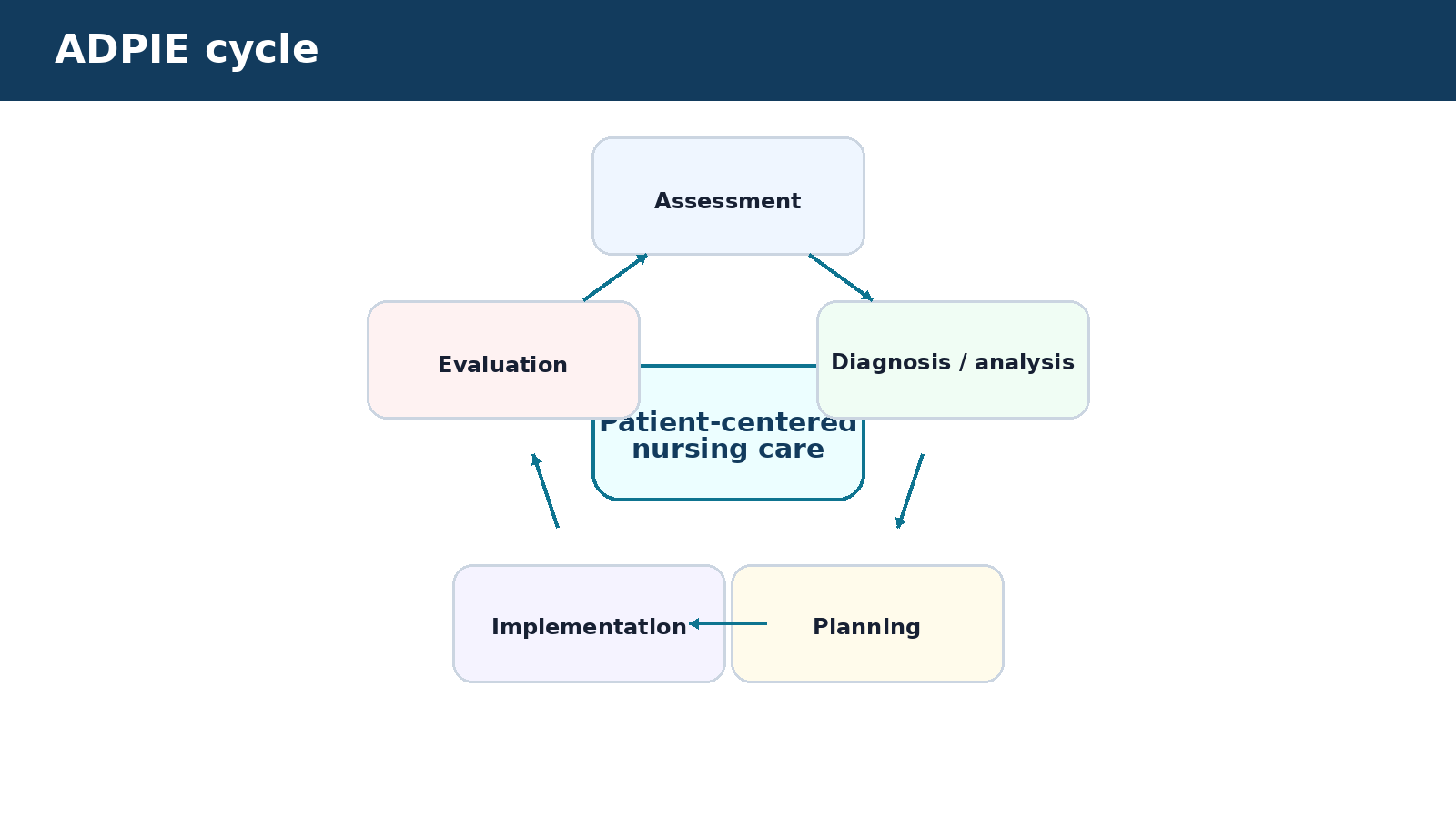
Direct answer: ADPIE is the nursing-process cycle of Assessment, Diagnosis, Planning, Implementation and Evaluation. NCSBN® uses closely related wording—assessment, analysis, planning, implementation and evaluation—in the 2026 test plan. The process is iterative: nurses continually reassess, update priorities, act and evaluate patient response.
The Nursing Process and ADPIE: Assessment, Diagnosis, Planning, Implementation and Evaluation is designed as a practical reference for nursing students and new nurses. It explains the topic in plain language, then connects that knowledge to assessment, safety, clinical judgment, documentation and patient teaching. The goal is not to replace an instructor, drug reference, institutional policy or clinical guideline. The goal is to help the learner understand why a safe nurse makes one decision rather than another.
-
Start with the patient, not the task. A technically correct action can still be unsafe if the patient is unstable, the order is unclear, the route is wrong, or the situation has changed.
-
Use trends and the whole clinical picture. One number, one symptom or one device alarm should rarely be interpreted in isolation.
-
Verify unfamiliar information in a current authoritative source. Nursing practice changes, products differ and local policies may be more restrictive than a general study guide.
-
Document what you assessed, what you did, how the patient responded and what you communicated when those details are clinically relevant.
NCLEX-RN® connection: The Nursing Process is explicitly one of the six integrated processes in the April 2026 NCLEX-RN® Test Plan and overlaps every Client Needs area and all six NCJMM clinical judgment steps.
Go deeper: Use active learning methods to turn reading into recall and application.
2. How this topic fits the April 2026 NCLEX-RN® Test Plan
The 2026 NCLEX-RN® Test Plan is effective from April 1, 2026 through March 31, 2029. The examination organizes nursing practice around Client Needs, while six integrated processes run through every content area: caring, clinical judgment, communication and documentation, culture and spirituality, nursing process, and teaching/learning. Most questions require application or higher-level thinking rather than simple recall.
-
Nursing Process: assessment, analysis, planning, implementation and evaluation.
-
Clinical Judgment: recognize cues, analyze cues, prioritize hypotheses, generate solutions, take action and evaluate outcomes.
-
Communication and Documentation: record assessment, care, response and handoff.
-
Teaching/Learning and Caring: include patient goals, education and preferences in planning and evaluation.
Practical check: A good study method therefore asks more than 'What is the fact?' Ask: What is the important cue? What could harm the patient? What additional assessment is needed? What can the nurse do now? What requires an order or escalation? What outcome would show improvement?
NCLEX-RN® connection: Expect the same fact to appear in different forms: a stand-alone question, a priority question, a calculation, a medication-safety question, a matrix or multiple-response item, or an unfolding clinical-judgment case.
Go deeper: Connect these topics to the 2026 NCLEX-RN® test plan.
3. A simple clinical-judgment method to use throughout the guide
Direct answer: Use the six clinical-judgment steps as a mental safety loop: recognize cues, analyze cues, prioritize hypotheses, generate solutions, take action, and evaluate outcomes.
Clinical judgment is not a separate subject that begins only when a case study appears. It is the way a nurse connects information to safe action. The 2026 NCLEX-RN® Test Plan names six measurable steps. Learners should practise using them during routine topics so that the process becomes automatic.
-
Recognize cues: identify the data that matter now, including symptoms, vital signs, laboratory results, medications, devices and trends.
-
Analyze cues: connect the findings. Decide which findings support the same problem and which may be unrelated.
-
Prioritize hypotheses: compare possible explanations by urgency, likelihood and risk if care is delayed.
-
Generate solutions: identify reasonable nursing actions, expected outcomes and people who may need to be involved.
-
Take action: choose the safest action that addresses the highest-priority problem within scope and policy.
-
Evaluate outcomes: reassess. Improvement, deterioration or no change tells the nurse whether the plan is working.
Avoid this mistake: Do not force every question into a rigid mnemonic. Airway, breathing and circulation are powerful priorities when they are truly threatened, but an immediate safety threat, severe bleeding, hypoglycemia, seizure activity or another time-sensitive problem may demand action first.
NCLEX-RN® connection: In case studies, new information can change the priority. Re-read the current data rather than staying attached to an earlier hypothesis.
Go deeper: Build your reasoning with the clinical judgment guide.
4. What ADPIE means
Direct answer: ADPIE stands for Assessment, Diagnosis, Planning, Implementation and Evaluation. It is a common teaching version of the nursing process. NCSBN® describes the nursing process in the 2026 test plan as assessment, analysis, planning, implementation and evaluation. The wording differs slightly, but both describe an iterative cycle of gathering data, making nursing judgments, planning care, acting and evaluating response.
The nursing process is not a rigid checklist completed once. New information can send the nurse back to assessment, change the diagnosis/analysis, revise goals or alter interventions.
NCLEX-RN® connection: The Nursing Process is one of six integrated processes in the April 2026 NCLEX-RN® Test Plan.
5. Step 1 — Assessment: collect relevant, reliable data
-
Assessment includes subjective data from the patient and objective data from observation, examination, devices, records and diagnostics.
-
Start with immediate safety and ABC threats when indicated.
-
Collect history, symptoms, medications, allergies, functional status, psychosocial/cultural factors and focused physical findings.
-
Validate surprising or inconsistent data.
-
Compare with baseline and trends.
-
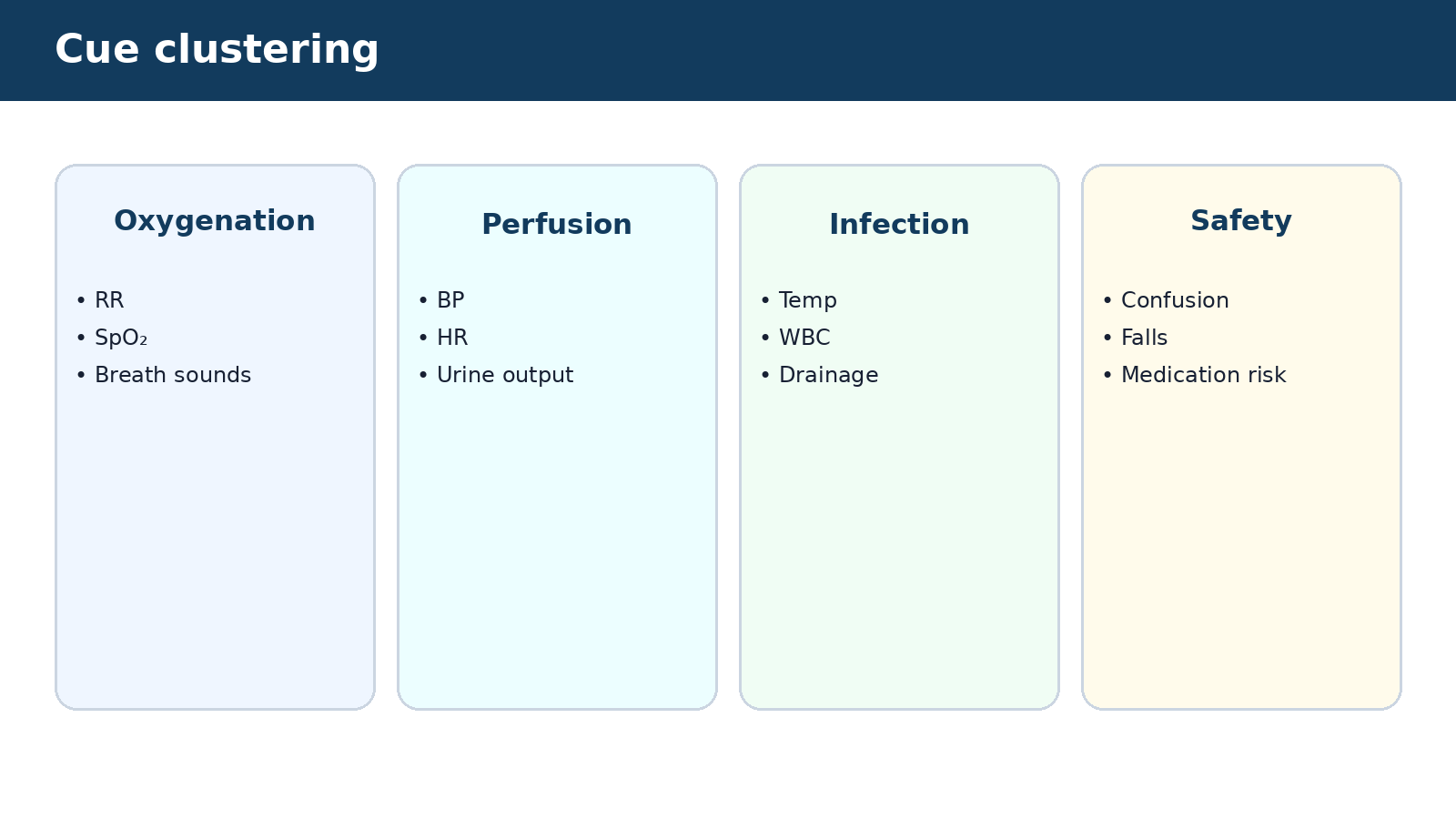
Cluster related cues instead of treating every abnormality separately.
Practical check: Assessment continues after every intervention; it is not only the first step.
Assessment funnel
- Collect relevant subjective and objective data
- Validate unexpected findings
- Compare with baseline and cluster related cues
- Identify urgent findings and escalate without delay
6. Subjective versus objective data
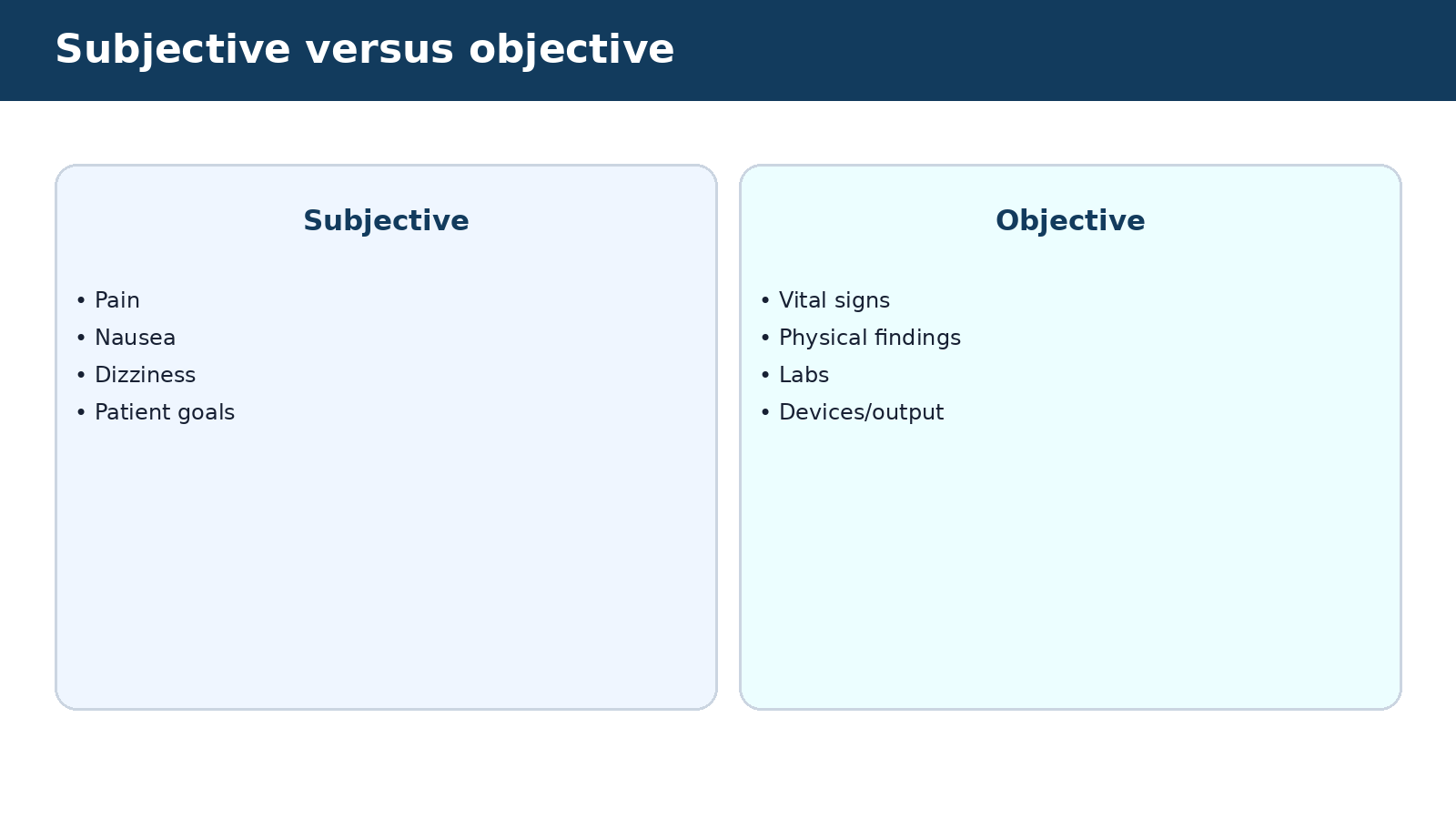
Both are valid data. Subjective does not mean “unreliable”; it means reported rather than directly measured.
Avoid this mistake: Do not chart an inference as an objective fact.
| Type | Meaning | Examples |
|---|---|---|
| Subjective | What the patient or caregiver reports | Pain, nausea, dizziness, shortness of breath |
| Objective | Observed/measured information | Vital signs, edema, urine output, laboratory result, wound appearance |
7. Validate and cluster cues
-
Before a nursing judgment is made, confirm that the cues are real and understand how they relate.
-
Repeat a technically questionable vital sign.
-
Confirm critical or unexpected results according to policy without delaying care for obvious deterioration.
-
Look for patterns: oxygenation, perfusion, infection, neurologic status, fluid balance, safety and coping.
-
Separate important cues from background information.
NCLEX-RN® connection: This parallels NCJMM recognize cues and analyze cues.
8. Step 2 — Diagnosis / analysis: identify the nursing problem
Direct answer: A nursing diagnosis describes a human response or risk that nursing can assess, monitor, prevent or treat within scope. A medical diagnosis identifies disease. Nursing analysis also includes prioritizing problems and recognizing when a medical emergency requires collaborative treatment.
-
Schools may use standardized nursing diagnosis terminology. Use the current terminology required by the program rather than inventing labels.
-
Base the problem on assessment data.
-
For problem-focused diagnoses, link the problem to a plausible contributing factor and supporting characteristics when the required format calls for it.
-
For risk diagnoses, identify risk factors rather than symptoms that are not present.
-
Prioritize life-threatening and unstable concerns.
Avoid this mistake: Do not turn a medical diagnosis directly into a nursing diagnosis without identifying the patient response.
9. PES statements and risk statements
-
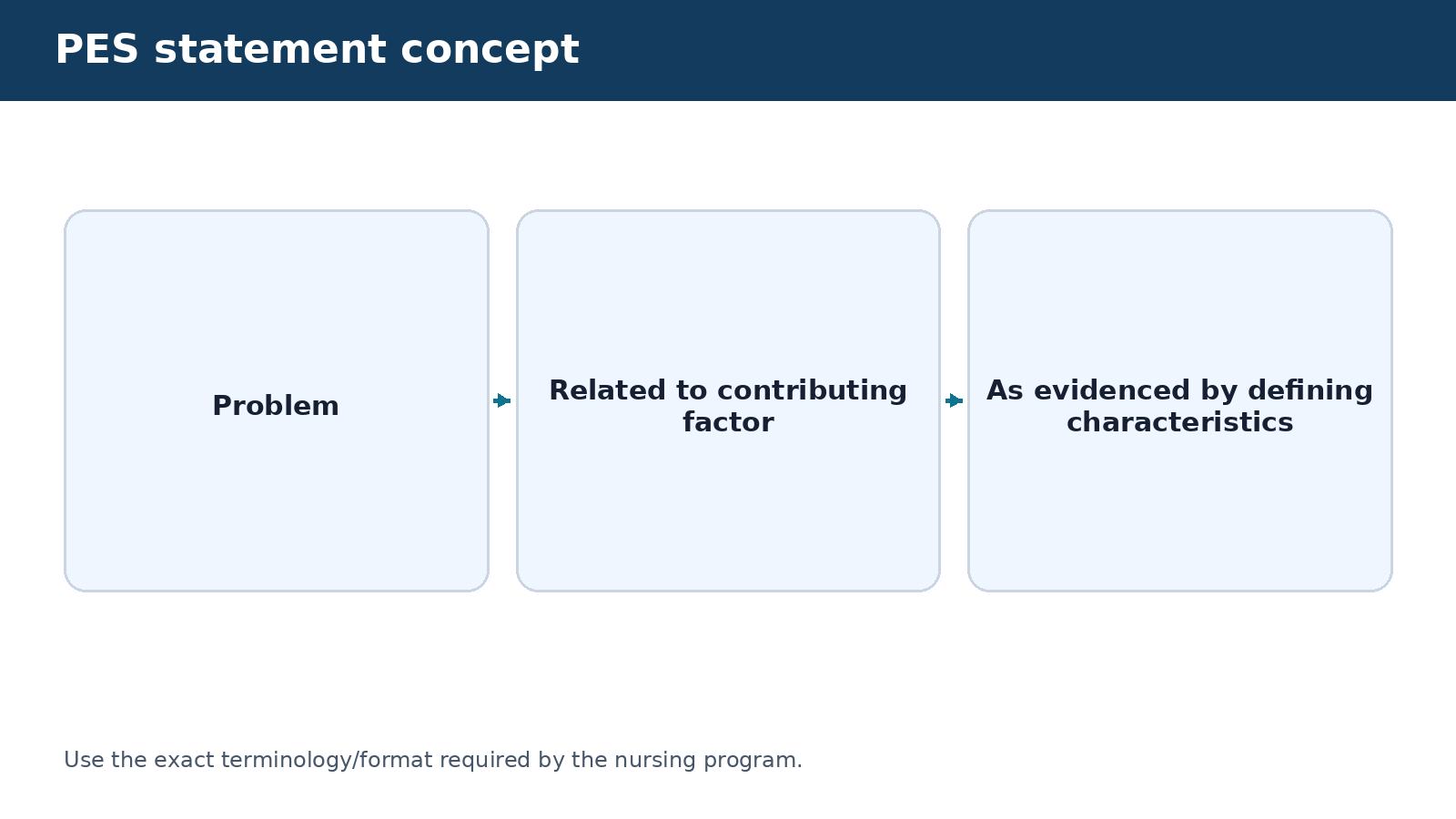
Many nursing programs teach a PES structure: Problem related to Etiology as evidenced by Signs/symptoms. Exact documentation conventions depend on the program and terminology system.
-
Problem: the nursing response/diagnostic label.
-
Etiology: a contributing factor that nursing interventions can meaningfully address or monitor.
-
Signs/symptoms: assessment evidence supporting the problem.
-
Risk diagnosis: generally uses the risk label plus risk factors; there are no defining characteristics because the problem has not occurred.
Avoid this mistake: Do not claim a copyrighted standardized label is “official” unless verified in the current taxonomy used by the school.
10. Prioritizing nursing problems
-
Priority is determined by urgency, threat to life/function, instability, time sensitivity, patient preferences and potential to prevent harm.
-
Immediate airway/breathing/circulation threats are high priority when present.
-
Acute change and instability generally outrank stable expected findings.
-
Actual severe problems often outrank potential problems, but a catastrophic immediate risk can outrank a minor actual problem.
-
Patient goals and preferences matter once immediate safety is addressed.
NCLEX-RN® connection: This parallels prioritize hypotheses in the NCJMM.
Priority filter
- Identify immediate threats
- Compare instability, change and time-sensitive harm
- Consider patient goals and risks
- Choose the priority using current cues; reassess as they change
11. Step 3 — Planning: write outcomes before choosing interventions
Direct answer: A plan connects a clearly defined problem with measurable patient outcomes and evidence-based nursing actions.
-
Make outcomes patient-centered, specific, measurable, achievable, relevant and time-bound when appropriate.
-
Specify what improvement will look like.
-
Choose a realistic time frame based on acuity.
-
Include discharge/self-management goals early.
-
Collaborate with patient/family and interprofessional team.
Avoid this mistake: “Patient will improve” is not measurable enough to evaluate.
12. Writing measurable goals and outcomes
Practical check: Outcomes should describe the patient response, not merely the nurse’s task.
| Weak outcome | Stronger outcome |
|---|---|
| Patient will breathe better. | Within 30 minutes, patient will report less dyspnea and maintain the ordered oxygen target with reduced work of breathing. |
| Patient will understand insulin. | Before discharge, patient will correctly demonstrate insulin preparation/injection and explain two hypoglycemia actions using teach-back. |
| Patient will not fall. | During hospitalization, patient will request assistance before ambulation and complete transfers with the prescribed assistance level. |
SMART outcome builder
- Specific: name the patient outcome
- Measurable: define observable evidence
- Achievable: match the patient and resources
- Relevant: connect to the assessed problem
- Time-bound: specify when to evaluate
13. Select interventions and rationales
-
Interventions should directly address the cause, risk or consequence identified in assessment and analysis. Rationales explain why the action is expected to help.
-
Independent nursing actions: assessment, positioning, teaching, comfort, safety measures within scope.
-
Dependent/collaborative actions: prescribed medications/treatments and interprofessional interventions.
-
Surveillance: what needs repeated monitoring and what change requires escalation.
-
Education: what the patient must know or demonstrate.
Avoid this mistake: Do not write generic interventions that are unrelated to the stated problem.
14. Step 4 — Implementation: perform care safely
-
Implementation is the action phase, but it still requires judgment. Before carrying out an intervention, verify that it remains appropriate for the patient’s current condition.
-
Reassess when the situation may have changed.
-
Confirm orders, allergies, consent and prerequisites.
-
Delegate only appropriate tasks and supervise/evaluate delegated care.
-
Explain procedures and preserve dignity.
-
Document the intervention and clinically important response.
NCLEX-RN® connection: This corresponds closely with take action in the NCJMM.
15. Delegation inside the nursing process
-
The RN may delegate selected tasks, but nursing accountability for assessment, care planning, clinical judgment and evaluation cannot simply be handed away. Scope rules vary by jurisdiction and employer policy.
-
Match task to client stability and predictability.
-
Match task to the delegatee’s authorized role and demonstrated competence.
-
Give clear directions and report parameters.
-
Follow up and evaluate the outcome.
Avoid this mistake: Do not use a universal RN/LPN/UAP task list without considering local scope and patient condition.
16. Step 5 — Evaluation: compare actual outcomes with expected outcomes
Direct answer: Evaluation asks whether the patient reached the planned outcome and whether the care plan should continue, change or stop.
-
Measure the same outcome that was defined in planning.
-
Decide whether the outcome was met, partially met or not met.
-
Ask why the result occurred.
-
Reassess new cues and revise the problem, goal or interventions as needed.
-
Document the response and updated plan.
Avoid this mistake: Evaluation is not “the medication was given.” It is the patient’s response to what was done.
Evaluation decision
- Measure the actual patient outcome
- Met: continue or advance the plan as appropriate
- Partly met: identify barriers and adjust the plan
- Not met or worse: reassess the cause and escalate when needed
- Document the response and revised plan
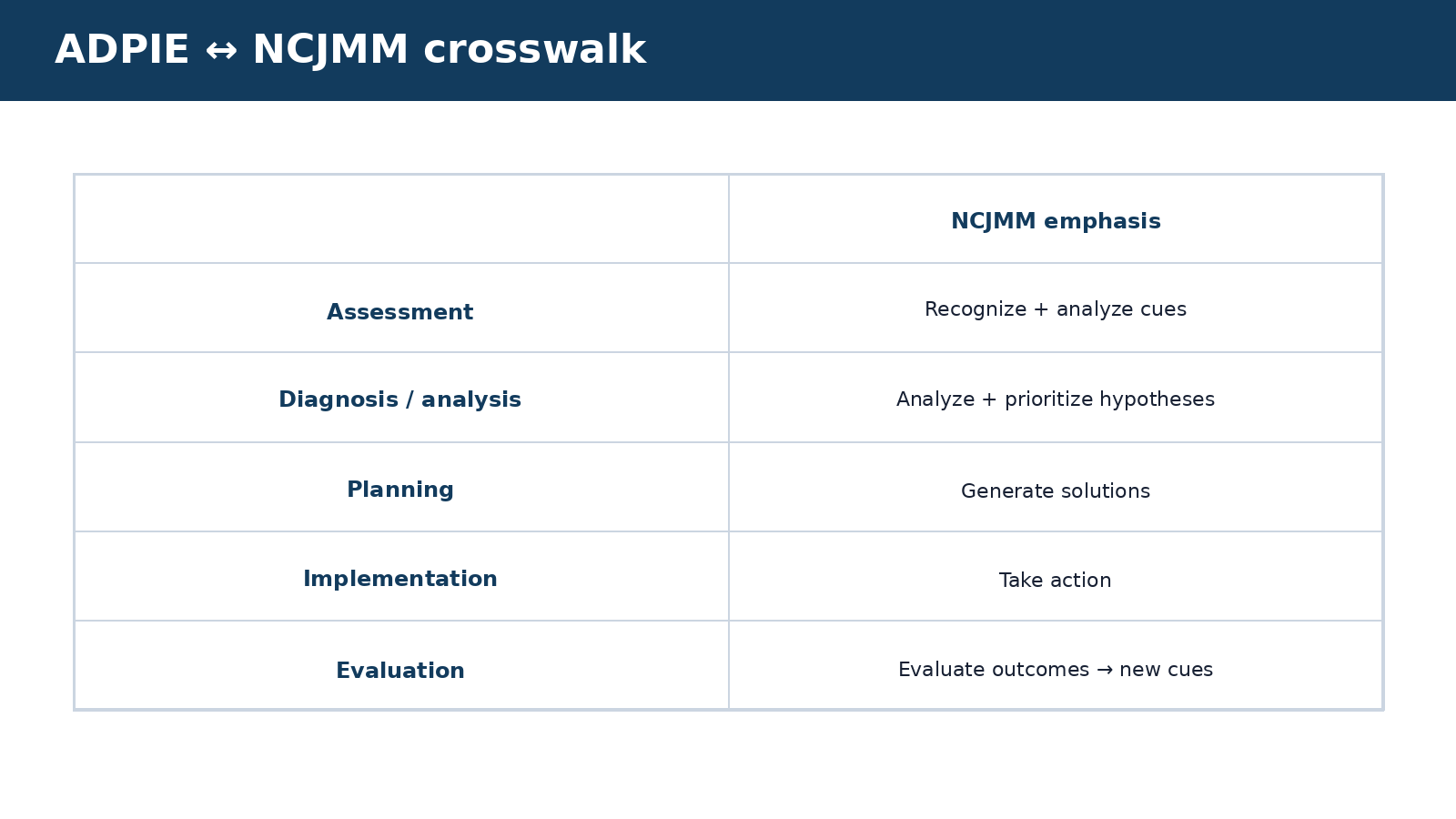
17. ADPIE and the six NCJMM clinical judgment steps
The models overlap but are not identical. NCJMM is a measurement framework for clinical judgment; the nursing process is a practice/education framework. Use each for its intended purpose.
| ADPIE / nursing process | Closest NCJMM emphasis |
|---|---|
| Assessment | Recognize cues; Analyze cues |
| Diagnosis/analysis | Analyze cues; Prioritize hypotheses |
| Planning | Generate solutions |
| Implementation | Take action |
| Evaluation | Evaluate outcomes; then recognize new cues |
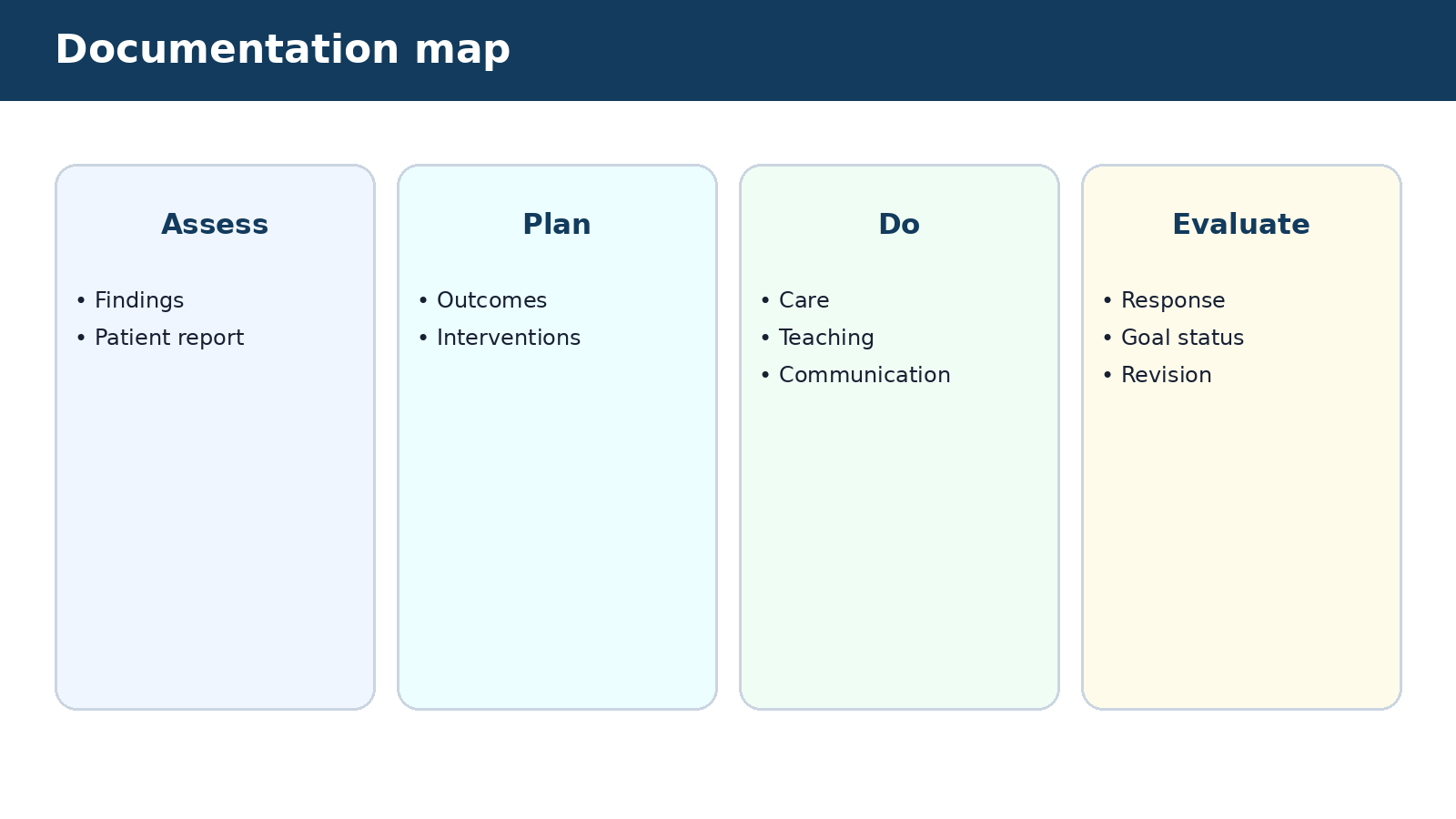
18. Documentation through ADPIE
-
Assessment: objective findings plus relevant patient report.
-
Diagnosis/analysis: nursing problem/risk according to the required format.
-
Planning: measurable outcomes and planned interventions.
-
Implementation: what was performed, taught, communicated or delegated.
-
Evaluation: response, outcome status and revisions.
Practical check: Document facts and clinical reasoning that are relevant to continuity of care; avoid copied-forward inaccuracies.
19. A complete worked example: heart failure with dyspnea
Assessment: patient reports increasing dyspnea; RR 28/min, crackles, edema and increasing oxygen need. Analysis: impaired oxygenation/fluid overload is a priority concern. Planning: reduce dyspnea and achieve the prescribed oxygen target while improving signs of congestion. Implementation: position for breathing, assess oxygenation, administer prescribed therapies, monitor fluid status and escalate deterioration. Evaluation: compare work of breathing, oxygen requirement, lung findings, urine output, edema and symptoms with baseline.
Practical check: If the patient worsens, return to assessment immediately; do not wait for the next scheduled care-plan review.
20. Common ADPIE mistakes
-
Collecting data without identifying the clinically important pattern.
-
Using a medical diagnosis as the entire nursing analysis.
-
Writing vague, unmeasurable goals.
-
Selecting interventions that do not match the stated problem.
-
Implementing a plan that is no longer safe after the patient changes.
-
Documenting tasks but not patient response.
-
Treating evaluation as the end rather than the start of the next cycle.
21. Using ADPIE in assignments and clinical practice
-
Assignments often require more formal written diagnoses and rationales than routine clinical documentation. Follow the school’s required terminology and citation style while keeping the reasoning clinically realistic.
-
Cite primary/current clinical sources for rationales when possible.
-
Do not copy a care plan that does not match the actual patient.
-
Protect privacy by using de-identified information in assignments according to school policy.
-
Separate an educational exercise from an order or real clinical plan.
22. Clinical judgment cases
How to use the cases: Read the scenario once for the big picture. Then identify the most important cues, the priority concern, the safest immediate nursing actions, and the findings that would show whether the plan worked. These cases are original educational examples, not official examination items.
Case 1: Postoperative low urine output
A postoperative patient has urine output 15 mL/hr for two hours, HR 112, BP 92/58 and dry mucous membranes.
| Clinical-judgment step | Reasoning |
|---|---|
| Recognize cues | Low urine output plus tachycardia/hypotension and possible volume deficit. |
| Analyze cues | Reduced renal perfusion from hypovolemia is one concern; obstruction or other causes must be considered. |
| Prioritize hypotheses | Perfusion and cause of oliguria. |
| Generate solutions | Assess bladder/catheter patency, fluid losses, surgical site, hemodynamics and notify/escalate; prepare for prescribed fluid/lab evaluation. |
| Take action | Do not simply document low urine output as an isolated elimination problem. |
| Evaluate outcomes | Urine output, BP/HR, perfusion and cause improve/are identified. |
Case 2: New confusion in an older adult
A previously oriented older adult becomes confused and restless overnight.
| Clinical-judgment step | Reasoning |
|---|---|
| Recognize cues | Acute mental-status change. |
| Analyze cues | Delirium may be caused by hypoxia, infection, medication, pain, retention, metabolic disturbance or environment. |
| Prioritize hypotheses | Immediate safety and reversible physiologic causes. |
| Generate solutions | Assess ABCs/vitals/oxygenation, glucose if indicated, pain, urinary retention, medications and infection cues; escalate. |
| Take action | Do not label it “dementia” without assessment. |
| Evaluate outcomes | Cause is identified and cognition/safety improve. |
Case 3: Diabetes teaching before discharge
A patient newly prescribed insulin says, “I think I understand,” but has not demonstrated injection technique.
| Clinical-judgment step | Reasoning |
|---|---|
| Recognize cues | Knowledge/skill outcome not yet verified. |
| Analyze cues | Verbal agreement does not prove safe self-management. |
| Prioritize hypotheses | Confirm ability before discharge. |
| Generate solutions | Use demonstration, teach-back and correction; address vision, dexterity, supplies and hypoglycemia plan. |
| Take action | Do not document “teaching complete” based only on nodding. |
| Evaluate outcomes | Patient correctly demonstrates and explains key safety actions. |
Case 4: Pain plan not working
Thirty minutes after analgesia, pain remains 9/10 and the patient is diaphoretic with new chest pressure.
| Clinical-judgment step | Reasoning |
|---|---|
| Recognize cues | Persistent pain plus new potentially cardiac symptoms. |
| Analyze cues | This is no longer a routine evaluation of analgesia. |
| Prioritize hypotheses | Urgent assessment for acute deterioration. |
| Generate solutions | Assess ABCs, cardiac symptoms/vitals and escalate according to chest-pain protocol. |
| Take action | Do not merely repeat the same pain intervention. |
| Evaluate outcomes | Cause identified and symptoms/hemodynamics stabilize. |
Case 5: Fall-risk plan after medication change
A patient started on a sedating medication becomes unsteady when walking to the bathroom.
| Clinical-judgment step | Reasoning |
|---|---|
| Recognize cues | New medication-related functional change. |
| Analyze cues | Existing plan may no longer match fall risk. |
| Prioritize hypotheses | Prevent injury and revise plan. |
| Generate solutions | Assist mobility, reassess sedation/orthostasis, review medication and increase safety supports. |
| Take action | Do not leave the original “independent” mobility order unchallenged. |
| Evaluate outcomes | Safe mobility level is established and documented. |
Case 6: Outcome partially met
Goal: ambulate 30 m twice daily by day 3. On day 3 the patient walks 15 m twice with improved endurance but still needs rest.
| Clinical-judgment step | Reasoning |
|---|---|
| Recognize cues | Progress occurred but full target was not reached. |
| Analyze cues | Outcome is partially met. |
| Prioritize hypotheses | Understand barriers and revise realistically. |
| Generate solutions | Assess pain, cardiopulmonary tolerance, strength and motivation; continue progressive mobility with updated goal. |
| Take action | Do not label the plan a total failure or falsely mark it “met.” |
| Evaluate outcomes | New measurable goal reflects current ability and progress. |
Go deeper: Apply the same approach to Next Generation NCLEX® case studies.
23. Practice questions with answers and rationales
Important: These are original RN Clarity practice questions. They are not copied from, endorsed by or affiliated with NCSBN® or the NCLEX® examination.
Question 1: Which ADPIE step asks whether the patient reached the planned outcome?
-
A. Assessment
-
B. Diagnosis
-
C. Implementation
-
D. Evaluation
Answer and rationale: D. Evaluation compares the actual patient response with the expected outcome.
Question 2: Which is subjective data?
-
A. BP 88/50
-
B. Patient says “I feel dizzy”
-
C. Potassium 3.0 mmol/L
-
D. Urine output 20 mL/hr
Answer and rationale: B. Subjective data are reported by the patient or caregiver.
Question 3: Which goal is most measurable?
-
A. Patient will improve
-
B. Patient will understand
-
C. By discharge, patient will demonstrate inhaler technique correctly
-
D. Nurse will teach medications
Answer and rationale: C. It identifies the patient behavior and a time frame that can be evaluated.
Question 4: What should happen if the patient deteriorates during implementation?
-
A. Finish the original plan first
-
B. Return to assessment and revise priorities
-
C. Wait until evaluation at end of shift
-
D. Ignore the new data
Answer and rationale: B. The nursing process is iterative; new cues require reassessment and possible plan changes.
Question 5: Which statement best describes a nursing diagnosis?
-
A. It is always the same as the medical diagnosis
-
B. It describes a patient response or risk nursing can address/monitor
-
C. It is a medication order
-
D. It can be invented without assessment data
Answer and rationale: B. Nursing diagnoses are based on assessed human responses or risks.
Go deeper: Continue with NCLEX-RN® practice questions.
24. Frequently asked questions
What does ADPIE stand for?
Assessment, Diagnosis, Planning, Implementation and Evaluation.
How does NCSBN® describe the nursing process?
The 2026 test plan uses assessment, analysis, planning, implementation and evaluation.
Is ADPIE the same as the NCJMM?
No. They overlap, but NCJMM is a clinical-judgment measurement framework with six steps.
What is subjective data?
Information reported by the patient/caregiver, such as pain, nausea or dizziness.
What is objective data?
Observable or measured information such as vital signs, exam findings or laboratory results.
What makes a goal measurable?
A clear patient outcome, observable measure and realistic time frame.
Can an RN delegate evaluation?
The RN retains responsibility for nursing judgment and evaluation, although others may collect/report observations within scope.
What happens when an outcome is not met?
Reassess why, identify new cues and revise the diagnosis/problem, goal or interventions as needed.
Is the nursing process linear?
No. It is iterative and may return to assessment whenever the patient changes.
How does ADPIE appear on NCLEX-RN® 2026?
The Nursing Process is an integrated process across all Client Needs and strongly overlaps the six clinical judgment steps.
25. Official and primary references
Sources checked September 10, 2026. Use the linked guidance for the full context and follow patient-specific orders, scope of practice and local policy.
-
2026 NCLEX-RN® Test Plan — Official definition of the Nursing Process and clinical-judgment integration.
-
American Nurses Association: The Nursing Process — Professional overview of assessment, diagnosis, outcomes/planning, implementation and evaluation.
-
NCSBN® Clinical Judgment Measurement Model — Official NCJMM framework.
26. Educational, clinical-safety and trademark disclaimer
Educational and clinical-safety disclaimer: This guide is provided by RN Clarity for general educational and informational purposes. It does not replace the official 2026 NCLEX-RN® Test Plan, nursing-school instruction, a current drug or clinical reference, provider orders, nursing regulator requirements, institutional policy, manufacturer instructions, local infection-control guidance or professional clinical judgment. Real patients may have conditions, medications, allergies, laboratory results, age-related needs or other factors that require a different approach. When a patient may be deteriorating, follow local emergency and escalation procedures. Use of this guide does not guarantee examination success or clinical competence. Non-affiliation and trademark notice: RN Clarity is an independent educational resource and is not affiliated with, endorsed by, sponsored by, approved by or officially connected with the National Council of State Boards of Nursing, Inc. NCLEX®, NCLEX-RN®, NCLEX-PN® and NCSBN® are registered trademarks of the National Council of State Boards of Nursing, Inc. All trademarks belong to their respective owner. Their use here is for identification, commentary and educational reference only.