Patient Safety in Nursing Guide
A complete nursing guide to falls, restraints, medication errors, emergencies, handoff and risk prevention.
1. Quick Answer and Essential Facts
Direct answer: Patient safety nursing combines correct identification, individualized risk assessment, reliable medication and procedure processes, fall and aspiration prevention, least restrictive restraint practice, infection prevention, emergency response, clear communication and learning from errors and near misses.
Patient Safety in Nursing: Falls, Restraints, Medication Errors, Emergencies and Risk Prevention is designed as a practical reference for nursing students and new nurses. It explains the topic in plain language, then connects that knowledge to assessment, safety, clinical judgment, documentation and patient teaching. The goal is not to replace an instructor, drug reference, institutional policy or clinical guideline. The goal is to help the learner understand why a safe nurse makes one decision rather than another.
-
Start with the patient, not the task. A technically correct action can still be unsafe if the patient is unstable, the order is unclear, the route is wrong, or the situation has changed.
-
Use trends and the whole clinical picture. One number, one symptom or one device alarm should rarely be interpreted in isolation.
-
Verify unfamiliar information in a current authoritative source. Nursing practice changes, products differ and local policies may be more restrictive than a general study guide.
-
Document what you assessed, what you did, how the patient responded and what you communicated when those details are clinically relevant.
NCLEX-RN® connection: Patient safety spans Management of Care, Safety and Infection Prevention and Control, Pharmacological and Parenteral Therapies, Reduction of Risk Potential and clinical judgment in the April 2026 NCLEX-RN® Test Plan.
Go deeper: Use active learning methods to turn reading into recall and application.
2. How this topic fits the April 2026 NCLEX-RN® Test Plan
The 2026 NCLEX-RN® Test Plan is effective from April 1, 2026 through March 31, 2029. The examination organizes nursing practice around Client Needs, while six integrated processes run through every content area: caring, clinical judgment, communication and documentation, culture and spirituality, nursing process, and teaching/learning. Most questions require application or higher-level thinking rather than simple recall.
-
Management of Care: prioritize, coordinate, advocate, communicate and report unsafe practice.
-
Safety and Infection Prevention and Control: identification, restraints, falls, environmental hazards and emergency preparedness.
-
Pharmacological and Parenteral Therapies: prevent medication and infusion harm.
-
Reduction of Risk Potential: recognize complications and act before harm progresses.
Practical check: A good study method therefore asks more than 'What is the fact?' Ask: What is the important cue? What could harm the patient? What additional assessment is needed? What can the nurse do now? What requires an order or escalation? What outcome would show improvement?
NCLEX-RN® connection: Expect the same fact to appear in different forms: a stand-alone question, a priority question, a calculation, a medication-safety question, a matrix or multiple-response item, or an unfolding clinical-judgment case.
Go deeper: Connect these topics to the 2026 NCLEX-RN® test plan.
3. A simple clinical-judgment method to use throughout the guide
Direct answer: Use the six clinical-judgment steps as a mental safety loop: recognize cues, analyze cues, prioritize hypotheses, generate solutions, take action, and evaluate outcomes.
Clinical judgment is not a separate subject that begins only when a case study appears. It is the way a nurse connects information to safe action. The 2026 NCLEX-RN® Test Plan names six measurable steps. Learners should practise using them during routine topics so that the process becomes automatic.
-
Recognize cues: identify the data that matter now, including symptoms, vital signs, laboratory results, medications, devices and trends.
-
Analyze cues: connect the findings. Decide which findings support the same problem and which may be unrelated.
-
Prioritize hypotheses: compare possible explanations by urgency, likelihood and risk if care is delayed.
-
Generate solutions: identify reasonable nursing actions, expected outcomes and people who may need to be involved.
-
Take action: choose the safest action that addresses the highest-priority problem within scope and policy.
-
Evaluate outcomes: reassess. Improvement, deterioration or no change tells the nurse whether the plan is working.
Avoid this mistake: Do not force every question into a rigid mnemonic. Airway, breathing and circulation are powerful priorities when they are truly threatened, but an immediate safety threat, severe bleeding, hypoglycemia, seizure activity or another time-sensitive problem may demand action first.
NCLEX-RN® connection: In case studies, new information can change the priority. Re-read the current data rather than staying attached to an earlier hypothesis.
Go deeper: Build your reasoning with the clinical judgment guide.
4. Patient safety is a system of risk recognition and reliable action
Direct answer: Patient safety means reducing preventable harm while delivering necessary care. Nurses contribute by identifying hazards, using reliable processes, communicating clearly, responding to deterioration, reporting errors and near misses, and designing care around the individual patient’s risks.
-
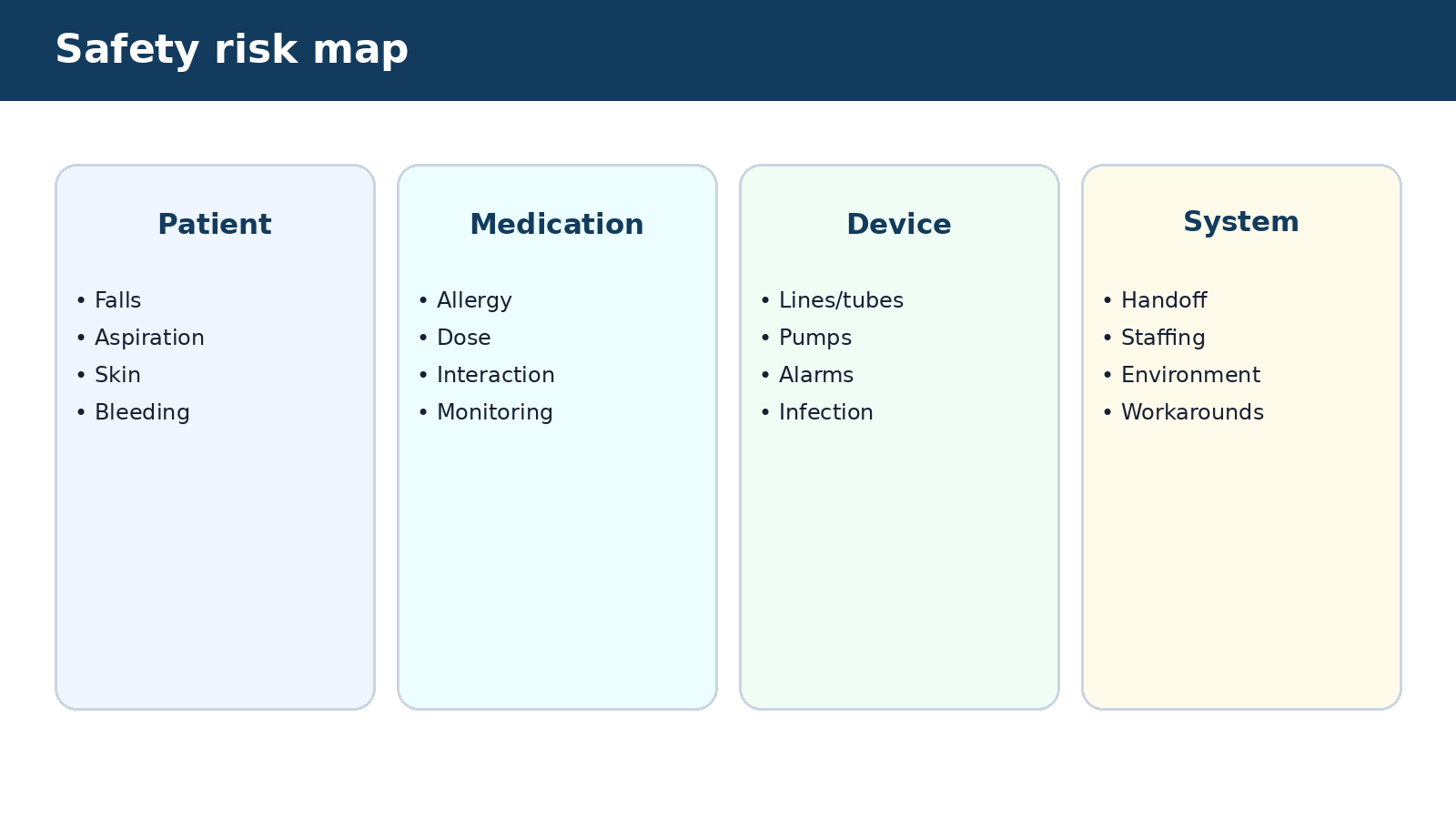
Safety is broader than “be careful.” Fatigue, workload, poor design, communication failures, medication complexity, equipment, environment and human factors all influence risk.
-
Identify the patient correctly before medications, procedures, specimens and blood products.
-
Assess fall, pressure-injury, aspiration, bleeding, infection and medication risks based on the individual.
-
Use alarms and technology thoughtfully rather than reflexively.
-
Escalate unsafe orders, environments or clinical changes.
-
Report errors and near misses through the appropriate system so the organization can learn.
NCLEX-RN® connection: Management of Care and Safety and Infection Prevention and Control contain many safety activities in the 2026 test plan.
5. The hierarchy of safety decisions
-
When several problems compete, prioritize immediate threats to life or irreversible harm, then rapidly changing/unstable conditions, then time-sensitive risks.
-
Airway, breathing and circulation threats are high priority when present.
-
Active bleeding, seizure, severe hypoglycemia, anaphylaxis, suicide risk and other time-critical threats may require immediate action.
-
An unstable patient generally takes priority over a stable patient with an expected finding.
-
Actual danger can outrank routine documentation, teaching or comfort tasks.
Avoid this mistake: Do not force every scenario into one mnemonic; use the actual cues.
Patient-safety hierarchy
- Address immediate threats to life or safety
- Assess unstable or newly changing conditions
- Act on time-sensitive risks
- Prevent foreseeable harm
- Complete routine care and reassess priorities as cues change
6. Correct patient identification
Direct answer: Use at least two approved patient identifiers before medications, blood products, specimens and procedures. Room number or location is not an identifier.
-
Match the patient to the order/MAR and intended procedure.
-
Ask the patient to state identifiers when possible rather than answering yes/no to a suggested name.
-
Use barcode systems correctly without workarounds.
-
Resolve mismatched wristbands or records before proceeding.
7. Falls: risk assessment and individualized prevention
-
Fall prevention is more effective when interventions match the person’s actual risks rather than using the same bundle for everyone.
-
Assess mobility, cognition, orthostatic symptoms, medications, toileting needs, vision, footwear and environment.
-
Keep needed items and call system accessible.
-
Assist with transfers/ambulation when risk is present.
-
Use appropriate mobility aids and non-slip footwear.
-
Reassess after medications, procedures, delirium, falls or change in condition.
Practical check: After a fall, assess the patient before moving them when injury is possible and follow the post-fall evaluation/reporting process.
Avoid this mistake: Physical restraints do not reliably prevent falls and can increase injury risk.
Fall-prevention pathway
- Assess individual fall risks
- Match interventions to mobility, cognition, medications and toileting needs
- Assist safely and keep needed support accessible
- Reassess after a change or fall
8. Restraints and seclusion: last-resort safety interventions
Direct answer: Restraints and seclusion are not convenience tools. CMS rules prohibit use for coercion, discipline, convenience or retaliation. Use the least restrictive effective approach and follow legal/regulatory and institutional requirements.
-
Identify the behavior or immediate safety risk.
-
Try appropriate alternatives when feasible.
-
Use the least restrictive intervention that protects the patient/others.
-
Obtain required orders and perform monitoring/reassessment according to the applicable rule/policy.
-
Remove as soon as the clinical reason no longer exists.
-
Protect dignity, circulation, skin, hydration, elimination and communication.
Avoid this mistake: Do not quote one universal reassessment interval for all ages/settings; requirements vary by restraint type, jurisdiction and regulation.
For US hospitals covered by 42 CFR 482.13, restraint or seclusion requires an authorized practitioner’s order and must end as soon as possible. Standing or PRN restraint/seclusion orders are prohibited. Seclusion is limited to violent or self-destructive behavior; it is not a response to ordinary wandering or fall risk. Monitoring, evaluation and order-renewal requirements depend on the indication, age, applicable law and hospital policy.
Least restrictive safety approach
- Identify and treat causes of distress or unsafe behavior
- Try appropriate environmental, communication and observation measures
- Use restraint only when justified and less restrictive measures are ineffective
- Follow applicable orders, monitoring and documentation requirements
- End restraint as soon as the safety indication resolves
9. Medication safety and high-alert medications
-
Medication harm prevention requires correct patient/drug/dose/route/time plus indication, assessment, allergies, interactions, monitoring and response.
-
Clarify incomplete or unsafe orders.
-
Use independent double checks when required for selected high-alert medications.
-
Avoid unsafe abbreviations and ambiguous decimal notation.
-
Use barcode and smart-pump technology correctly.
-
Monitor for therapeutic and adverse effects.
-
Perform medication reconciliation at transitions.
Medication safety barrier model
- Verify the current order
- Prepare and dispense safely
- Verify patient and medication at the bedside
- Use technology without bypassing clinical checks
- Monitor and document patient response
10. Preventing diagnostic and specimen errors
-
Wrong-patient, wrong-site, mislabeled or contaminated specimens can lead to harmful treatment.
-
Identify patient before collection.
-
Label specimens at the bedside according to policy.
-
Use correct container, site and timing.
-
Escalate critical results through the required process.
-
Question results that do not fit the clinical picture and verify when appropriate.
11. Procedure and surgical safety
-
Confirm correct patient, procedure and site.
-
Verify consent and required preprocedure assessment according to role.
-
Complete time-out/site verification processes.
-
Check allergies, anticoagulants, fasting status and required diagnostics as applicable.
-
Monitor recovery for airway, bleeding, pain, nausea, delirium and other complications.
Avoid this mistake: Do not assume signed consent means the nurse should ignore evidence that the patient does not understand or has changed their mind.
12. Aspiration and swallowing safety
-
Aspiration risk increases with dysphagia, altered consciousness, neurologic disease, sedation and some feeding situations.
-
Screen/assess swallowing according to protocol before oral intake when indicated.
-
Position appropriately for feeding and medication administration.
-
Follow texture/thickened-fluid recommendations from the appropriate assessment.
-
Stop feeding and reassess if coughing, choking, wet voice or respiratory distress occurs.
-
Maintain oral hygiene because poor oral health can increase pneumonia risk.
Aspiration safety
- Assess swallowing and aspiration risk
- Follow the prescribed positioning and swallowing plan
- Observe feeding and medication administration
- Stop oral intake and respond to coughing, choking or respiratory changes
- Reassess and seek the appropriate evaluation
13. Pressure injury and skin safety
-
Pressure injuries arise from pressure, shear and tissue vulnerability. Prevention requires individualized risk assessment and consistent care.
-
Inspect skin, including under devices.
-
Reposition/offload according to patient risk and tolerance.
-
Manage moisture and nutrition.
-
Use pressure-redistribution surfaces when indicated.
-
Do not massage reddened bony prominences.
14. Emergency preparedness and bedside emergencies
-
Nurses must know how to activate emergency response, locate equipment and protect patients during fire, evacuation, severe weather, hazardous-material or clinical emergencies.
-
Know local code/rapid-response activation.
-
Prioritize immediate life threats.
-
Use fire/emergency procedures taught by the organization.
-
Maintain oxygen/electrical safety.
-
Communicate clearly during transfer or evacuation.
Avoid this mistake: Facility emergency mnemonics are local operational tools; follow the current employer plan.
15. Alarm safety and monitoring technology
-
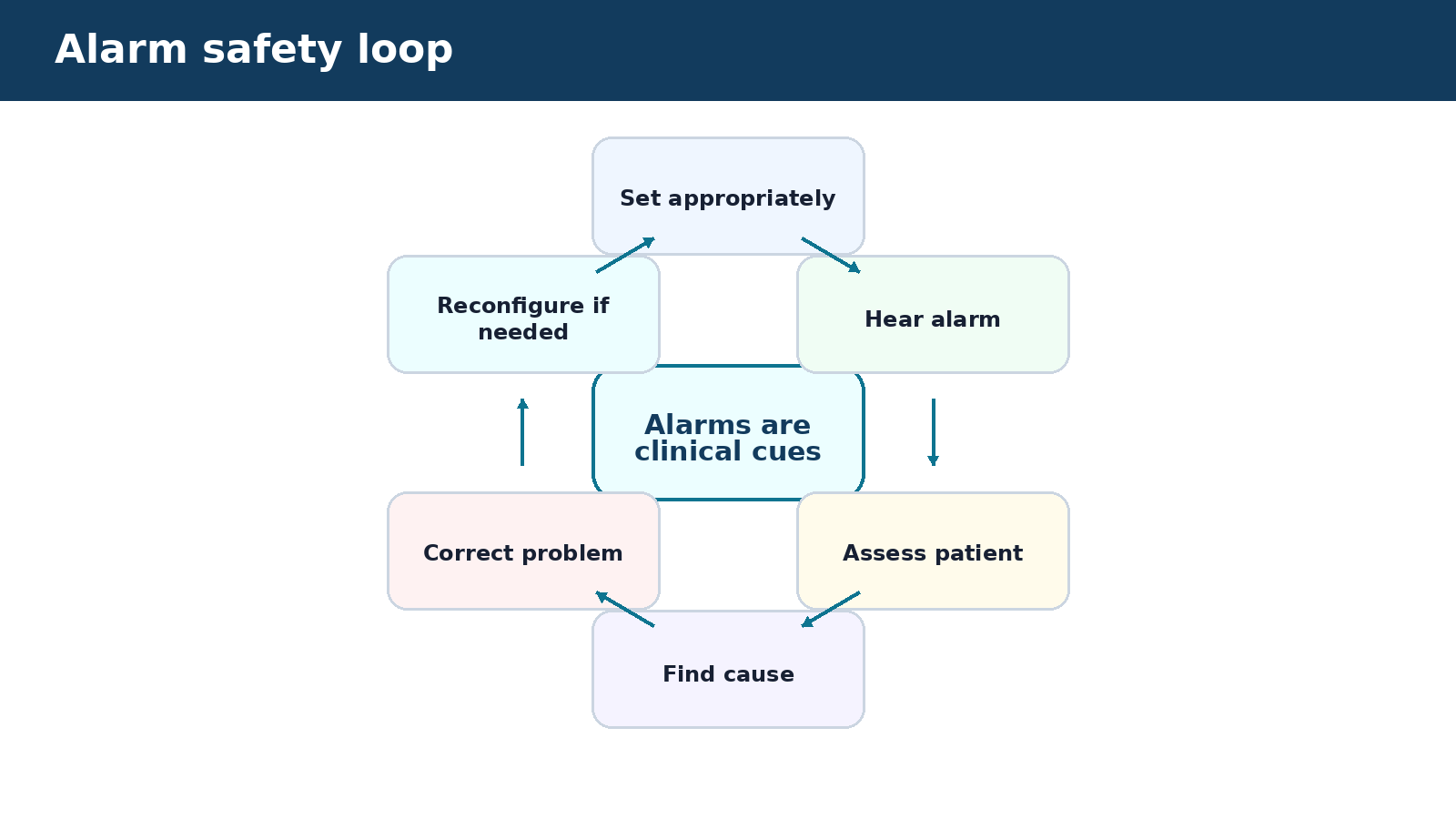
Alarms are useful only if configured, heard and acted upon. Excessive nonactionable alarms can create alarm fatigue.
-
Set patient-appropriate parameters within policy.
-
Do not silence an alarm without identifying the cause.
-
Check sensor/lead connections and the patient.
-
Ensure alarm volume/routing is functional.
-
Escalate equipment malfunction.
16. Communication, handoff and escalation
-
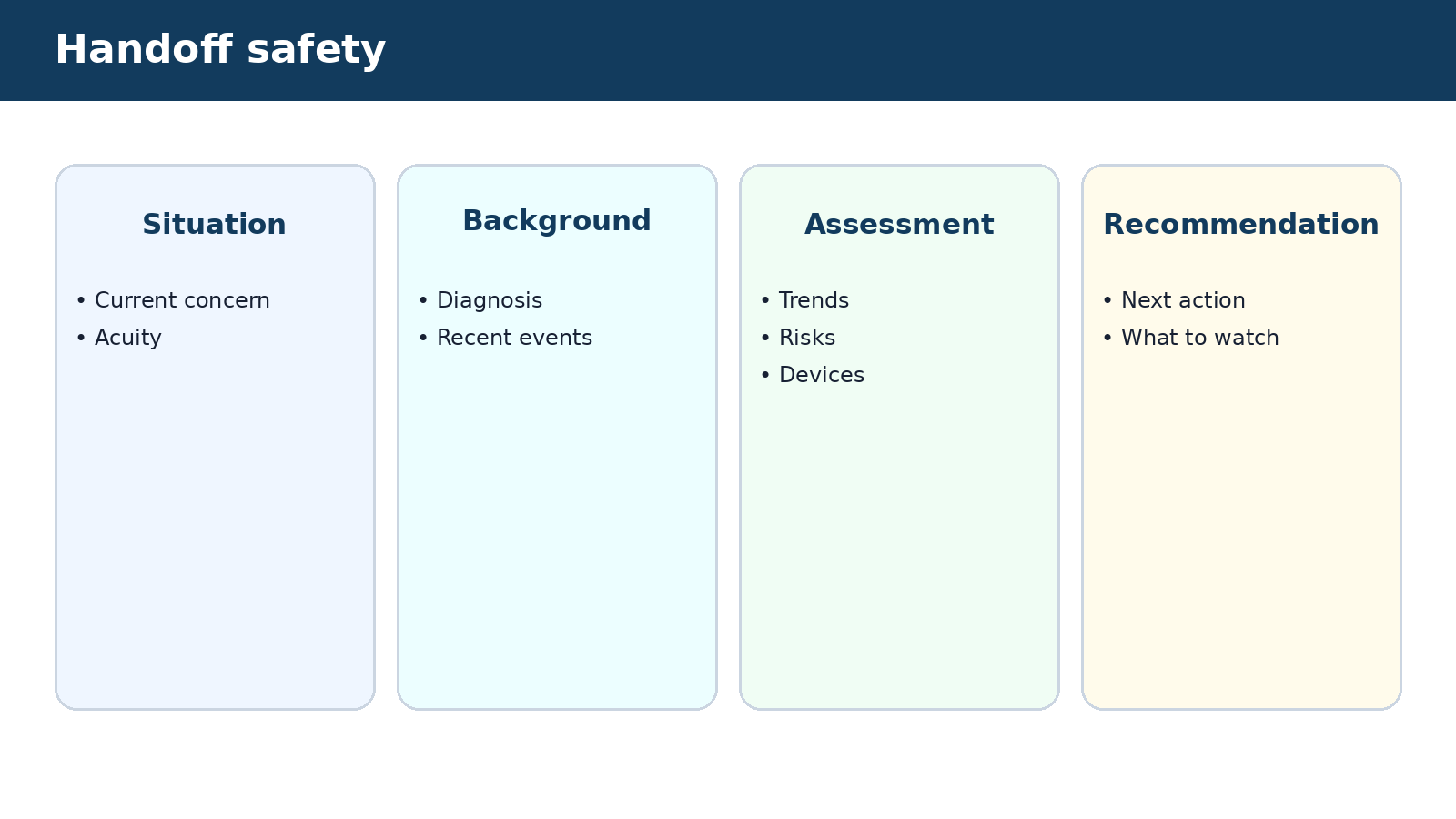
Many preventable harms involve missing or delayed communication. Use structured handoff and closed-loop communication for high-risk information.
-
State the concern and why it is urgent.
-
Include trend and relevant background.
-
Read back critical verbal/telephone orders or results as required.
-
Use chain of command when a safety concern is not resolved.
-
Document clinically important communication and response.
Escalation chain
- Identify the concern and its urgency
- Take indicated immediate bedside safety action
- Contact the responsible clinician or emergency team
- Use the chain of command if the concern remains unresolved
- Reassess and document the response
17. Errors, near misses and just culture
Direct answer: A near miss is a safety event intercepted before it reaches the patient. An event that reaches the patient without discernible harm is a no-harm incident; both deserve reporting under the local safety process. Reporting near misses is valuable because it reveals weak systems before someone is injured.
-
A just-culture approach distinguishes human error, at-risk behavior and reckless behavior while still preserving accountability. The goal is learning and safer systems, not hiding mistakes.
-
First protect and assess the patient.
-
Notify appropriate clinicians and follow disclosure/reporting requirements.
-
Document the clinical facts in the health record; use the incident-reporting system for quality review according to policy.
-
Do not alter or conceal the record.
-
Participate in root-cause/system analysis when requested.
Error response
- Protect and assess the patient
- Notify and obtain needed treatment
- Document clinical facts accurately
- Report through the safety system
- Use the findings to improve care
18. Violence, suicide and elopement risk
-
Safety includes behavioral risks. Assessment should be direct, respectful and based on current risk.
-
Ask directly about suicidal thoughts when indicated.
-
Remove/secure hazards according to the required observation level and policy.
-
Use de-escalation and least restrictive approaches.
-
Escalate threats of violence or elopement risk promptly.
-
Maintain staff safety and seek assistance early.
19. A patient-safety bedside pause
-
Correct patient?
-
Immediate deterioration or emergency?
-
Fall/aspiration/skin/infection/bleeding risks?
-
Medication/allergy/device hazards?
-
Lines/tubes/drains secure and necessary?
-
Environment safe and call system accessible?
-
What changed since last assessment?
-
What must be communicated or escalated now?
20. Clinical judgment cases
How to use the cases: Read the scenario once for the big picture. Then identify the most important cues, the priority concern, the safest immediate nursing actions, and the findings that would show whether the plan worked. These cases are original educational examples, not official examination items.
Case 1: Unwitnessed fall
A confused older adult is found on the floor beside the bed and reports hip pain.
| Clinical-judgment step | Reasoning |
|---|---|
| Recognize cues | Fall with possible injury. |
| Analyze cues | Moving the patient before assessment could worsen injury; delirium and medication factors may also be present. |
| Prioritize hypotheses | Immediate assessment and prevention of further harm. |
| Generate solutions | Call for help, assess ABCs, pain, neurologic status and injury signs; follow post-fall protocol and obtain medical evaluation. |
| Take action | Do not pull the patient back into bed before appropriate assessment if serious injury is possible. |
| Evaluate outcomes | Complete monitoring, identify causes and revise fall-prevention plan. |
Case 2: Wrong medication almost given
Barcode scanning alerts that the medication belongs to another patient before administration.
| Clinical-judgment step | Reasoning |
|---|---|
| Recognize cues | Near miss. |
| Analyze cues | The safety system intercepted a wrong-patient medication event. |
| Prioritize hypotheses | Do not administer; verify correct medication/patient and investigate the workflow failure. |
| Generate solutions | Remove incorrect medication, obtain correct product and report near miss as required. |
| Take action | Do not bypass the alert because the drug “looks right.” |
| Evaluate outcomes | Patient receives correct therapy and system issue is addressed. |
Case 3: Restraint requested for convenience
A staff member suggests restraining a restless patient “so we can finish the shift.”
| Clinical-judgment step | Reasoning |
|---|---|
| Recognize cues | Convenience is not an acceptable indication. |
| Analyze cues | Restraints carry physical and psychological risk and require strict justification. |
| Prioritize hypotheses | Use least restrictive safety measures and assess the cause of restlessness. |
| Generate solutions | Evaluate pain, toileting, delirium, hypoxia and environment; increase observation or use alternatives. |
| Take action | Do not apply restraint solely for convenience. |
| Evaluate outcomes | Patient remains safe with the least restrictive intervention. |
Case 4: Critical lab result not acknowledged
A laboratory calls a critical potassium value but the responsible provider has not responded to repeated pages.
| Clinical-judgment step | Reasoning |
|---|---|
| Recognize cues | Time-sensitive result with unresolved communication. |
| Analyze cues | Delay can cause serious harm. |
| Prioritize hypotheses | Escalate through chain of command while assessing the patient. |
| Generate solutions | Assess cardiac symptoms/rhythm as indicated, verify result context, notify using escalation policy. |
| Take action | Do not wait indefinitely after one unanswered message. |
| Evaluate outcomes | Treatment plan is implemented and patient remains monitored. |
Case 5: Choking during meal
A stroke patient begins coughing, has a wet voice and oxygen saturation falls during lunch.
| Clinical-judgment step | Reasoning |
|---|---|
| Recognize cues | Possible aspiration and airway compromise. |
| Analyze cues | Continuing oral intake can worsen aspiration. |
| Prioritize hypotheses | Airway/breathing and stop exposure. |
| Generate solutions | Stop feeding, position and suction/support airway as needed, call for help and obtain swallow reassessment. |
| Take action | Do not encourage another sip to “clear the throat.” |
| Evaluate outcomes | Respiratory status stabilizes and a safer feeding plan is established. |
Case 6: Pump alarm repeatedly silenced
A high-alert infusion pump has alarmed several times; a staff member keeps silencing it without checking the patient or line.
| Clinical-judgment step | Reasoning |
|---|---|
| Recognize cues | Unsafe alarm response. |
| Analyze cues | Drug delivery may be interrupted or incorrect. |
| Prioritize hypotheses | Assess patient and infusion immediately. |
| Generate solutions | Trace line, inspect access, verify pump/drug/rate and correct cause; escalate equipment issue. |
| Take action | Do not normalize repeated alarm silencing. |
| Evaluate outcomes | Correct infusion is restored and cause documented/resolved. |
Go deeper: Apply the same approach to Next Generation NCLEX® case studies.
21. Practice questions with answers and rationales
Important: These are original RN Clarity practice questions. They are not copied from, endorsed by or affiliated with NCSBN® or the NCLEX® examination.
Question 1: What is the first priority after discovering a medication error that reached the patient?
-
A. Complete the incident report before seeing the patient
-
B. Assess and protect the patient
-
C. Delete the MAR entry
-
D. Wait to see if symptoms develop
Answer and rationale: B. Patient assessment and harm reduction come first; reporting and analysis follow.
Question 2: Which is an appropriate reason for restraint?
-
A. Staff convenience
-
B. Punishment
-
C. A time-limited safety need after less restrictive approaches are insufficient and requirements are met
-
D. Preventing every possible fall
Answer and rationale: C. Restraints are last-resort safety interventions, not convenience or punishment.
Question 3: What is a near miss?
-
A. A potentially harmful event intercepted before reaching the patient
-
B. A minor illness
-
C. A normal handoff
-
D. A patient complaint only
Answer and rationale: A. Near misses reveal system vulnerabilities and should be learned from.
Question 4: Which action best prevents wrong-patient errors?
-
A. Use room number
-
B. Use at least two approved identifiers
-
C. Ask “Are you Mr. Lee?” only
-
D. Rely on memory
Answer and rationale: B. Two approved identifiers are a core patient-identification safeguard.
Question 5: A patient begins choking during a meal. What is the priority?
-
A. Finish the tray
-
B. Stop feeding and address airway/breathing
-
C. Document calorie count
-
D. Ask dietary to send a new tray
Answer and rationale: B. Airway/breathing danger takes priority.
Go deeper: Continue with NCLEX-RN® practice questions.
22. Frequently asked questions
What is patient safety in nursing?
The prevention and reduction of avoidable harm through reliable clinical processes, risk recognition, communication and system learning.
Do restraints prevent falls?
They do not reliably prevent falls and can increase injury and other complications. Use least restrictive approaches and follow strict requirements.
Can restraints be used for convenience?
No. CMS rules prohibit restraint or seclusion for coercion, discipline, convenience or retaliation.
What should a nurse do after an error?
Protect and assess the patient first, notify/escalate, document clinical facts, report through the required system and participate in learning.
What is a near miss?
A safety event that could have caused harm but was intercepted or did not cause harm.
What are two patient identifiers?
Examples include full name, date of birth, medical-record number or another approved identifier; location is not an identifier.
How should a critical result be handled?
Follow the required read-back/notification process and escalate through chain of command if timely action is not occurring.
Why are alarm settings important?
Incorrect, ignored or overly broad alarms can delay recognition of deterioration or therapy failure.
What is individualized fall prevention?
Matching interventions to the person’s mobility, cognition, medications, toileting, orthostatic and environmental risks.
How does patient safety appear on NCLEX-RN® 2026?
Through identification, falls, restraints, medication safety, infection prevention, error reporting, emergency response, delegation and clinical judgment.
23. Official and primary references
Sources checked September 10, 2026. Use the linked guidance for the full context and follow patient-specific orders, scope of practice and local policy.
-
2026 NCLEX-RN® Test Plan — Official patient-safety and management-of-care activities.
-
AHRQ PSNet: Falls — Evidence-based overview of inpatient falls and prevention.
-
Hospital patient rights, restraint and seclusion requirements — Current federal hospital conditions of participation.
-
AHRQ Medication Errors and Adverse Drug Events — Medication-safety and systems perspective.
-
AHRQ Nursing and Patient Safety — Nursing contributions to patient safety.
-
CDC Standard Precautions — Infection-prevention safety practices.
24. Educational, clinical-safety and trademark disclaimer
Educational and clinical-safety disclaimer: This guide is provided by RN Clarity for general educational and informational purposes. It does not replace the official 2026 NCLEX-RN® Test Plan, nursing-school instruction, a current drug or clinical reference, provider orders, nursing regulator requirements, institutional policy, manufacturer instructions, local infection-control guidance or professional clinical judgment. Real patients may have conditions, medications, allergies, laboratory results, age-related needs or other factors that require a different approach. When a patient may be deteriorating, follow local emergency and escalation procedures. Use of this guide does not guarantee examination success or clinical competence. Non-affiliation and trademark notice: RN Clarity is an independent educational resource and is not affiliated with, endorsed by, sponsored by, approved by or officially connected with the National Council of State Boards of Nursing, Inc. NCLEX®, NCLEX-RN®, NCLEX-PN® and NCSBN® are registered trademarks of the National Council of State Boards of Nursing, Inc. All trademarks belong to their respective owner. Their use here is for identification, commentary and educational reference only.