Safe Medication Administration Nursing Guide
A plain-English nursing guide to medication rights, routes, safety checks, errors, documentation and NCLEX-RN® clinical judgment.
1. Quick Answer and Essential Facts
Direct answer: Safe medication administration means verifying the right patient, medication, dose, route and time while also checking indication, allergies, relevant assessment data, interactions, patient understanding, documentation and response. The safest nurse stops when something does not make sense and resolves the concern before the medication reaches the patient.
Safe Medication Administration: Rights, Routes, Checks, Errors and Nursing Responsibilities is designed as a practical reference for nursing students and new nurses. It explains the topic in plain language, then connects that knowledge to assessment, safety, clinical judgment, documentation and patient teaching. The goal is not to replace an instructor, drug reference, institutional policy or clinical guideline. The goal is to help the learner understand why a safe nurse makes one decision rather than another.
-
Start with the patient, not the task. A technically correct action can still be unsafe if the patient is unstable, the order is unclear, the route is wrong, or the situation has changed.
-
Use trends and the whole clinical picture. One number, one symptom or one device alarm should rarely be interpreted in isolation.
-
Verify unfamiliar information in a current authoritative source. Nursing practice changes, products differ and local policies may be more restrictive than a general study guide.
-
Document what you assessed, what you did, how the patient responded and what you communicated when those details are clinically relevant.
NCLEX-RN® connection: This topic directly maps to Pharmacological and Parenteral Therapies, which represents 13–19% of scored content in the April 2026 test plan, and also overlaps Management of Care, Safety and Infection Prevention and Control, Reduction of Risk Potential and clinical judgment.
Go deeper: Use active learning methods to turn reading into recall and application.
2. How this topic fits the April 2026 NCLEX-RN® Test Plan
The 2026 NCLEX-RN® Test Plan is effective from April 1, 2026 through March 31, 2029. The examination organizes nursing practice around Client Needs, while six integrated processes run through every content area: caring, clinical judgment, communication and documentation, culture and spirituality, nursing process, and teaching/learning. Most questions require application or higher-level thinking rather than simple recall.
Pharmacological and Parenteral Therapies: 13–19% of scored content; includes order evaluation, medication rights, dosage calculations, IV monitoring, controlled substances, contraindications/labs/allergies/interactions, titration, high-risk medications, reconciliation, teaching and response evaluation.
-
Reduction of Risk Potential: monitoring diagnostic data, vital-sign changes and complications that may make medication administration unsafe.
-
Management of Care: client rights, scope, communication, collaboration and continuity of care.
-
Safety and Infection Prevention and Control: safe injection practices, patient identification, equipment safety and error prevention.
Practical check: A good study method therefore asks more than 'What is the fact?' Ask: What is the important cue? What could harm the patient? What additional assessment is needed? What can the nurse do now? What requires an order or escalation? What outcome would show improvement?
NCLEX-RN® connection: Expect the same fact to appear in different forms: a stand-alone question, a priority question, a calculation, a medication-safety question, a matrix or multiple-response item, or an unfolding clinical-judgment case.
Go deeper: Connect these topics to the 2026 NCLEX-RN® test plan.
3. A simple clinical-judgment method to use throughout the guide
Direct answer: Use the six clinical-judgment steps as a mental safety loop: recognize cues, analyze cues, prioritize hypotheses, generate solutions, take action, and evaluate outcomes.
Clinical judgment is not a separate subject that begins only when a case study appears. It is the way a nurse connects information to safe action. The 2026 NCLEX-RN® Test Plan names six measurable steps. Learners should practise using them during routine topics so that the process becomes automatic.
-
Recognize cues: identify the data that matter now, including symptoms, vital signs, laboratory results, medications, devices and trends.
-
Analyze cues: connect the findings. Decide which findings support the same problem and which may be unrelated.
-
Prioritize hypotheses: compare possible explanations by urgency, likelihood and risk if care is delayed.
-
Generate solutions: identify reasonable nursing actions, expected outcomes and people who may need to be involved.
-
Take action: choose the safest action that addresses the highest-priority problem within scope and policy.
-
Evaluate outcomes: reassess. Improvement, deterioration or no change tells the nurse whether the plan is working.
Avoid this mistake: Do not force every question into a rigid mnemonic. Airway, breathing and circulation are powerful priorities when they are truly threatened, but an immediate safety threat, severe bleeding, hypoglycemia, seizure activity or another time-sensitive problem may demand action first.
NCLEX-RN® connection: In case studies, new information can change the priority. Re-read the current data rather than staying attached to an earlier hypothesis.
Go deeper: Build your reasoning with the clinical judgment guide.
4. Medication safety starts before the medication reaches the bedside
Direct answer: Safe medication administration is a system, not a single bedside check. It begins with a valid order and continues through preparation, administration, documentation, monitoring, teaching and medication reconciliation.
A nurse is often the final person in the medication-use process before a drug reaches the patient. That makes bedside verification important, but it does not mean every error is caused by the nurse. Prescribing, transcription, pharmacy preparation, storage, labeling, technology, interruptions and handoffs can all create risk. Safe practice uses several layers so that one weak layer does not automatically reach the patient.
-
Confirm that the order is complete, clear, clinically appropriate and consistent with the patient’s current condition before preparing the dose.
-
Use at least two approved patient identifiers. Room number or physical location is not a reliable patient identifier.
-
Check allergies and previous reactions. Clarify whether a reported “allergy” was a true hypersensitivity reaction, an intolerance or an expected side effect when that distinction affects care.
-
Review relevant vital signs, laboratory results, diagnoses, pregnancy status, swallowing ability, renal/hepatic function and drug interactions when they matter for the medication.
-
Prepare medications in a setting that reduces interruptions. Use barcode medication administration and smart technology correctly, but do not let technology replace clinical judgment.
-
After administration, evaluate whether the expected effect occurred and whether the patient developed an adverse effect.
Practical check: If something does not make sense, stop and clarify. A familiar medication can still be unsafe for a particular patient today because the dose, route, timing, laboratory result, allergy or clinical status has changed.
Avoid this mistake: Do not normalize workarounds such as pre-scanning medications, scanning from a copied barcode, bypassing alerts without evaluation, or administering a medication because “the patient always gets it.”
NCLEX-RN® connection: The 2026 test plan specifically expects the RN to evaluate the appropriateness and accuracy of medication orders, review contraindications, laboratory results, allergies and interactions, use medication-administration rights, teach the patient and evaluate the response.
Medication safety is a cycle
- Review the order and reconcile medications
- Assess the patient
- Verify and prepare the medication
- Administer safely
- Document administration
- Evaluate the response
5. The medication-administration rights: what they mean and what they do not mean
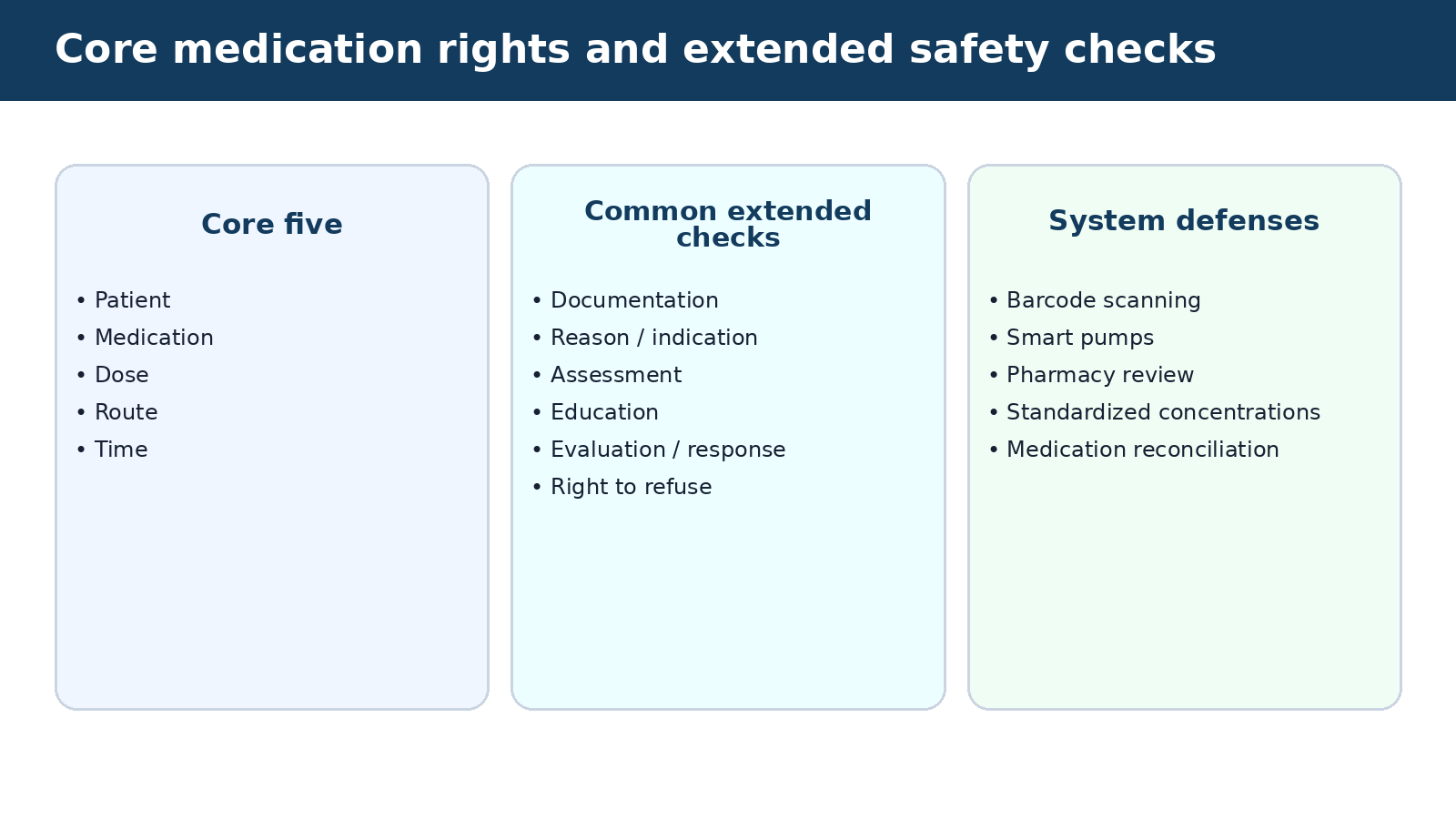
Direct answer: The five core medication rights are right patient, right medication, right dose, right route and right time. Many schools and hospitals add documentation, reason/indication, assessment, education, evaluation/response and the patient’s right to refuse. There is no single universal number of “rights.”
The “rights” are a memory aid, not a complete safety system. NCSBN® uses the phrase “rights of medication administration” in the 2026 test plan without defining one fixed number. Different schools and organizations teach five, six, seven, ten or more. Learners should understand the core concepts instead of arguing about the count.
Practical check: Treat the rights as questions that trigger thinking. For example, “right dose” includes more than matching the MAR: the nurse may need to verify weight, renal function, a maximum dose, concentration or a safe-dose calculation.
Avoid this mistake: A scanned barcode can confirm that a package matches the electronic record, but it cannot tell the nurse that the patient is newly hypotensive, cannot swallow safely or has a laboratory result that makes the dose unsafe.
NCLEX-RN® connection: A question may test a right indirectly. A low pulse before a rate-lowering medication is an assessment issue; an enteric-coated tablet ordered through a feeding tube is a formulation/route issue; a patient declining therapy is a rights, communication and documentation issue.
| Right or check | Plain-language meaning | Typical nursing question |
|---|---|---|
| Right patient | The medication is intended for this patient. | Do two approved identifiers match the MAR/order and the patient? |
| Right medication | The drug and formulation match the order. | Is this the correct generic/brand drug, concentration and formulation? |
| Right dose | The amount is appropriate and correctly calculated. | Does the ordered dose make sense for this patient and route? |
| Right route | The drug is being given by the ordered and safe route. | Can this formulation be given by this route? |
| Right time | Timing supports the order, therapeutic purpose and policy. | Is it due now, and does food/timing/lab monitoring matter? |
| Documentation | The record accurately shows what occurred. | What was given, withheld, refused or not given, and why? |
| Reason/indication | The drug has a valid purpose for this patient. | Why is the patient receiving it? |
| Assessment | Prerequisite data are checked. | Do blood pressure, pulse, glucose, labs or symptoms affect safety? |
| Education | The patient receives understandable information. | What does the patient need to know before self-management? |
| Evaluation/response | The nurse checks effect and harm. | Did the drug work and did an adverse effect occur? |
| Right to refuse | A capable patient may decline after informed discussion. | Has refusal been respected, assessed, explained and communicated? |
6. The three medication checks: a common educational safety workflow
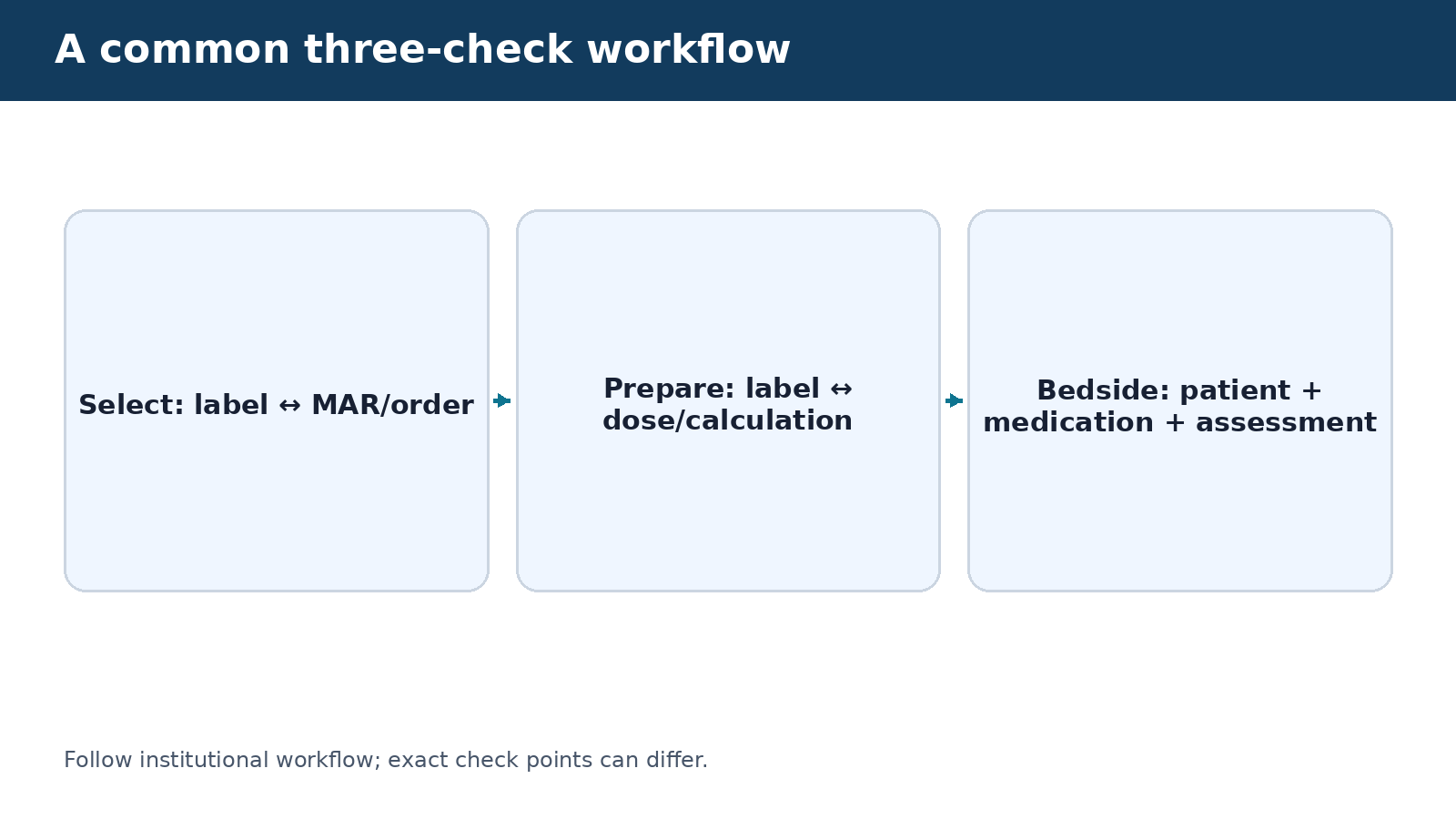
Direct answer: Many nursing programs teach three label-to-order checks: when the medication is obtained, during preparation, and immediately before administration or when returning the container. Exact workflow varies by institution, automation and packaging, so follow local policy.
The purpose of repeated checks is to catch selection and preparation errors at more than one point. The exact wording of the “three checks” is not a universal law and may look different with unit-dose packaging, automated dispensing cabinets or bedside barcode systems.
-
First comparison: match the medication label to the active MAR/order when selecting or removing the medication.
-
Second comparison: re-check the label, concentration, dose and patient while calculating or preparing the medication.
-
Final comparison: verify the medication again at the bedside or immediately before administration, including patient identifiers and any required assessment.
-
For controlled substances, high-alert drugs and waste, follow specific witnessing, documentation and storage procedures required by policy and regulation.
-
If the medication has been removed from original packaging or the label is not readable, do not guess what it is.
Practical check: The checks are most effective when the nurse is not interrupted and when each comparison is deliberate. If an interruption occurs during preparation, restart the safety check rather than relying on memory.
Avoid this mistake: Do not prepare medications for several patients together in unlabeled cups or syringes. Do not leave prepared medications unattended. Do not use a medication from a container with an incomplete or unclear label.
NCLEX-RN® connection: When an item asks which action is safest during preparation, the best answer usually preserves identification, verification, sterility when required and the ability to link the prepared medication to one patient and one order.
7. How to evaluate a medication order before giving it
Direct answer: Before giving a medication, confirm that the order is clear enough to execute safely and that it still makes sense for the patient’s current condition.
-
A complete order normally identifies the patient, medication, dose, route, timing/frequency and any parameters needed for safe use. PRN orders also need a clear indication and sometimes limits. Nurses should not invent missing information.
-
Check the medication name, dose, route and timing against the MAR and the original/current order when a discrepancy is suspected.
-
Question unclear abbreviations, ambiguous decimals, illegible instructions or a dose that is outside the expected range.
-
Review patient-specific factors: allergy, age, weight when relevant, kidney/liver function, pregnancy/lactation, swallowing, vascular access and current symptoms.
-
Review hold or titration parameters exactly as ordered. Do not create a personal threshold that is not in the order or policy.
-
When a medication seems unsafe, pause it and obtain clarification through the appropriate prescriber/pharmacy/chain-of-command process.
Practical check: A nurse is not expected to independently prescribe a replacement regimen. The nurse is expected to recognize a potentially unsafe order, prevent administration until it is clarified, communicate the concern and document clinically relevant actions.
Avoid this mistake: Avoid assuming that a computer-generated order is automatically correct. Also avoid refusing or withholding a medication indefinitely without appropriate escalation when the order needs prompt clarification.
NCLEX-RN® connection: The test plan explicitly includes evaluating appropriateness and accuracy of medication orders. Questions often provide one abnormal cue—such as renal dysfunction, bradycardia, low blood pressure or an allergy—that changes the safe action.
8. Pre-administration assessment: the data that can change a medication decision
Direct answer: The correct pre-medication assessment depends on the drug. The nurse should review only the information that is clinically relevant, but should not skip a required check.
Some medications can be given safely after routine verification. Others require a focused assessment, vital sign, point-of-care result or laboratory value. A student should learn the relationship between a medication class and the harm the nurse is trying to prevent.
Practical check: If a required value is missing, obtain it or clarify the plan before administering the drug when the missing information could change safety. One value should be interpreted with symptoms and trends, not in isolation.
Avoid this mistake: Do not memorize “hold rules” that are not tied to an order or guideline. A specific hold parameter can differ by medication, indication and patient.
NCLEX-RN® connection: Look for the assessment that directly relates to the medication’s most important expected effect or serious adverse effect.
| Medication type or situation | Examples of relevant checks | Why the check matters |
|---|---|---|
| Blood-pressure/heart-rate lowering therapy | Blood pressure, pulse, symptoms; ordered parameters | May worsen hypotension or bradycardia. |
| Insulin or glucose-lowering therapy | Current glucose, meal status, type/timing of insulin, symptoms | Mismatch can cause hypoglycemia or inadequate treatment. |
| Anticoagulant therapy | Bleeding assessment; ordered laboratory monitoring when applicable; renal function for some drugs | Bleeding risk and dosing/monitoring requirements differ by drug. |
| Opioid/sedating medication | Pain, respiratory status, sedation level, oxygenation and concurrent CNS depressants | Respiratory depression and oversedation are major safety risks. |
| Electrolyte replacement | Current electrolyte value, renal function, ECG/telemetry when indicated, IV access | Too little or too much replacement can be dangerous. |
| Nephrotoxic/hepatotoxic medication | Relevant renal/hepatic results and trends as ordered | Impaired clearance can increase toxicity. |
| Enteral medication | Swallowing ability or feeding-tube suitability; formulation | Aspiration or inappropriate crushing can cause harm. |
Pre-administration safety screen
- Confirm two identifiers and allergies
- Check indication, dose and calculation
- Review relevant vital signs, laboratory results and interactions
- Verify route, formulation and patient readiness
- Stop and clarify any unsafe finding before administration
9. Routes of medication administration: match the route, formulation and patient
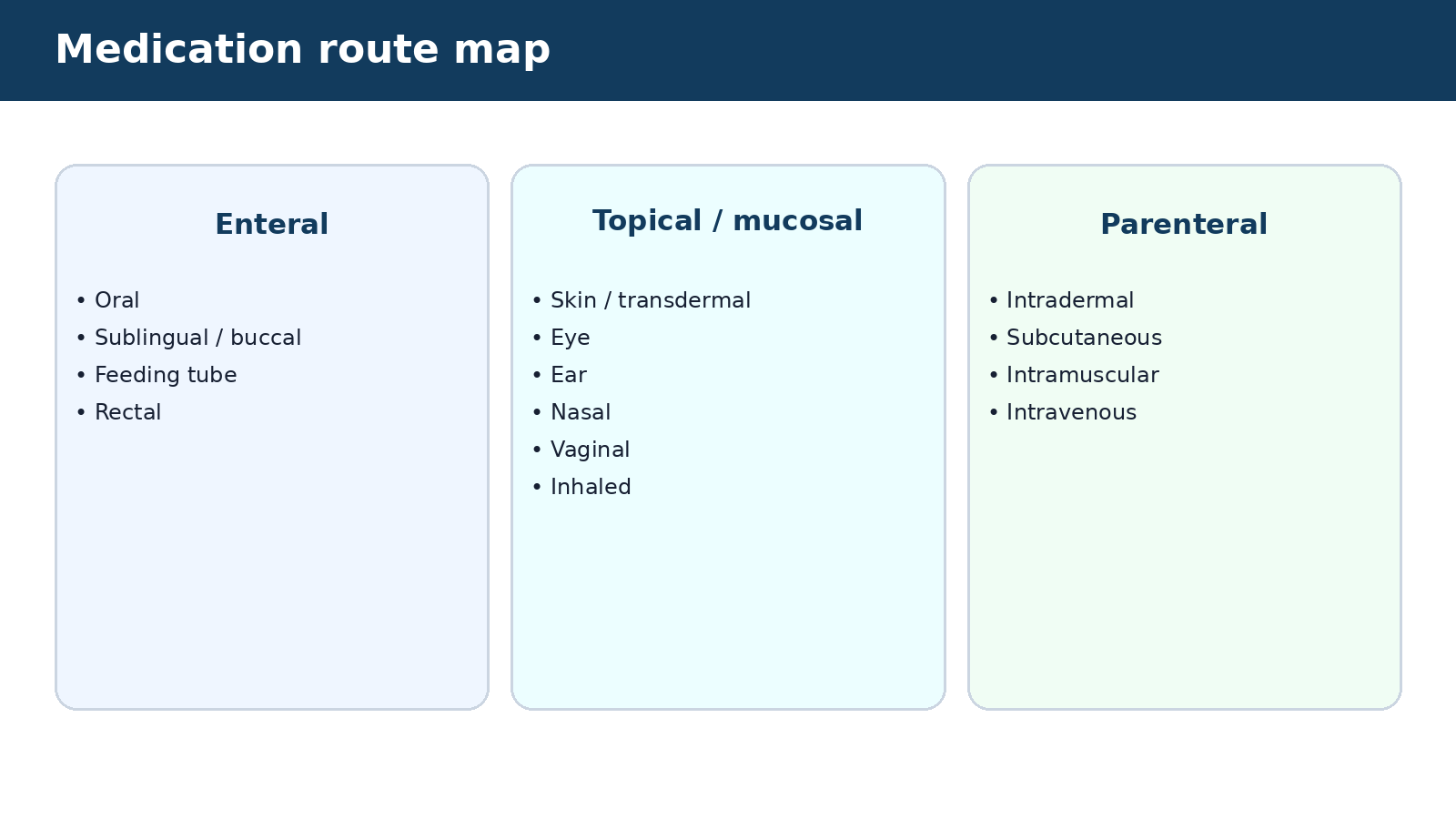
Direct answer: Common routes include oral, buccal, sublingual, enteral-tube, topical, transdermal, inhaled, ophthalmic, otic, rectal, vaginal, intradermal, subcutaneous, intramuscular and intravenous. Each route has unique safety checks.
Route is not simply where a medication is placed. Route affects absorption, onset, formulation, technique and risk. A medication formulated for one route may be dangerous by another route.
Practical check: When the ordered route is unsafe for the patient—for example, an oral medication in a patient with acute swallowing impairment—do not simply change the route. Hold and seek an appropriate order.
Avoid this mistake: Never assume an injectable medication can be given by any parenteral route. Wrong-route errors can cause catastrophic harm.
NCLEX-RN® connection: Route questions often test aspiration risk, formulation integrity, aseptic technique, line safety or whether the nurse must clarify an order before administration.
| Route | High-yield nursing considerations |
|---|---|
| Oral | Confirm swallowing ability; position safely; do not crush products that must remain intact; consider food timing if ordered. |
| Sublingual/buccal | Place in the ordered location and allow to dissolve as directed; do not automatically swallow or chew. |
| Feeding tube | Verify tube use per policy; confirm formulation can be crushed/opened; give medications separately when required; flush per policy and product guidance. |
| Topical/transdermal | Use gloves when indicated; remove old patches when appropriate; rotate sites; document patch location/time; avoid cutting patches unless product information permits. |
| Eye/ear | Avoid contaminating dropper tip; use correct organ and technique; age-specific ear technique may differ. |
| Inhaled | Assess technique; spacer/device instructions vary; sequence can matter when multiple inhalers are ordered. |
| Subcutaneous | Use an appropriate site and device; rotate sites for repeated injections; avoid areas that are bruised, scarred or otherwise unsuitable. |
| Intramuscular | Site and needle choice depend on age, muscle mass, medication volume and product instructions; avoid universal angle/length rules without context. |
| Intravenous | Verify concentration, compatibility, access, dilution and rate; use pump/drug library when required; monitor site and patient response. |
10. Oral and enteral medications: safe administration without damaging the formulation
Direct answer: Before crushing, opening or dissolving a medication, verify that the dosage form is designed for modification. Modified-release, enteric-coated and certain hazardous or specialized products may be unsafe to crush.
-
A feeding tube does not turn every tablet into a crushable medication. Crushing can destroy delayed-release or extended-release properties, change exposure, block a tube or expose staff to hazardous powder.
-
Use a current pharmacy/drug reference or manufacturer information to determine whether the product can be crushed, opened or dispersed.
-
Do not mix multiple medications together unless a reliable reference and policy specifically support that method.
-
Give tube medications separately when required and flush according to institutional policy, tube type, fluid restrictions and medication guidance.
-
Pause enteral nutrition only when the medication has a clinically meaningful feeding interaction or the order/reference requires separation.
-
Assess tube position/patency using the approved method for that device and setting. Do not rely on unsafe or outdated bedside tests.
Practical check: If a medication cannot be given safely through the current route, contact pharmacy/prescriber for an appropriate formulation or alternative plan.
Avoid this mistake: Do not use the phrase “crush all meds for NG tube” as a general rule. It is unsafe. Also do not assume a liquid formulation is automatically compatible with the tube or feeding.
NCLEX-RN® connection: A question may present an extended-release or enteric-coated product and test whether the nurse recognizes the need to clarify rather than crush.
11. Parenteral medication safety: injections and IV medications
Direct answer: Parenteral medications bypass part or all of the gastrointestinal tract, so errors can reach the circulation quickly. Correct preparation, aseptic technique, route verification and monitoring are essential.
-
Intradermal, subcutaneous, intramuscular and intravenous routes differ in tissue target, absorption and technique. Product instructions, patient age/body composition and institutional policy guide site, needle, volume and administration method.
-
Use aseptic technique and disinfect access points according to current policy and infection-prevention guidance.
-
Label prepared syringes immediately if they are not administered at once or if there is any chance they could be separated from the medication container.
-
Trace IV tubing from patient to source before connecting, disconnecting, programming or changing an infusion.
-
Check compatibility when medications share tubing or are administered into an existing infusion.
-
Use an infusion pump and approved drug library for medications that require controlled rates or standardized concentrations.
-
Never bypass a pump alert until the alert has been clinically evaluated.
Practical check: The nurse should know whether a drug is an irritant, vesicant or high-alert medication because that information affects access selection, monitoring and response to complications.
Avoid this mistake: Do not administer a medication IV push unless the formulation, dilution and rate are verified as appropriate. Do not assume that “slow IV push” means the same rate for all drugs.
NCLEX-RN® connection: The test plan includes common and parenteral routes, titration, high-risk drugs, IV monitoring, central venous devices and evaluation of patient response.
12. High-alert medications and independent double checks
Direct answer: High-alert medications are drugs that carry a greater risk of serious harm when used in error. The safest approach combines standardized processes, technology, clear labeling, dose limits and independent checks when policy requires them.
High-alert does not mean the medication is inherently bad. It means the consequences of an error can be severe. Common examples in acute care include insulin, anticoagulants, concentrated electrolytes, certain opioids, chemotherapy and some vasoactive infusions, but organizations maintain their own lists.
-
Follow the organization’s high-alert list and standardized concentration/dosing policy.
-
Use independent double checks only where they are required and useful. A true independent check means the second clinician performs the verification separately rather than simply agreeing with the first person.
-
Use smart-pump drug libraries and hard/soft limits as designed. A soft alert is not a suggestion to ignore automatically.
-
Separate look-alike/sound-alike products and use tall-man lettering or other system controls when provided.
-
For insulin and anticoagulants, verify the product, concentration, dose, patient-specific indication and relevant monitoring.
Practical check: The nurse’s strongest safety action is to recognize when a medication is high risk and slow down the process enough to perform every required verification.
Avoid this mistake: Do not create false reassurance by calling every medication a “double-check drug.” Excessive checking can become superficial. Use the policy-defined process correctly.
NCLEX-RN® connection: When a high-alert drug appears in a question, pay close attention to dose, units, concentration, route, pump programming, laboratory values and patient condition.
High-alert medication defense layers
- Use standardized orders and concentrations
- Assess patient-specific risks
- Complete an independent check when required
- Use barcode and smart-pump safeguards correctly
- Monitor the response and act on abnormal cues
13. Barcode medication administration and electronic safeguards
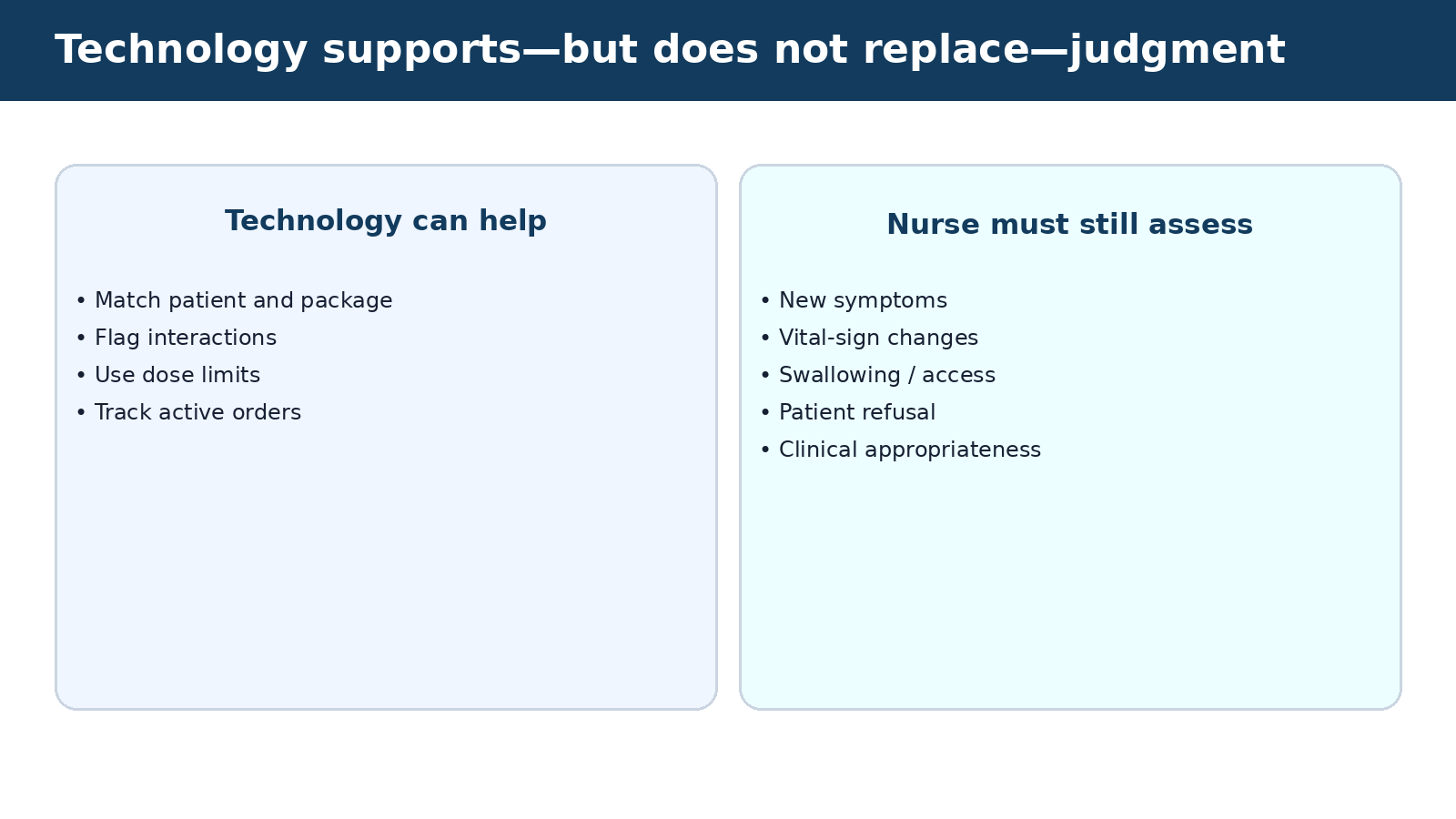
Direct answer: Barcode medication administration can reduce wrong-patient and wrong-medication errors when used correctly, but it does not replace assessment or clinical judgment.
-
Electronic medication administration records, barcode scanners, clinical decision support and smart pumps create valuable defenses. They also create new risks if users develop workarounds or become over-reliant on alerts.
-
Scan the patient’s approved identifier and the medication at the point of care according to workflow.
-
Investigate mismatch alerts instead of overriding them reflexively.
-
Do not use copied barcodes, scan medication away from the patient or document administration before it occurs.
-
Confirm that the electronic record reflects the most current order, especially after transfers, procedures or order changes.
-
If technology is unavailable, follow the organization’s approved downtime process rather than inventing a workaround.
Practical check: Technology is most powerful when it supports a sound manual safety process. If the screen and the patient tell different stories, reassess and resolve the discrepancy.
Avoid this mistake: Alert fatigue can make clinically important warnings easy to miss. Pause when an alert concerns allergy, dose, duplicate therapy, interaction or route.
NCLEX-RN® connection: Computer-based safety systems may appear in Management of Care, Pharmacological and Parenteral Therapies or Safety content. The safe answer preserves verification and patient assessment.
14. Medication reconciliation at transitions of care
Direct answer: Medication reconciliation compares the best possible current medication list with new orders at transitions such as admission, transfer and discharge so that omissions, duplications, interactions and unintended changes can be identified.
-
Medication discrepancies are common when patients move between home, emergency care, inpatient units, procedures and discharge. The nurse often helps collect an accurate medication history and identify discrepancies for resolution.
-
Ask about prescriptions, over-the-counter products, vitamins, supplements, inhalers, injections, patches, eye/ear drops and as-needed medications.
-
Record dose, route, frequency and what the patient actually takes, not only what appears on an old list.
-
Clarify recent starts/stops, duplicate brand/generic products, adherence problems and access barriers.
-
At discharge, compare the new list with the pre-admission list and clearly explain what is new, changed, continued and stopped.
-
Communicate unresolved discrepancies before the transition is complete.
Practical check: A “brown bag” approach—asking the patient to bring all medications and supplements—can improve the accuracy of the list when feasible. Pharmacy collaboration is valuable for complex regimens.
Avoid this mistake: Do not copy forward a medication list without verifying it. An old electronic list may contain medications that were discontinued months ago.
NCLEX-RN® connection: The 2026 test plan explicitly includes participation in medication reconciliation. Questions may ask which information is most important to clarify before discharge or transfer.
Medication reconciliation bridge
- Obtain the actual home medication list
- Compare with admission orders
- Reconcile at transfer
- Compare the discharge plan with prior therapy
- Explain the final list and changes with teach-back
15. Medication errors, near misses and adverse drug events: know the difference
Direct answer: A medication error is a preventable event that can lead to inappropriate medication use or patient harm. A near miss is caught before reaching the patient. An adverse drug event is harm related to medication use and may occur with or without an error.
-
The first priority after a suspected medication error is patient safety, not blame or paperwork. The nurse should assess the patient, limit ongoing exposure when appropriate, obtain needed help and follow the organization’s clinical and reporting process.
-
Assess the patient immediately for actual or potential harm and obtain relevant vital signs or focused assessment.
-
Stop or pause an ongoing medication/infusion when doing so is the safe immediate action and within protocol; do not remove an IV access device if it may be needed for treatment unless indicated.
-
Notify the appropriate prescriber, pharmacist and leadership/rapid-response resources based on the severity and local process.
-
Carry out monitoring or treatment orders promptly and evaluate the response.
-
Document clinical facts and patient response in the health record. Complete the safety/incident report separately according to policy.
-
Participate in disclosure and learning processes according to organizational policy and law.
Practical check: Near misses should also be reported through the safety system because they reveal weak points before someone is harmed.
Avoid this mistake: Do not alter the chart, hide the event, delay assessment while completing paperwork or place blame-focused language in the clinical record.
NCLEX-RN® connection: If a question asks what to do first after an error, choose the patient-focused assessment or immediate safety action before incident reporting.
Medication-error response
- Assess the patient and obtain urgent help when needed
- Stop ongoing exposure when clinically appropriate
- Carry out treatment and monitoring orders
- Document clinical facts and communicate promptly
- Complete safety reporting and participate in learning
16. Allergy, side effect, adverse effect and intolerance: use the right words
Direct answer: A side effect is a known secondary effect; an adverse effect is an unwanted harmful response; an allergy is an immune-mediated hypersensitivity reaction; an intolerance is an unpleasant effect that is not necessarily immune mediated.
-
Patients often use the word “allergy” for nausea, headache or other intolerance. The nurse should not delete a reported allergy casually, but should collect enough detail to help the team classify and manage the risk.
-
Ask what drug caused the reaction, what happened, how soon it happened, how severe it was and whether treatment was required.
-
Watch for emergency signs of severe hypersensitivity such as airway swelling, wheeze/bronchospasm, hypotension or widespread systemic symptoms.
-
Distinguish predictable side effects from serious toxicity so that the patient knows what can be monitored and what requires urgent help.
-
Document reactions clearly and update allergy information according to policy.
Practical check: The safest response to an unclear allergy history is to clarify and verify, not to assume the medication is safe or unsafe without investigation.
Avoid this mistake: Do not label every expected pharmacologic effect as an “allergy.” This can unnecessarily restrict treatment options. Conversely, do not minimize a history of anaphylaxis as a simple side effect.
NCLEX-RN® connection: Questions may ask which symptom represents an expected side effect versus a dangerous adverse reaction. Choose the finding with the greatest immediate safety implication.
17. Interactions and incompatibilities: medication-medication, food, disease and IV-fluid relationships
Direct answer: An interaction changes the effect or safety of a medication because of another drug, food, supplement, disease state or substance. An IV incompatibility is a physical or chemical problem when products are mixed in the same line or container.
-
Nurses do not need to memorize every possible interaction. They do need to recognize high-risk patterns and use a reliable current reference when the answer is not known.
-
Review the complete medication list, including OTC products and supplements.
-
Consider additive effects such as multiple sedating drugs, multiple blood-pressure-lowering drugs or multiple agents that increase bleeding risk.
-
Check renal/hepatic function when impaired clearance can increase exposure.
-
Verify IV compatibility for concurrent infusions, Y-site use and medication-fluid combinations using an approved compatibility reference.
-
Separate administration times when required by a verified interaction or absorption issue.
Practical check: When an interaction alert appears, determine its clinical significance. Some combinations are intentionally used with monitoring; others require an alternative plan.
Avoid this mistake: Do not tell patients to stop prescribed therapy solely because an interaction checker flags a combination. Escalate for clinical review.
NCLEX-RN® connection: The 2026 test plan directly includes identifying incompatibilities and monitoring interactions among medications and fluids.
18. Controlled substances: accountability, security and patient safety
Direct answer: Controlled substances require the same clinical assessment as other medications plus stricter storage, access, wasting and documentation controls under law and institutional policy.
Nurses may handle opioids and other controlled medications in many settings. The exact regulatory process varies by jurisdiction, but the safety principles are consistent: secure access, accurate counts, witnessed waste when required, timely documentation and prompt investigation of discrepancies.
-
Access only medications needed for assigned patient care and never share login credentials or access badges.
-
Record administration and waste accurately and promptly.
-
Follow witness requirements exactly. A witness should actually observe the required process rather than co-sign from memory.
-
Report inventory discrepancies, suspected diversion or tampering through the designated process.
-
Monitor the patient for therapeutic effect and serious adverse effects, particularly sedation and respiratory depression with opioids.
Practical check: Diversion is both a patient-safety and worker-health concern. A culture that encourages prompt reporting protects patients and staff.
Avoid this mistake: Do not “borrow” a controlled medication from another patient’s supply or carry an unused controlled medication in a pocket for later.
NCLEX-RN® connection: Questions may combine controlled-substance accountability with pain assessment, opioid safety, documentation or professional responsibility.
19. Patient education and the right to refuse
Direct answer: Patients need enough understandable information to participate in medication decisions. A capable patient may refuse a medication, even when the nurse believes it is beneficial.
Medication teaching works best as a conversation rather than a list of side effects. The nurse should explain the purpose, how to take/use the drug, major precautions, expected effects, important warning signs and monitoring needs in language the patient understands.
-
Ask what the patient already knows and what matters to them.
-
Use plain language and teach-back rather than asking only, “Do you understand?”
-
Explain important interactions, missed-dose instructions and storage only when they are relevant and verified for that medication.
-
If the patient refuses, explore the reason without coercion. Correct misunderstandings, address symptoms or access barriers, and notify the appropriate clinician when refusal changes the treatment plan.
-
Document the refusal, education and communication according to policy.
Practical check: Respect for autonomy does not mean walking away from a refusal. The nurse still assesses capacity, urgency, understanding and potential harm, then communicates appropriately.
Avoid this mistake: Do not threaten, shame or secretly administer a medication to a capable adult who has refused it. Emergencies and incapacity require legal and policy-based processes.
NCLEX-RN® connection: Patient rights, informed decision-making, teaching and documentation can all be tested within a medication scenario.
20. Medication administration in children, older adults and other high-risk situations
Direct answer: Medication risk rises when dosing, clearance, communication or physiologic reserve differs from the typical adult. Pediatric weight-based calculations and older-adult polypharmacy are especially important nursing concerns.
-
The safest approach is individualized. Age alone never tells the whole story. Children need accurate current weight and age-appropriate formulations. Older adults may have reduced renal function, multiple medications, altered sensitivity and higher fall risk.
-
Use kilograms for weight-based pediatric calculations and verify that the ordered dose is within the prescribed or referenced safe range.
-
Do not use household spoons for precise liquid dosing. Use an appropriate calibrated device.
-
Review renal function, cognition, swallowing, dexterity and ability to self-manage in older adults.
-
Look for duplicate therapies, anticholinergic burden, sedation, hypotension and drug-disease interactions in polypharmacy.
-
Use interpreters and accessible education formats when language, vision, hearing, literacy or cognition affects understanding.
Practical check: High-risk patients benefit from slower, more deliberate reconciliation and teaching, not simply more paperwork.
Avoid this mistake: Do not assume a child is a “small adult” or that an older adult should automatically receive a lower dose without a prescribing basis.
NCLEX-RN® connection: The test plan applies across the lifespan. When age/weight is provided, assume it is relevant until you have shown otherwise.
21. Documentation after medication administration
Direct answer: Document medication administration accurately after the medication is given, not before. Record clinically relevant omissions, refusals, PRN indication/effect and adverse responses according to policy.
-
Documentation is part of the medication safety cycle because it tells the next clinician what has already happened. Pre-charting can create dangerous duplicate dosing if the dose is delayed, refused or never given.
-
Record the medication, dose, route and time in the approved record.
-
For PRN medication, document the indication and later reassess/document the patient response within the expected timeframe and policy.
-
Record clinically important injection/patch/site information when the route requires it.
-
Document why a medication was withheld, omitted or refused and who was notified when that affects care.
-
Document adverse symptoms, assessment, interventions, notifications and patient response.
Practical check: The clinical record should contain patient-care facts. Safety-event reporting systems contain organizational learning information and are typically separate from the chart.
Avoid this mistake: Do not chart “incident report completed” in the medical record unless local policy specifically requires it. Do not use blame-focused language.
NCLEX-RN® connection: Communication and documentation is an integrated process in the 2026 test plan; the safest answer often includes reassessment and accurate documentation after the clinical priority is addressed.
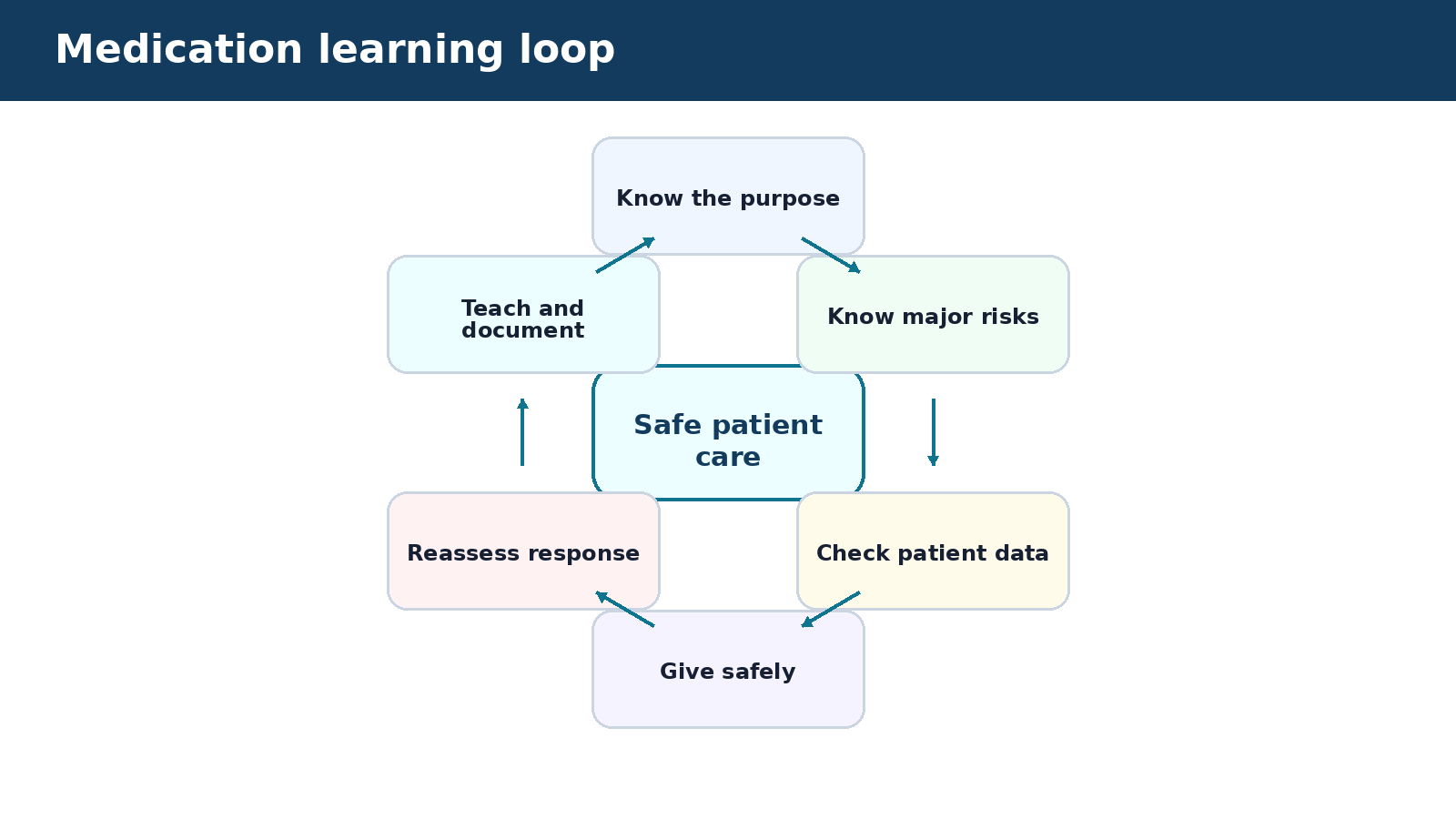
22. A bedside medication-administration checklist
Direct answer: A short bedside checklist can reduce omissions: identify, verify, assess, prepare, explain, administer, document and evaluate.
-
Checklists are most useful when they support thinking rather than replace it. The following sequence can be adapted to local policy.
-
Identify: two approved identifiers; allergy status; correct patient.
-
Verify: active order/MAR, drug, formulation, dose, route, time, indication and calculation.
-
Assess: relevant vital signs, symptoms, laboratory values, swallowing/access and contraindications.
-
Prepare: clean technique/asepsis, correct device, label, independent check if required, minimize interruptions.
-
Explain: purpose, key precautions and what the patient should report.
-
Administer: correct route and technique; scan/technology correctly; remain with the patient when appropriate.
-
Document: accurately after administration or document omission/refusal according to policy.
-
Evaluate: therapeutic effect, side/adverse effects, PRN response and need for escalation.
Practical check: The checklist should become faster with experience, but none of the safety logic disappears. Experts often perform the same checks more efficiently because they know which cue matters most.
Avoid this mistake: Rushing through the checklist without noticing a new clinical change defeats its purpose.
NCLEX-RN® connection: When unsure between two answers, choose the action that preserves patient identification, assessment, verification and the opportunity to prevent harm before the medication reaches the patient.
23. Clinical judgment cases
How to use the cases: Read the scenario once for the big picture. Then identify the most important cues, the priority concern, the safest immediate nursing actions, and the findings that would show whether the plan worked. These cases are original educational examples, not official examination items.
Case 1: Bradycardia before a scheduled medication
A patient is due for a scheduled medication that can lower heart rate. The MAR shows the usual dose. The current pulse is 48/min, the patient reports lightheadedness and the previous pulse was 72/min. The order includes patient-specific hold parameters.
| Clinical-judgment step | Reasoning |
|---|---|
| Recognize cues | New bradycardia, symptoms and a meaningful change from baseline are important cues. |
| Analyze cues | The scheduled drug may worsen the current hemodynamic problem. The hold parameters are directly relevant. |
| Prioritize hypotheses | Prevent symptomatic worsening while determining why the heart rate changed. |
| Generate solutions | Hold according to the existing parameters, perform focused assessment, review other relevant medications and notify the appropriate clinician. |
| Take action | Do not administer automatically because it is “scheduled.” Follow the ordered parameter and escalate the symptomatic change. |
| Evaluate outcomes | Reassess pulse, blood pressure, symptoms and response to any new plan or treatment. |
Remember: Medication timing never overrides a clinically important assessment cue.
Case 2: Insulin and a delayed meal
A patient has a premeal rapid-acting insulin dose ordered. The glucose result and dose have been verified, but the meal tray has been delayed and the patient says food may not arrive for another 45 minutes.
| Clinical-judgment step | Reasoning |
|---|---|
| Recognize cues | The timing of rapid-acting insulin and food availability are linked to hypoglycemia risk. |
| Analyze cues | Giving the dose without reliable carbohydrate availability may create avoidable harm. |
| Prioritize hypotheses | Prevent hypoglycemia while following the ordered insulin plan. |
| Generate solutions | Clarify timing per order/protocol, coordinate meal availability and monitor glucose/symptoms as appropriate. |
| Take action | Do not follow a clock-only approach if the meal-dependent conditions are not met. |
| Evaluate outcomes | Confirm the patient receives the intended nutrition and remains free of hypoglycemia. |
Case 3: Possible opioid oversedation
A postoperative patient received an opioid and is now difficult to arouse with slow, shallow respirations. The medication was documented correctly.
| Clinical-judgment step | Reasoning |
|---|---|
| Recognize cues | Decreased level of consciousness and respiratory depression after an opioid are emergency cues. |
| Analyze cues | The patient may be experiencing opioid-induced respiratory depression. |
| Prioritize hypotheses | Airway and breathing take priority over routine pain documentation. |
| Generate solutions | Stimulate/assess, support airway/ventilation, call for immediate help and follow the local emergency/opioid-reversal protocol. |
| Take action | Begin the emergency response rather than waiting for the next scheduled vital signs. |
| Evaluate outcomes | Monitor respiratory rate, depth, oxygenation, level of consciousness and recurrence because reversal may be shorter acting than the opioid. |
Case 4: Feeding-tube medication that should not be crushed
A patient with a feeding tube has a new extended-release tablet ordered. The tube is the only current enteral route and the patient cannot swallow tablets.
| Clinical-judgment step | Reasoning |
|---|---|
| Recognize cues | The dosage form and available route are incompatible with routine crushing. |
| Analyze cues | Crushing extended-release medication can destroy release characteristics and cause dose dumping or tube problems. |
| Prioritize hypotheses | Prevent an unsafe route/formulation administration. |
| Generate solutions | Hold the dose and contact pharmacy/prescriber for an appropriate formulation or route. |
| Take action | Do not crush the tablet simply to fit the tube. |
| Evaluate outcomes | Verify the revised order/formulation can be administered safely through the available route. |
Case 5: Medication mismatch during barcode scanning
At the bedside, the scanner warns that the medication package does not match the active MAR. The medication name looks similar to the ordered drug and the unit is busy.
| Clinical-judgment step | Reasoning |
|---|---|
| Recognize cues | A mismatch alert is a safety cue, especially with a look-alike/sound-alike product. |
| Analyze cues | The package may be the wrong drug, strength or patient-specific product, or the electronic record may be outdated. |
| Prioritize hypotheses | Prevent wrong-medication administration. |
| Generate solutions | Stop, compare the package with the order/MAR, verify dispensing information and involve pharmacy if unresolved. |
| Take action | Do not override the alert to save time. |
| Evaluate outcomes | Administer only after the discrepancy is resolved and the medication is confirmed. |
Case 6: Medication error discovered after administration
A nurse realizes that a medication was administered at the wrong dose. The patient is awake and currently denies symptoms.
| Clinical-judgment step | Reasoning |
|---|---|
| Recognize cues | A wrong-dose event occurred even though no harm is yet apparent. |
| Analyze cues | The patient may still develop delayed effects depending on the medication. |
| Prioritize hypotheses | Assess the patient and limit potential harm before completing administrative reporting. |
| Generate solutions | Perform focused assessment, obtain needed monitoring, notify the appropriate clinician/pharmacy and follow treatment/observation instructions. |
| Take action | Address the patient first and then complete the required safety report. |
| Evaluate outcomes | Continue monitoring for the expected time period and document the patient’s clinical response and communications. |
Go deeper: Apply the same approach to Next Generation NCLEX® case studies.
24. Practice questions with answers and rationales
Important: These are original RN Clarity practice questions. They are not copied from, endorsed by or affiliated with NCSBN® or the NCLEX® examination.
Question 1: Which action best reflects the purpose of medication-administration rights?
-
A. They replace the need for pharmacology knowledge.
-
B. They create a structured set of safety checks before and after administration.
-
C. They guarantee that an electronic order is correct.
-
D. They require the same number of checks in every institution.
Answer and rationale: B. The rights are a structured memory aid for safe verification. They do not replace assessment, drug knowledge, local policy or clinical judgment, and there is no universally fixed number of rights.
Question 2: A patient states, “Penicillin makes me nauseated, so I am allergic.” What is the nurse’s best first response?
-
A. Delete the allergy because nausea is never important.
-
B. Administer the medication because nausea is not anaphylaxis.
-
C. Clarify the exact drug, reaction, timing and severity before deciding how the information should be handled.
-
D. Label every antibiotic as an allergy.
Answer and rationale: C. The nurse should collect a specific reaction history. Nausea may represent intolerance rather than immune allergy, but the reported reaction must be clarified and managed safely rather than ignored.
Question 3: Which patient identifier is inappropriate as one of the two identifiers before medication administration?
-
A. Full name
-
B. Date of birth
-
C. Medical record number
-
D. Room number
Answer and rationale: D. Physical location is not a reliable patient identifier. Use two identifiers approved by the organization, such as name plus date of birth or medical record number.
Question 4: A barcode scanner produces a mismatch alert. What should the nurse do first?
-
A. Override the alert if the package looks familiar.
-
B. Stop and resolve the discrepancy before administration.
-
C. Ask the patient whether the medication looks correct.
-
D. Document the medication as given and investigate later.
Answer and rationale: B. A mismatch is a safety signal. The nurse should verify the package, order/MAR and patient information before the drug reaches the patient.
Question 5: Which action is safest when an ordered tablet is labeled extended release and the patient requires medications through a feeding tube?
-
A. Crush the tablet very finely.
-
B. Dissolve it in hot water.
-
C. Hold the dose and verify an appropriate formulation or route with pharmacy/prescriber.
-
D. Mix it with all other medications to reduce tube flushes.
Answer and rationale: C. Extended-release products often should not be crushed. The nurse should verify product-specific guidance and obtain an appropriate formulation or route.
Question 6: A patient refuses a scheduled medication after the nurse explains its purpose. What is the best nursing action?
-
A. Hide it in food.
-
B. Respect the refusal, explore the reason, communicate important consequences and document/notify as appropriate.
-
C. Tell the patient refusal is not allowed in the hospital.
-
D. Discard it without documenting.
Answer and rationale: B. A capable patient can refuse treatment. Nursing responsibilities include respectful assessment, education, communication and documentation.
Question 7: When should medication administration generally be documented?
-
A. Before removing the medication from storage.
-
B. Before entering the patient room.
-
C. After the medication is actually administered, or as the organization directs for omitted/refused doses.
-
D. Only at the end of the shift.
Answer and rationale: C. Pre-documenting can falsely show a dose was given and create duplicate-dosing risk if administration does not occur.
Question 8: Which statement about high-alert medications is correct?
-
A. They are medications that should never be used.
-
B. They have a heightened risk of serious harm when used in error.
-
C. They always require the same double-check process worldwide.
-
D. They can be given safely without patient assessment if a smart pump is used.
Answer and rationale: B. High-alert medications are necessary drugs whose errors may cause serious harm. Safety systems and local policies determine required controls.
Question 9: A nurse is interrupted halfway through preparing several medications. What is the safest approach?
-
A. Continue from memory.
-
B. Restart the relevant verification steps before administration.
-
C. Ask another nurse to sign that the medications are correct without checking.
-
D. Skip barcode scanning because the labels were already seen.
Answer and rationale: B. Interruptions increase selection and preparation errors. Re-performing the verification protects the patient.
Question 10: Which finding is most important before administering a medication known to lower blood pressure?
-
A. Favorite food
-
B. Current blood pressure and symptoms
-
C. Last bowel movement if unrelated
-
D. Shoe size
Answer and rationale: B. Pre-administration data should be clinically linked to the medication’s effect and risks.
Question 11: Which action is appropriate after discovering a wrong-dose medication error?
-
A. Complete the incident report before seeing the patient.
-
B. Assess the patient and take immediate safety actions, then notify and report according to policy.
-
C. Delete the medication entry.
-
D. Wait for symptoms before telling anyone.
Answer and rationale: B. Patient assessment and prevention/treatment of harm come first. Reporting and organizational learning follow promptly.
Question 12: Which statement best describes medication reconciliation?
-
A. Counting controlled medications at shift change.
-
B. Comparing the patient’s actual medication list with new orders at transitions of care.
-
C. Checking only prescription medications at discharge.
-
D. Replacing the medication MAR with the patient’s home list.
Answer and rationale: B. Medication reconciliation identifies omissions, duplications and unintended changes by comparing the best possible current list with orders at transitions.
Question 13: Which practice is unsafe when administering IV medications?
-
A. Tracing tubing from patient to source.
-
B. Checking compatibility for shared tubing.
-
C. Using the smart-pump drug library when required.
-
D. Assuming all IV medications may be given as a rapid IV push.
Answer and rationale: D. IV push suitability, dilution and rate are drug specific. Some medications must never be pushed or require controlled infusion.
Question 14: What is the best way to verify an unfamiliar medication-food interaction?
-
A. Rely on a social-media post.
-
B. Use a current approved drug reference or pharmacist.
-
C. Guess based on the drug name.
-
D. Avoid all food with every medication.
Answer and rationale: B. Interaction information is medication specific and should be checked in a reliable current source.
Question 15: Which action demonstrates a true independent double check?
-
A. The second nurse watches the first nurse calculate and agrees.
-
B. Two nurses calculate or verify separately, then compare results.
-
C. The first nurse tells the second nurse the expected answer before checking.
-
D. Both nurses sign without reviewing the medication.
Answer and rationale: B. Independence reduces confirmation bias because the second clinician forms a separate verification before comparison.
Question 16: Which statement about PRN medication documentation is best?
-
A. Only the administration time matters.
-
B. The indication and later response should be documented as required by policy.
-
C. PRN medications do not require reassessment.
-
D. The patient decides whether documentation is needed.
Answer and rationale: B. PRN use should show why the medication was needed and whether it produced the intended response or an adverse effect.
Question 17: A medication order is unclear and could be interpreted as two different doses. What should the nurse do?
-
A. Choose the smaller dose.
-
B. Choose the dose used yesterday.
-
C. Clarify the order before administration.
-
D. Ask the patient which dose seems right.
Answer and rationale: C. The nurse should not guess missing or ambiguous prescribing information.
Question 18: Why is an exact current weight important for many pediatric medications?
-
A. Children always need adult doses divided by two.
-
B. Many pediatric doses are weight based, so an inaccurate weight can create a dosing error.
-
C. Weight is used only for dietary planning.
-
D. The dose does not depend on units.
Answer and rationale: B. Weight-based dosing requires an accurate weight, typically in kilograms, and a verified safe-dose range when appropriate.
Question 19: Which action is appropriate with a transdermal patch?
-
A. Apply a new patch without checking for the old one.
-
B. Document the site and time when relevant and remove prior patches as ordered/product-specific.
-
C. Cut every patch to reduce the dose.
-
D. Place over broken skin to improve absorption.
Answer and rationale: B. Patch safety includes checking for old patches, using appropriate skin sites and following product-specific instructions. Many patches must not be cut.
Question 20: Which statement best reflects clinical judgment during medication administration?
-
A. If the MAR is correct, the dose must be given.
-
B. The nurse integrates the order with the patient’s current assessment and relevant data before acting.
-
C. Clinical judgment is needed only after an error occurs.
-
D. Medication administration is a technical task that is separate from assessment.
Answer and rationale: B. The 2026 test plan explicitly links medication administration to assessment, contraindications, lab data, interactions and evaluation of response.
Go deeper: Continue with NCLEX-RN® practice questions.
25. Frequently asked questions
How many medication rights should a nursing student learn?
Know the five core rights—right patient, medication, dose, route and time—and understand common extended safety rights such as documentation, reason/indication, assessment, education, evaluation/response and the patient’s right to refuse. The number taught varies; NCSBN® does not prescribe one universal count.
What are the three medication checks?
Many programs teach comparing the medication label with the order/MAR when selecting the medication, during preparation, and immediately before administration or when returning the container. Exact workflow varies with packaging and technology, so follow institutional policy.
Can a nurse hold a medication?
A nurse may need to withhold or delay a medication when ordered parameters, patient assessment, allergy, contraindication or an unclear/unsafe order makes administration inappropriate. The nurse should follow the order/policy and communicate promptly; the nurse should not invent new prescribing parameters.
Should all extended-release or enteric-coated tablets be crushed for a feeding tube?
No. Many should not be crushed. Verify the specific formulation in a current pharmacy/drug reference and obtain an alternative formulation or route when necessary.
Does barcode scanning replace the two-identifier check?
No. Barcode systems are an additional safety layer. Use approved patient identifiers and follow the organization’s bedside scanning process.
What should a nurse do first after a medication error?
Protect the patient: assess for harm and take any immediate safety actions. Then notify the appropriate clinicians, carry out monitoring/treatment, document patient-care facts and complete the safety report according to policy.
What is a high-alert medication?
A high-alert medication is one that has a heightened risk of causing serious patient harm when used in error. Organizations maintain lists and safeguards for these medications.
Can a patient refuse a medication?
A capable patient generally has the right to refuse. The nurse should assess the reason, provide clear information, respect the decision, notify as appropriate and document the refusal and education.
When should PRN medication effectiveness be reassessed?
Within a timeframe appropriate to the medication, route, condition, expected onset and institutional policy. There is no single universal minute value for all PRN medications.
What does medication reconciliation include?
Prescription drugs, OTC products, supplements, inhalers, injections, patches, drops and as-needed products, including what the patient actually takes. The list is compared with new orders at transitions.
Why do medication questions often include laboratory results?
Because renal/hepatic function, electrolytes, coagulation results, drug levels or other tests may change medication safety, dosing or monitoring. The nurse should connect the lab to the drug rather than memorizing unrelated values.
Is this guide a substitute for a drug reference?
No. Use a current drug reference, pharmacist, manufacturer information, local formulary and institutional policy for drug-specific doses, preparation, compatibility, routes and monitoring.
26. Official and primary references
Sources checked September 10, 2026. Use the linked guidance for the full context and follow patient-specific orders, scope of practice and local policy.
-
2026 NCLEX-RN® Test Plan — Official test-plan blueprint and medication/parenteral activity statements.
-
Medication Errors and Adverse Drug Events - AHRQ PSNet — Patient-safety overview of medication errors and safety strategies.
-
Medication Administration Errors - AHRQ PSNet — Administration-error risks and prevention principles.
-
Designing the Medication Reconciliation Process - AHRQ — Medication reconciliation framework.
-
FDA Route of Administration standard — Official route terminology reference.
-
FDA Infusion Pumps — Infusion pump safety information relevant to IV medication delivery.
-
CDC Preventing Unsafe Injection Practices — Injection safety and single-use needle/syringe principles.
27. Educational, clinical-safety and trademark disclaimer
Educational and clinical-safety disclaimer: This guide is provided by RN Clarity for general educational and informational purposes. It does not replace the official 2026 NCLEX-RN® Test Plan, nursing-school instruction, a current drug or clinical reference, provider orders, nursing regulator requirements, institutional policy, manufacturer instructions, local infection-control guidance or professional clinical judgment. Real patients may have conditions, medications, allergies, laboratory results, age-related needs or other factors that require a different approach. When a patient may be deteriorating, follow local emergency and escalation procedures. Use of this guide does not guarantee examination success or clinical competence. Non-affiliation and trademark notice: RN Clarity is an independent educational resource and is not affiliated with, endorsed by, sponsored by, approved by or officially connected with the National Council of State Boards of Nursing, Inc. NCLEX®, NCLEX-RN®, NCLEX-PN® and NCSBN® are registered trademarks of the National Council of State Boards of Nursing, Inc. All trademarks belong to their respective owner. Their use here is for identification, commentary and educational reference only.