Vital Signs for Nurses Guide
Interpret temperature, pulse, respirations, blood pressure, orthostatic findings, oxygen saturation and vital-sign trends.
1. Quick Answer and Essential Facts
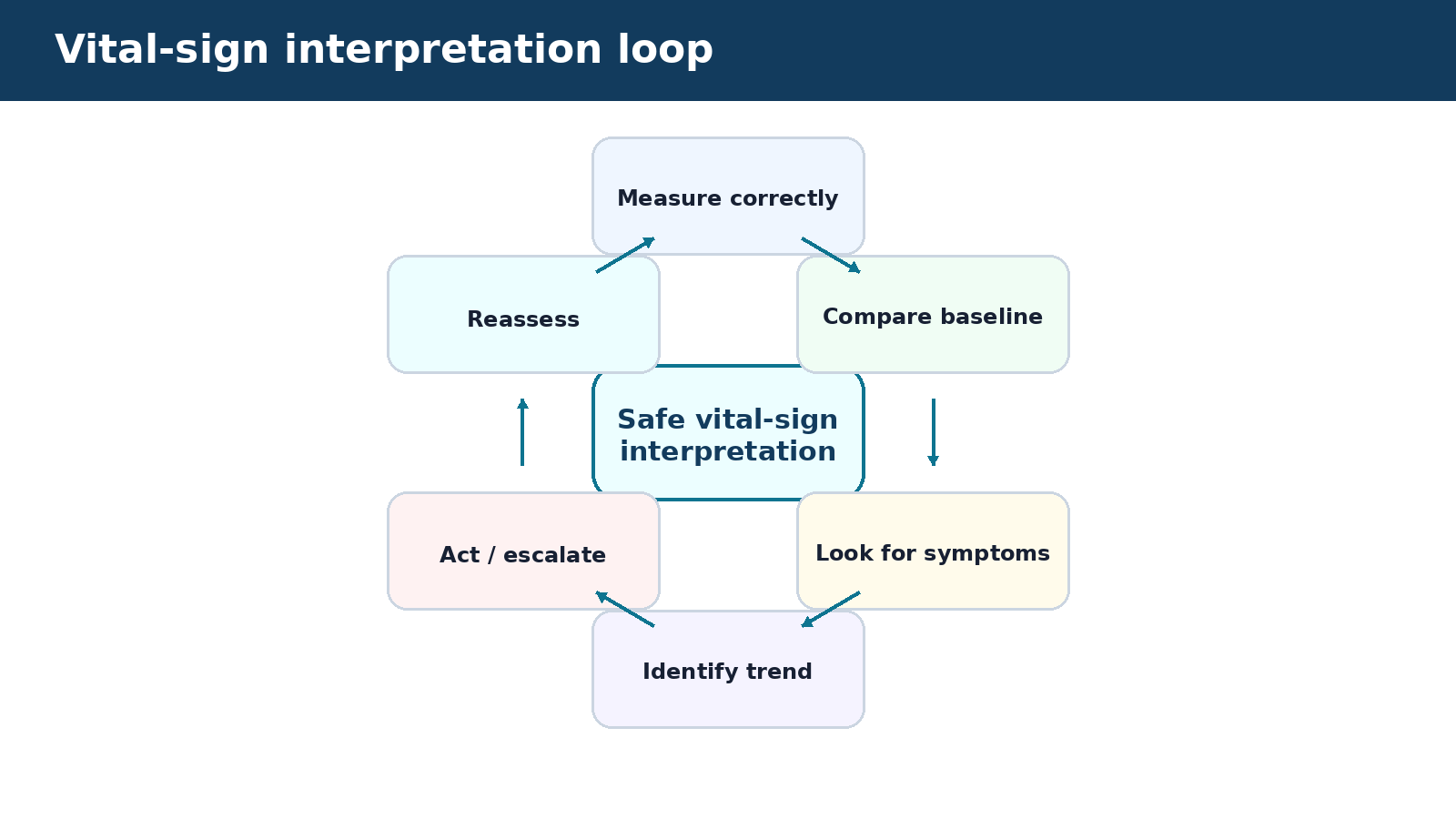
Direct answer: Vital signs are useful only when they are measured correctly and interpreted in context. Nurses should compare temperature, pulse, respirations, blood pressure and oxygen saturation with the patient’s baseline and trend, assess symptoms, verify questionable measurements and escalate clinically important change.
Vital Signs for Nurses: Normal Ranges, Abnormal Findings and Clinical Interpretation is designed as a practical reference for nursing students and new nurses. It explains the topic in plain language, then connects that knowledge to assessment, safety, clinical judgment, documentation and patient teaching. The goal is not to replace an instructor, drug reference, institutional policy or clinical guideline. The goal is to help the learner understand why a safe nurse makes one decision rather than another.
-
Start with the patient, not the task. A technically correct action can still be unsafe if the patient is unstable, the order is unclear, the route is wrong, or the situation has changed.
-
Use trends and the whole clinical picture. One number, one symptom or one device alarm should rarely be interpreted in isolation.
-
Verify unfamiliar information in a current authoritative source. Nursing practice changes, products differ and local policies may be more restrictive than a general study guide.
-
Document what you assessed, what you did, how the patient responded and what you communicated when those details are clinically relevant.
NCLEX-RN® connection: Vital-sign trends are explicitly included in Reduction of Risk Potential and are integrated across medication safety, physiologic adaptation, assessment and clinical judgment in the April 2026 NCLEX-RN® Test Plan.
Go deeper: Use active learning methods to turn reading into recall and application.
2. How this topic fits the April 2026 NCLEX-RN® Test Plan
The 2026 NCLEX-RN® Test Plan is effective from April 1, 2026 through March 31, 2029. The examination organizes nursing practice around Client Needs, while six integrated processes run through every content area: caring, clinical judgment, communication and documentation, culture and spirituality, nursing process, and teaching/learning. Most questions require application or higher-level thinking rather than simple recall.
-
Reduction of Risk Potential: monitor and evaluate trends in vital signs and focused assessments.
-
Physiological Adaptation: recognize signs of acute deterioration, oxygenation and perfusion problems.
-
Pharmacological and Parenteral Therapies: use vital signs to evaluate medication safety and response.
-
Clinical Judgment: connect changes over time to hypotheses, actions and outcomes.
Practical check: A good study method therefore asks more than 'What is the fact?' Ask: What is the important cue? What could harm the patient? What additional assessment is needed? What can the nurse do now? What requires an order or escalation? What outcome would show improvement?
NCLEX-RN® connection: Expect the same fact to appear in different forms: a stand-alone question, a priority question, a calculation, a medication-safety question, a matrix or multiple-response item, or an unfolding clinical-judgment case.
Go deeper: Connect these topics to the 2026 NCLEX-RN® test plan.
3. A simple clinical-judgment method to use throughout the guide
Direct answer: Use the six clinical-judgment steps as a mental safety loop: recognize cues, analyze cues, prioritize hypotheses, generate solutions, take action, and evaluate outcomes.
Clinical judgment is not a separate subject that begins only when a case study appears. It is the way a nurse connects information to safe action. The 2026 NCLEX-RN® Test Plan names six measurable steps. Learners should practise using them during routine topics so that the process becomes automatic.
-
Recognize cues: identify the data that matter now, including symptoms, vital signs, laboratory results, medications, devices and trends.
-
Analyze cues: connect the findings. Decide which findings support the same problem and which may be unrelated.
-
Prioritize hypotheses: compare possible explanations by urgency, likelihood and risk if care is delayed.
-
Generate solutions: identify reasonable nursing actions, expected outcomes and people who may need to be involved.
-
Take action: choose the safest action that addresses the highest-priority problem within scope and policy.
-
Evaluate outcomes: reassess. Improvement, deterioration or no change tells the nurse whether the plan is working.
Avoid this mistake: Do not force every question into a rigid mnemonic. Airway, breathing and circulation are powerful priorities when they are truly threatened, but an immediate safety threat, severe bleeding, hypoglycemia, seizure activity or another time-sensitive problem may demand action first.
NCLEX-RN® connection: In case studies, new information can change the priority. Re-read the current data rather than staying attached to an earlier hypothesis.
Go deeper: Build your reasoning with the clinical judgment guide.
4. Vital signs are measurements plus interpretation
Direct answer: Vital signs are temperature, pulse, respiratory rate and blood pressure; oxygen saturation is commonly included in modern bedside monitoring, and pain is often assessed alongside them. The nurse must verify measurement quality, compare with the patient’s baseline and trend, assess symptoms and act on clinically important change.
-
A single “normal range” is never enough. Age, pregnancy, medications, sleep, pain, fever, exercise, altitude, chronic lung disease and measurement technique can change results.
-
Confirm the reading is technically reliable.
-
Compare with baseline and previous values.
-
Look for concordant symptoms and other physiologic signs.
-
Recognize direction and speed of change.
-
Repeat abnormal measurements when appropriate without delaying treatment for obvious deterioration.
NCLEX-RN® connection: The 2026 test plan specifically includes monitoring vital-sign trends and responding to changes in patient condition.
5. Common adult resting reference points—and why they are not universal
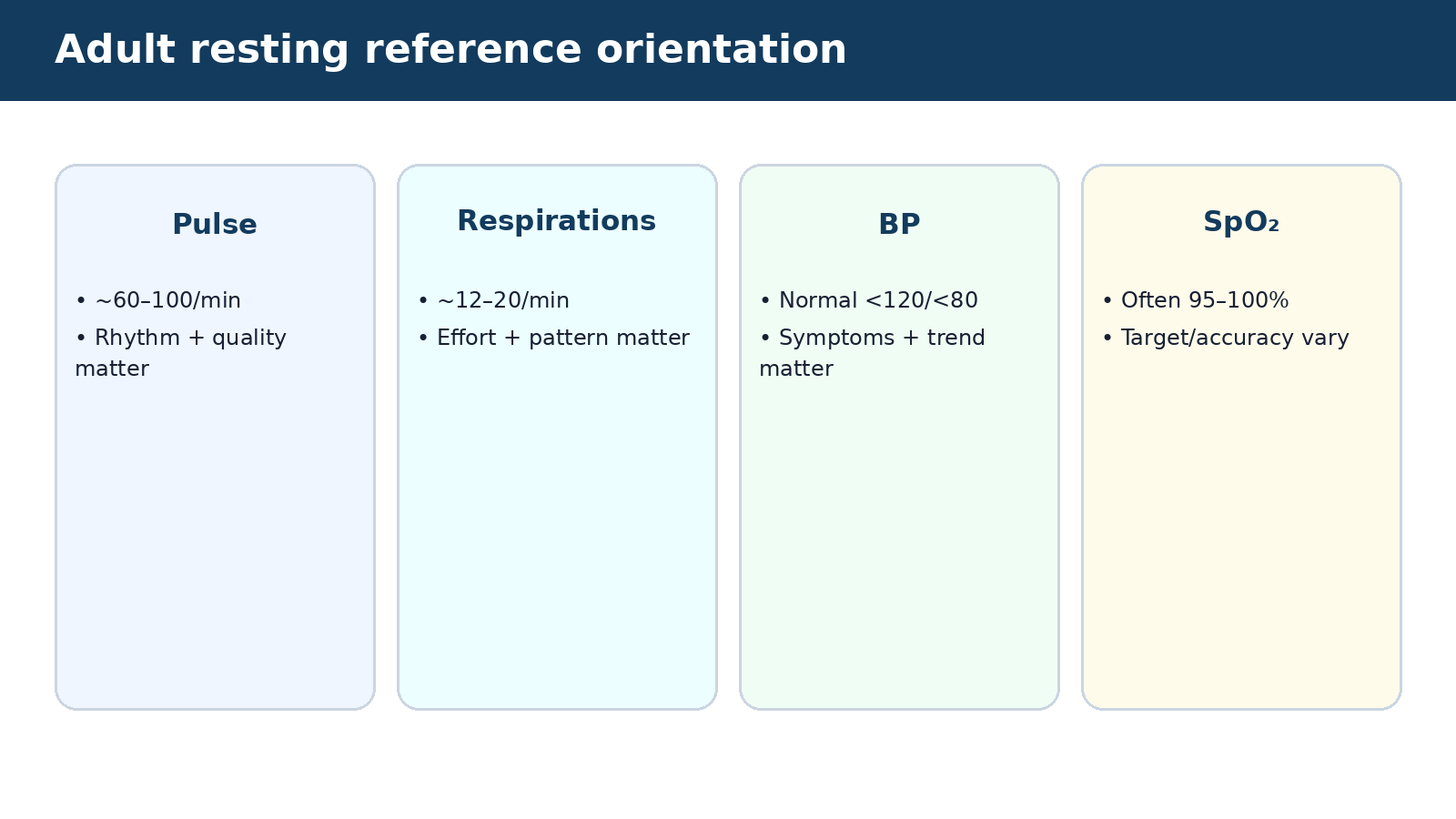
Use these as orientation points, not universal treatment thresholds. Pediatric ranges vary strongly with age, and pregnancy/critical illness may require different targets.
| Measure | Common resting adult reference | Important qualification |
|---|---|---|
| Temperature | About 36.5–37.3 °C (97.7–99.1 °F) in one MedlinePlus adult reference | Method/site and time of day affect values; fever thresholds depend on method/context. |
| Pulse | About 60–100 beats/min | Athletes, medications and conduction disease may alter baseline. |
| Respirations | Often about 12–20 breaths/min | Count actual respirations; do not rely only on monitor display. |
| Blood pressure | Normal category <120/<80 mm Hg in AHA classification | A single office value does not diagnose chronic hypertension. |
| SpO₂ | Often 95–100% at sea level in healthy people | May be lower with lung disease/altitude; device limitations matter. |
6. Temperature: measurement, fever and hypothermia
-
Temperature reflects heat production and loss but varies by measurement site/device. Oral, tympanic, temporal, axillary and rectal measurements are not interchangeable without context.
-
Know the device/site and document it when relevant.
-
A fever is a clinical clue, not a diagnosis; evaluate the patient and source.
-
Older adults and immunocompromised patients may have serious infection without a high fever.
-
Hypothermia can impair coagulation, cardiac rhythm and mental status.
-
Trend response after antipyretic, warming or treatment rather than recording one value only.
Avoid this mistake: Do not automatically add or subtract a fixed degree to convert one site to another; use device-specific guidance.
Temperature interpretation
- Measure temperature with the correct device and site
- Compare with baseline and symptoms
- Consider fever, hypothermia and atypical presentation
- Assess the possible cause and reassess after intervention
7. Pulse and heart rate
-
Assess rate, rhythm and quality. The apical rate may be needed when rhythm is irregular, in selected pediatric situations or before certain medications according to policy.
-
Tachycardia can reflect fever, pain, dehydration, hypoxia, anemia, anxiety, medications, arrhythmia and many other causes.
-
Bradycardia can be normal in trained athletes or caused by medications, conduction disease, hypothermia or neurologic conditions.
-
An irregular pulse may require ECG evaluation rather than simple rate counting.
-
Pulse deficit and poor peripheral pulses can indicate perfusion problems.
Practical check: Treat the patient, not the number. A heart rate of 55 in an asymptomatic athlete differs from 55 with syncope and hypotension.
8. Respiratory rate: often the earliest warning sign
-
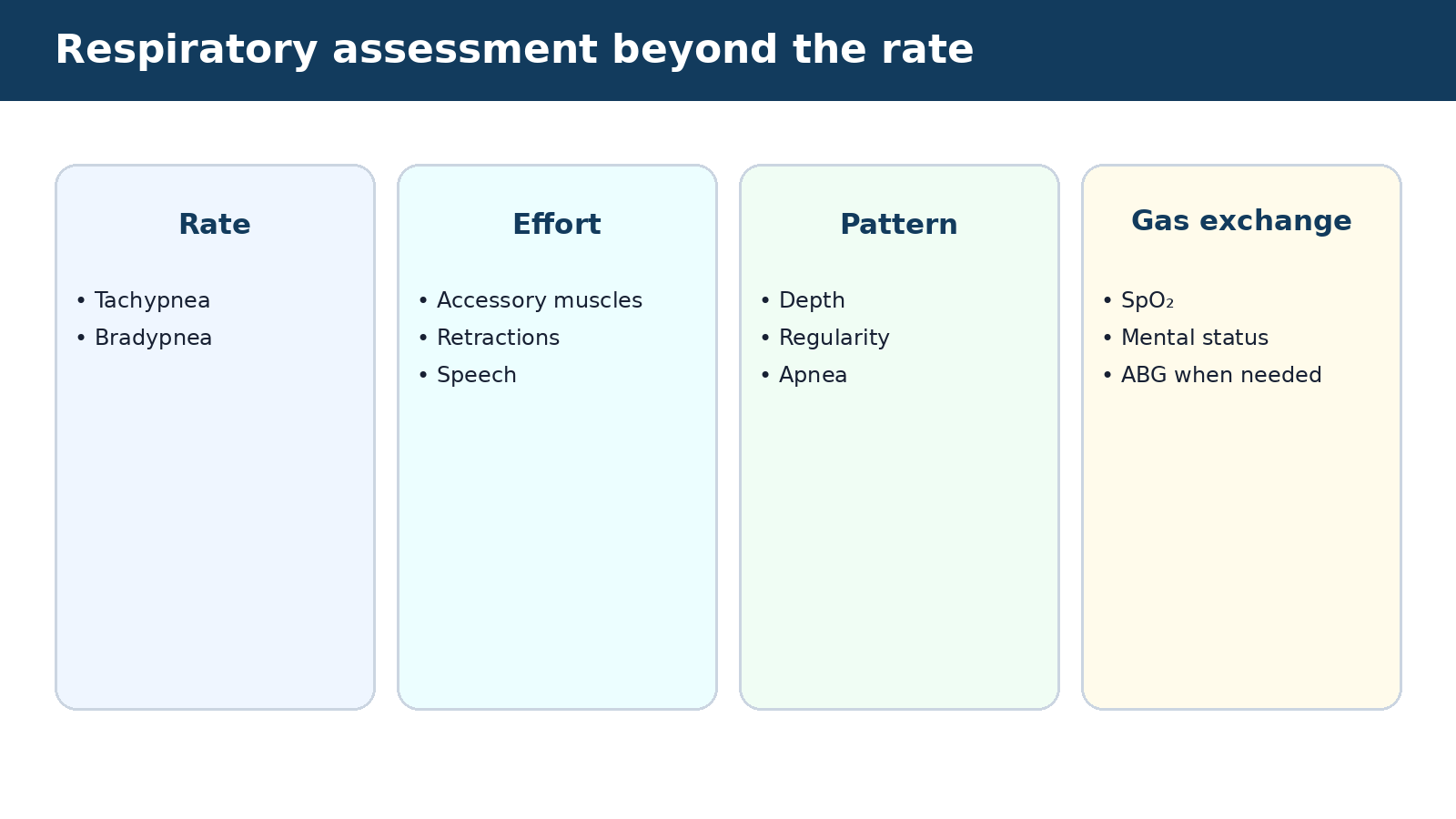
Respiratory rate should be counted without prompting the patient to change their breathing. Rate alone is insufficient; also observe depth, effort, pattern, speech, accessory-muscle use, breath sounds and mental status.
-
Tachypnea can accompany hypoxemia, metabolic acidosis, fever, pain, sepsis, anxiety and pulmonary disease.
-
Bradypnea may occur with opioids/sedatives, neurologic injury, fatigue or other causes.
-
A “normal” SpO₂ does not rule out dangerous hypoventilation, especially with supplemental oxygen.
-
Sudden increased work of breathing is an emergency cue even before SpO₂ falls.
NCLEX-RN® connection: Clinical judgment often depends on recognizing respiratory pattern and trend before severe deterioration.
9. Blood pressure: technique matters
-
Incorrect cuff size, arm position, talking, recent activity, unsupported posture and automated-device limitations can distort blood pressure.
-
Use an appropriately sized cuff on the recommended site.
-
Position the arm at heart level when feasible.
-
Allow appropriate rest before routine measurement when the situation permits.
-
Repeat an unexpected reading manually or with another validated method when appropriate.
-
Assess symptoms and perfusion when pressure is unexpectedly high or low.
Avoid this mistake: Do not delay emergency treatment to obtain a perfect routine blood-pressure technique when the patient is clearly unstable.
Blood-pressure measurement reliability
- Confirm patient and allow appropriate rest
- Use the correct cuff size and positioning
- Measure using the approved technique
- Verify an unexpected result without delaying urgent care
- Interpret symptoms, baseline and trends
10. Interpreting blood pressure categories
AHA adult categories commonly define normal as less than 120 systolic and less than 80 diastolic; elevated as 120–129 and less than 80; stage 1 as 130–139 or 80–89; and stage 2 as at least 140 or at least 90. These categories describe chronic cardiovascular risk and are not a substitute for evaluating acute symptoms.
Practical check: Acute hypotension, shock and hypertensive emergencies are clinical syndromes. Symptoms, organ perfusion and rate of change matter.
Avoid this mistake: Do not diagnose chronic hypertension from one isolated reading in a nursing study scenario unless the case explicitly supports it.
11. Orthostatic vital signs
Direct answer: Orthostatic assessment compares blood pressure and pulse after supine rest and after standing. A commonly used consensus definition of orthostatic hypotension is a fall in systolic pressure of at least 20 mm Hg or diastolic pressure of at least 10 mm Hg within 3 minutes of standing.
Technique and patient safety are critical. CDC STEADI specifies five minutes lying down, a supine blood pressure and pulse, then blood pressure and pulse at one and three minutes after standing. Record symptoms at each stage. If the patient is unsafe to stand, do not force the test.
-
Assess fall risk before standing.
-
Ask about dizziness, weakness, visual change or near-syncope.
-
Record position and timing with each measurement.
-
Interpret pulse response, hydration, medications and symptoms.
Orthostatic assessment
- Have the patient lie down for five minutes
- Measure supine blood pressure and pulse
- Assist the patient to stand only if safe
- Repeat blood pressure and pulse at one and three minutes
- Record position, timing and symptoms; stop if unsafe
12. Pulse oximetry: useful but imperfect
Direct answer: Pulse oximetry estimates arterial oxygen saturation noninvasively. Typical readings in healthy people at sea level are often 95–100%, but individual targets differ.
-
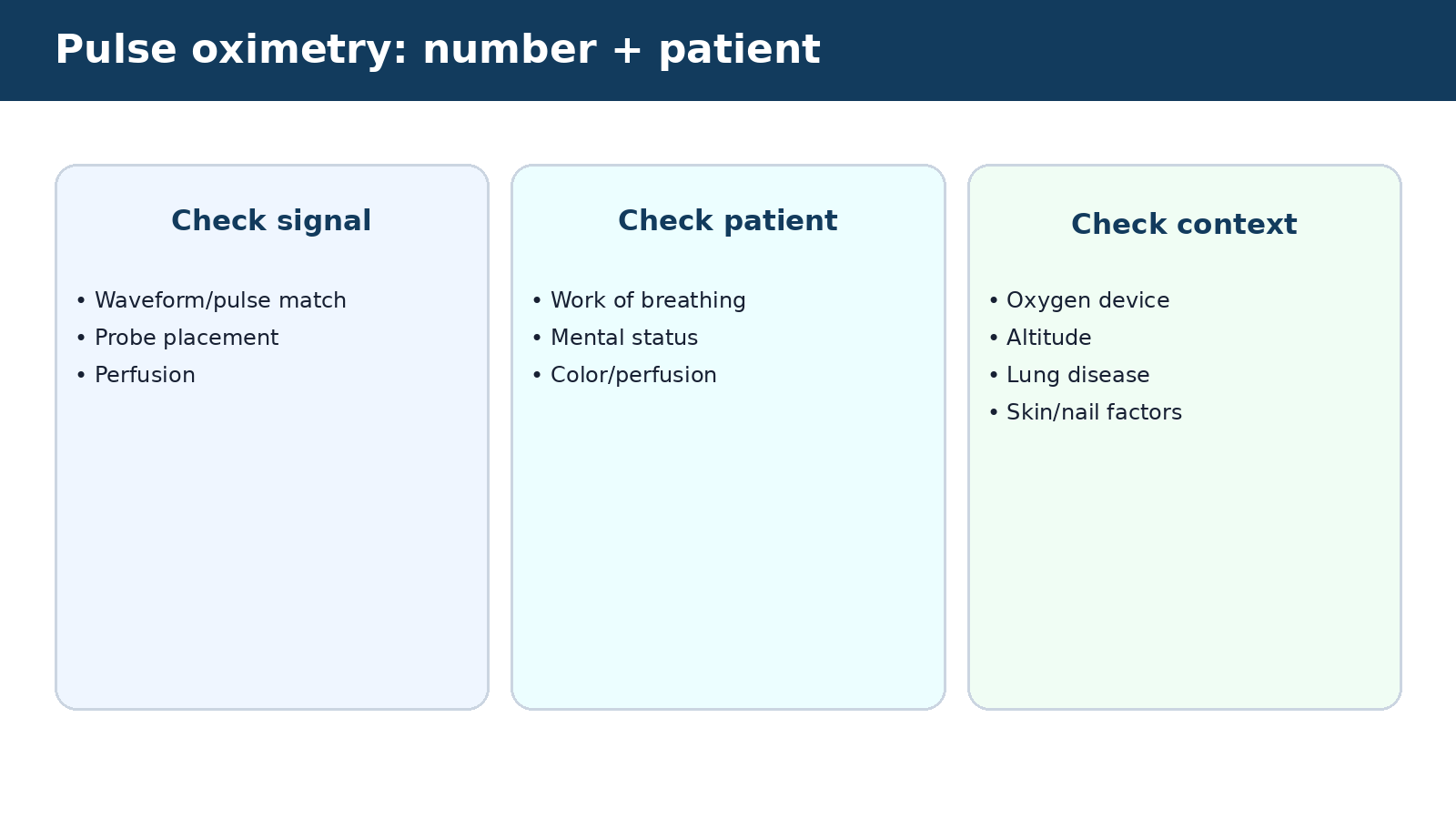
FDA notes that accuracy can be affected by poor circulation, skin pigmentation, skin thickness/temperature, tobacco use, nail polish and other factors. Device readings must be interpreted with symptoms and the clinical situation.
-
Check signal quality and probe placement.
-
Warm/reposition a poorly perfused finger when appropriate.
-
Compare the reading with work of breathing and mental status.
-
Escalate discordance between the device and the patient.
-
An ABG or other evaluation may be required when precise oxygenation/ventilation information is needed.
Avoid this mistake: Do not assume a reassuring SpO₂ excludes hypercapnia or respiratory failure.
13. Pain and other bedside observations
-
Pain is subjective and should be assessed using an appropriate validated scale and the patient’s report when possible. It is not a substitute for physiologic assessment.
-
Assess location, quality, severity, timing, triggers and associated symptoms.
-
Reassess after intervention.
-
Behavioral scales may be needed when self-report is not possible.
-
Sudden severe pain with abnormal vital signs can signal an emergency.
14. Trend interpretation: the direction can matter more than the absolute value
-
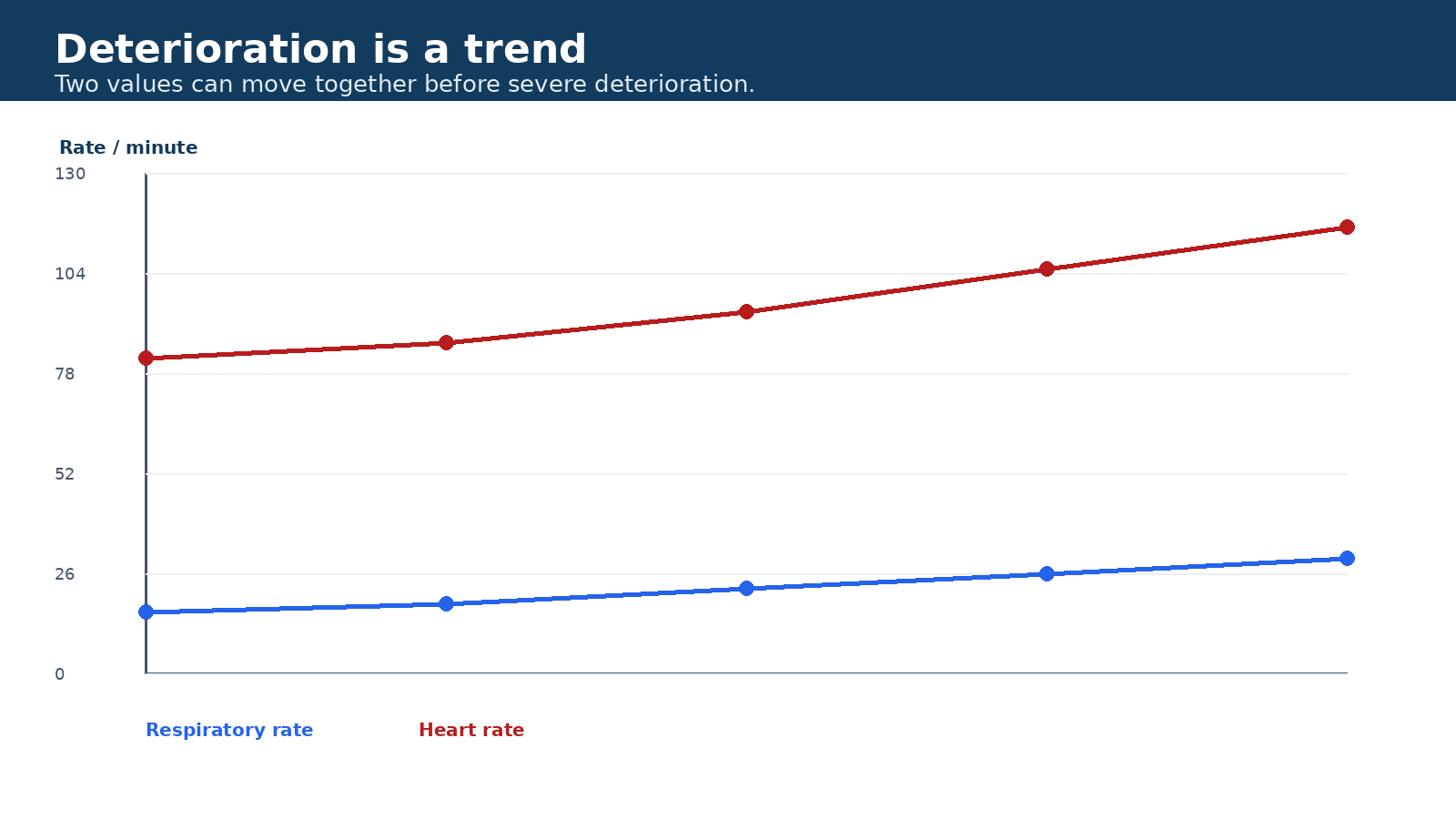
Deterioration often appears as a cluster: rising respiratory rate, increasing heart rate, falling pressure, altered mental status, reduced urine output or changing oxygen requirement.
-
Compare current values with baseline and recent measurements.
-
Ask what changed before the trend began—medication, procedure, fluid loss, infection, mobility or device change.
-
Escalate when multiple systems point toward deterioration even if each number alone is only mildly abnormal.
Practical check: A repeat measurement should answer a clinical question, not become a way to postpone action.
15. Pediatric vital signs
-
Children have age-dependent heart-rate, respiratory-rate and blood-pressure expectations. A single adult range must never be applied to infants and children.
-
Use age-specific reference ranges from the current pediatric clinical source used by the organization.
-
Observe work of breathing, perfusion, behavior and hydration.
-
Measure blood pressure with a correctly sized cuff.
-
In children, compensation can mask serious illness until deterioration becomes rapid.
Avoid this mistake: Avoid memorizing one pediatric table as universal across all textbooks and institutions; ranges and awake/asleep definitions differ.
16. Pregnancy and postpartum vital-sign interpretation
-
Pregnancy produces physiologic changes in heart rate, blood volume and vascular tone. Postpartum patients can deteriorate from hemorrhage, hypertension, thromboembolism or infection even when early signs are subtle.
-
Trend symptoms and bleeding with vital signs.
-
Severe headache, visual changes, chest pain, dyspnea, seizures or severe hypertension require urgent evaluation.
-
Tachycardia with falling pressure and increasing bleeding raises concern for hemorrhage.
17. Older adults and atypical presentation
Older adults may have lower baseline temperature, blunted fever response, medication-related bradycardia or orthostatic changes. New confusion, weakness or functional decline may accompany acute illness.
Practical check: Compare with baseline and do not use absence of fever to dismiss infection.
18. When an abnormal vital sign requires escalation
-
Verify accuracy quickly when appropriate.
-
Assess airway, breathing, circulation, neurologic status and symptoms.
-
Look for reversible immediate causes.
-
Use the facility early-warning/rapid-response process when criteria or clinical concern are met.
-
Communicate the trend, not only the latest number.
-
Reassess after every intervention.
Avoid this mistake: Do not “chart and move on” when a value indicates possible deterioration.
Escalation pathway
- Assess the patient and immediate life threats
- Make a rapid technical check when appropriate
- Start indicated emergency actions and call for help without delay
- Communicate the value, trend and symptoms
- Reassess and document the response
19. Documentation and handoff
-
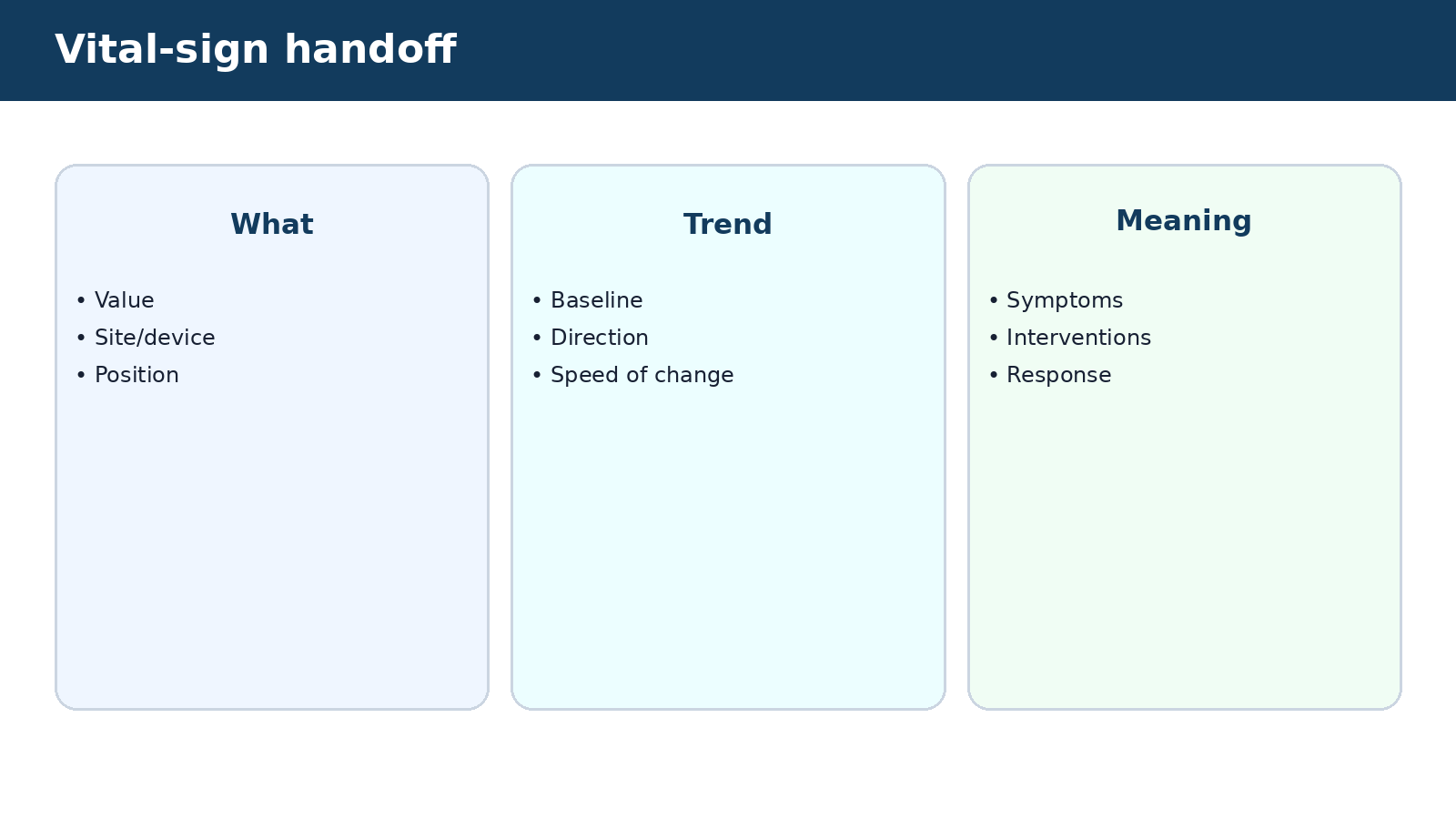
Document the measurement, relevant site/position/device, abnormal symptoms, interventions, notification and patient response when clinically important.
-
“BP 82/48, supine, automated left arm; patient dizzy on standing” is more useful than “BP low.”
-
Communicate oxygen device and flow/FiO₂ with SpO₂.
-
Report trends and time sequence.
-
Record repeat measurements and response after intervention.
20. Clinical judgment cases
How to use the cases: Read the scenario once for the big picture. Then identify the most important cues, the priority concern, the safest immediate nursing actions, and the findings that would show whether the plan worked. These cases are original educational examples, not official examination items.
Case 1: Rising respiratory rate after surgery
Four hours after abdominal surgery, respirations rise from 16 to 28/min, heart rate from 82 to 108/min, SpO₂ falls from 97% to 92%, and the patient is increasingly restless.
| Clinical-judgment step | Reasoning |
|---|---|
| Recognize cues | Coordinated respiratory and cardiovascular deterioration with mental-status change. |
| Analyze cues | Pain alone is possible, but hypoventilation, atelectasis, pulmonary embolism, bleeding or other complications must be considered. |
| Prioritize hypotheses | Airway/breathing assessment and urgent evaluation. |
| Generate solutions | Assess work of breathing, lungs, oxygen delivery, circulation, pain/sedation and surgical findings; escalate. |
| Take action | Do not simply document the numbers or give more opioid without assessment. |
| Evaluate outcomes | Trend RR, SpO₂, mental status, HR/BP and response to treatment. |
Case 2: Low SpO₂ with cold fingers
A comfortable patient has SpO₂ 82% on a finger probe but is speaking full sentences, has warm central skin and no distress; the waveform is poor and fingers are cold.
| Clinical-judgment step | Reasoning |
|---|---|
| Recognize cues | Severe displayed desaturation with poor signal and discordant clinical appearance. |
| Analyze cues | The reading may be inaccurate, but true hypoxemia must still be excluded. |
| Prioritize hypotheses | Verify measurement while assessing the patient. |
| Generate solutions | Reposition/warm or change site/device, assess respiratory status and repeat; escalate if low reading persists or symptoms appear. |
| Take action | Do not ignore the reading or treat the number blindly without verification. |
| Evaluate outcomes | Confirm reliable signal and consistent oxygenation assessment. |
Case 3: Orthostatic dizziness
After five minutes supine, BP is 128/76. Three minutes after standing it is 104/64 and the patient feels lightheaded.
| Clinical-judgment step | Reasoning |
|---|---|
| Recognize cues | Systolic drop of 24 and diastolic drop of 12 with symptoms. |
| Analyze cues | This meets a commonly used orthostatic hypotension definition and creates fall risk. |
| Prioritize hypotheses | Prevent fall and assess cause. |
| Generate solutions | Assist safely to sitting/lying, review hydration/medications/bleeding and notify as indicated. |
| Take action | Do not tell the patient to walk it off. |
| Evaluate outcomes | Symptoms resolve and contributing causes are addressed. |
Case 4: Fever absent in an older adult with infection
An older adult is newly confused, weak and tachypneic. Temperature is 37.2 °C.
| Clinical-judgment step | Reasoning |
|---|---|
| Recognize cues | Acute mental-status and respiratory changes despite no high fever. |
| Analyze cues | Older adults may have serious infection without marked fever. |
| Prioritize hypotheses | Evaluate acute deterioration rather than dismissing infection. |
| Generate solutions | Assess vitals/trends, oxygenation, hydration, infection sources and escalate. |
| Take action | Do not use normal temperature as proof there is no infection. |
| Evaluate outcomes | Identify cause and trend response. |
Case 5: Blood pressure after antihypertensive medication
One hour after a scheduled medication, BP is 86/50 and the patient is dizzy and pale.
| Clinical-judgment step | Reasoning |
|---|---|
| Recognize cues | Symptomatic hypotension after medication. |
| Analyze cues | Medication effect, volume depletion or another acute cause may be contributing. |
| Prioritize hypotheses | Perfusion and fall prevention. |
| Generate solutions | Keep patient safe, assess ABCs, repeat/verify BP, review medications and fluid status, notify/escalate. |
| Take action | Do not allow unassisted ambulation. |
| Evaluate outcomes | BP, symptoms and perfusion improve. |
Case 6: Opioid patient with normal SpO₂ but slow respirations
A patient on supplemental oxygen after opioid administration has SpO₂ 98% but respirations 7/min and is difficult to arouse.
| Clinical-judgment step | Reasoning |
|---|---|
| Recognize cues | Severe hypoventilation and depressed consciousness despite a normal SpO₂. |
| Analyze cues | Supplemental oxygen can preserve saturation while ventilation fails. |
| Prioritize hypotheses | Airway and ventilation. |
| Generate solutions | Stimulate/assess, call for urgent help, support ventilation/airway and use reversal protocol/orders as indicated. |
| Take action | Do not be reassured by SpO₂ alone. |
| Evaluate outcomes | Respiratory rate, ventilation, consciousness and oxygenation improve. |
Go deeper: Apply the same approach to Next Generation NCLEX® case studies.
21. Practice questions with answers and rationales
Important: These are original RN Clarity practice questions. They are not copied from, endorsed by or affiliated with NCSBN® or the NCLEX® examination.
Question 1: Which vital-sign change may be an early sign of deterioration?
-
A. A rising respiratory rate
-
B. A stable pulse for three days
-
C. A normal temperature
-
D. A repeated identical BP with no symptoms
Answer and rationale: A. Respiratory-rate changes often precede more obvious deterioration and must be interpreted with the whole patient.
Question 2: What should the nurse do with an unexpected BP of 78/42 in a pale, dizzy patient?
-
A. Document it and recheck tomorrow
-
B. Assess the patient immediately and escalate while verifying as appropriate
-
C. Ignore it if the cuff is automated
-
D. Have the patient walk to improve circulation
Answer and rationale: B. Symptomatic hypotension can indicate poor perfusion and requires immediate assessment.
Question 3: Which SpO₂ statement is correct?
-
A. A normal SpO₂ always proves ventilation is adequate
-
B. Pulse oximetry has limitations and must be interpreted clinically
-
C. Nail polish and perfusion never affect readings
-
D. All patients require a target of exactly 100%
Answer and rationale: B. Pulse oximetry is useful but imperfect; targets and accuracy vary.
Question 4: Which is a common adult resting pulse reference?
-
A. 10–20/min
-
B. 60–100/min
-
C. 120–160/min for all adults
-
D. Exactly 80/min
Answer and rationale: B. A common resting adult reference is approximately 60–100 beats/min, though individual baseline matters.
Question 5: What is essential when documenting orthostatic vitals?
-
A. Only the final BP
-
B. Position and timing with symptoms
-
C. Room number
-
D. The patient’s breakfast choice
Answer and rationale: B. Orthostatic interpretation depends on position, timing and symptoms.
Go deeper: Continue with NCLEX-RN® practice questions.
22. Frequently asked questions
What are the main vital signs?
Temperature, pulse, respiratory rate and blood pressure; oxygen saturation is commonly included in bedside monitoring.
What is a normal adult respiratory rate?
A common resting reference is about 12–20 breaths/min, but interpret age, condition and trend.
What is a normal adult pulse?
A common resting reference is about 60–100 beats/min, with important individual exceptions.
What is normal blood pressure?
AHA adult classification calls less than 120 systolic and less than 80 diastolic normal, but one reading does not diagnose chronic hypertension.
What is a normal SpO₂?
Often 95–100% in healthy people at sea level; individual targets and device accuracy vary.
What is orthostatic hypotension?
A commonly used definition is a fall of at least 20 mm Hg systolic or 10 mm Hg diastolic within 3 minutes of standing.
Can normal SpO₂ hide respiratory failure?
Yes. Supplemental oxygen can maintain saturation while hypoventilation and carbon-dioxide retention worsen.
Should an abnormal vital sign always be repeated before action?
Verify unexpected readings when appropriate, but never delay treatment or escalation for obvious clinical deterioration.
Are pediatric vital signs the same as adults?
No. Heart rate, respiratory rate and blood pressure vary substantially by age.
How does NCLEX-RN® 2026 test vital signs?
Through trend interpretation, focused assessment, medication safety, deterioration recognition and clinical judgment.
23. Official and primary references
Sources checked September 10, 2026. Use the linked guidance for the full context and follow patient-specific orders, scope of practice and local policy.
-
2026 NCLEX-RN® Test Plan — Official vital-sign trend and focused-assessment activities.
-
MedlinePlus Vital Signs — General adult reference values.
-
American Heart Association Blood Pressure Categories — Current adult BP categories.
-
MedlinePlus Pulse Oximetry — General SpO₂ interpretation.
-
FDA Pulse Oximeter Basics — Limitations and factors affecting accuracy.
-
CDC STEADI Orthostatic Blood Pressure — Orthostatic measurement approach.
24. Educational, clinical-safety and trademark disclaimer
Educational and clinical-safety disclaimer: This guide is provided by RN Clarity for general educational and informational purposes. It does not replace the official 2026 NCLEX-RN® Test Plan, nursing-school instruction, a current drug or clinical reference, provider orders, nursing regulator requirements, institutional policy, manufacturer instructions, local infection-control guidance or professional clinical judgment. Real patients may have conditions, medications, allergies, laboratory results, age-related needs or other factors that require a different approach. When a patient may be deteriorating, follow local emergency and escalation procedures. Use of this guide does not guarantee examination success or clinical competence. Non-affiliation and trademark notice: RN Clarity is an independent educational resource and is not affiliated with, endorsed by, sponsored by, approved by or officially connected with the National Council of State Boards of Nursing, Inc. NCLEX®, NCLEX-RN®, NCLEX-PN® and NCSBN® are registered trademarks of the National Council of State Boards of Nursing, Inc. All trademarks belong to their respective owner. Their use here is for identification, commentary and educational reference only.