Free classroom kit · NGN scoring

NGN Partial-Credit Workshop

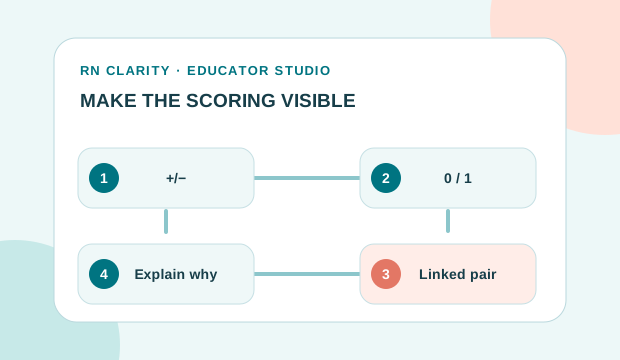
Three interactive scoring demonstrations, learner calculations and worked keys for +/−, 0/1 and a linked-pair rationale rule.

30-minute sessionFree · No loginPDF + editable HTML
Original visual overview of NGN Partial-Credit Workshop

What learners will do

Observable learning outcomes

  • Calculate a plus/minus item score with a floor of zero.
  • Distinguish a prescribed-count 0/1 example from an unrestricted-selection example.
  • Explain why both elements of a linked pair must be correct in the paired-rationale example.

Suggested session flow

  1. 0–5 minExplain that the examples demonstrate scoring rules, not live NCLEX item wording.
  2. 5–15 minCalculate the plus/minus examples before using the interactive demonstration.
  3. 15–23 minCompare 0/1 and linked-pair examples.
  4. 23–30 minDiscuss evidence-based option selection and complete the exit ticket.

Try the three scoring rules

Non-clinical demonstrations make the arithmetic visible. Work the handout first, then check your calculation here.

1 · +/−: select all even numbers

Key: 2, 4 and 8. Select any number of options.

2 · 0/1: select exactly two colours

Traditional RYB paint-colour key: red and blue.

3 · Linked-pair rationale

The shape is supplied. Select its defining statement; both elements must match for the pair point.

Ready for learners

Learner handout

Complete the activity before opening the worked key.

NGN Partial-Credit Workshop · Learner handout

RN Clarity · Free teaching kit · 2026 NCLEX-RN alignment

Read the rule before calculating

These fictional non-clinical items isolate the arithmetic. Actual items require clinical reasoning and instructions. A practice-item raw score is not an NCLEX pass probability. The exam uses an adaptive measurement process; do not turn this workshop into a pass-prediction calculator.

Exercise A · Plus/minus

Instruction: select all even numbers in 2, 3, 4, 7 and 8. The key is 2, 4 and 8. There is no prescribed selection count. Each selected key option earns one point; each selected incorrect option subtracts one. The item score cannot be negative and cannot exceed three.

SelectionsCorrect selectedIncorrect selectedScore out of 3
2, 4, 8__________________
2, 3, 4__________________
2, 3, 7__________________
2, 3, 4, 7, 8__________________
No options__________________

Exercise B · Zero/one

Instruction: select exactly two primary colours from red, green, blue and orange, using the traditional red-yellow-blue paint-colour set specified for this exercise. The key is red and blue. Each correctly selected key option earns one point; an incorrect choice earns zero. The maximum is two.

SelectionsPoints for each selectionScore out of 2
Red and blue____________
Red and green____________
Green and orange____________

Exercise C · Linked-pair rationale

Match the shape to its defining statement: triangle → has three sides; square → has four equal sides and four right angles. Each row is one linked pair. A row earns one point only if both its shape and statement are correct. The maximum is two. This illustrates a two-element paired rule; it does not describe every rationale-format variant.

Row responseAre both parts correct?Pair point
Triangle + has three sides____________
Square + has three sides____________
Square + has four equal sides and four right angles____________

Transfer the lesson to clinical options

  • Explain why selecting an unsupported extra option can reduce a plus/minus score.
  • Explain why leaving every option blank does not earn points.
  • What should you check when the instruction gives a fixed number of selections?
  • For a linked clinical pair, explain the relationship, not merely two isolated facts.
  • Use cues, the instruction and clinical knowledge. Do not wait for impossible 100% certainty or choose every option as a scoring shortcut.

Exit ticket

Complete: “The rule for this item is ____. My selected option is supported by ____. The additional option I rejected is unsupported because ____.”

For the educator

Open the facilitator key

Worked reasoning, misconceptions, feedback and adaptations.

NGN Partial-Credit Workshop · Facilitator notes & worked key

Exercise A · Answer key

SelectionsCalculationItem score
2, 4, 83 correct − 0 incorrect3/3
2, 3, 42 correct − 1 incorrect1/3
2, 3, 71 correct − 2 incorrect, floored at 00/3
All five3 correct − 2 incorrect1/3
None0 correct − 0 incorrect0/3

Exercise B · Answer key

Red and blue earns 2/2; red and green earns 1/2; green and orange earns 0/2. An incorrect selected option gets no credit in this example; it does not subtract a point. Because the instruction requires exactly two responses, an extra selection is not a valid response in the workshop tool.

The explicitly stated paint-colour set avoids making the exercise depend on an unstated colour model. Use that same habit when discussing clinical items: identify the frame and the actual instruction before applying a rule.

Exercise C · Answer key

Triangle plus three sides earns one point. Square plus three sides earns zero because the statement does not match. Square plus four equal sides and four right angles earns one point. In this two-pair example, one correct pair and one incorrect pair total 1/2. Both correct pairs total 2/2.

Do not generalise this simplified linked-pair demonstration into a scoring rule for every three-element rationale item. Consult the current official examples and instructions when teaching a particular item structure.

Worked option-selection discussion

A learner who selects every plus/minus option in Exercise A receives 1/3, not full credit. A learner who picks no options receives 0/3. The useful lesson is to evaluate each option with evidence, rather than to adopt “select everything” or “never answer unless certain.” In clinical practice questions, ask what cue and principle support each selected option.

Use a second attempt after discussion, but ask learners to state why they changed a choice. An improved arithmetic score alone does not show that the underlying clinical concept was learned. Separate scoring-rule errors from concept errors in the remediation record.

Facilitation and misconception checks

MisconceptionCorrection
“Negative item scores reduce another item’s score.”In the stated plus/minus rule, the item is floored at zero.
“Wrong answers always subtract points.”Subtraction applies to the plus/minus example; the 0/1 example gives incorrect selections zero.
“One half of the pair gets half a point.”In the paired example, both linked elements must be correct for the pair point.
“A 70% workshop result means I will pass.”These raw teaching scores are not an NCLEX outcome prediction.

Bridge to real learning

After this arithmetic workshop, use an original clinical practice item and ask learners to explain each selected and rejected option. RN Clarity’s linked public scoring guide adds detailed examples; the case lab supplies clinical-reasoning discussion. Match the format to the teaching objective rather than attempting to mimic proprietary exam items.

Take it into your classroom

Two copies. The key stays separate.

Print/save a branded PDF, or download a self-contained editable HTML lesson file. No account or email required.

Learner handout

Activities, questions and note spaces. No worked answer keys.

Facilitator pack

Learner activities plus worked keys, feedback and references.

Open the downloaded HTML in a browser, click the lesson text to edit, then choose “Save an edited copy”. For PDF, choose your browser’s Save as PDF destination. Custom planner entries are included.