Free classroom kit · Feedback & remediation

Rationale Review & Remediation Clinic

A worked error analysis, seven-day transfer check, weekly check-in and printable plan builder. Replace “do more questions” with a specific next action.

30-minute sessionFree · No loginPDF + editable HTML
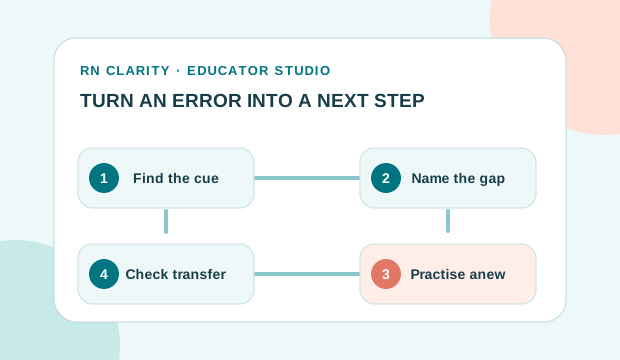
Original visual overview of Rationale Review & Remediation Clinic

What learners will do

Observable learning outcomes

  • Identify a missed cue, concept gap, priority error or option-selection error using evidence.
  • Link the error to a small learning action and a different follow-up task.
  • Check whether reasoning transfers, rather than repeating a memorised answer.

Suggested session flow

  1. 0–5 minSelect one fictional or de-identified learning error and read the full rationale.
  2. 5–12 minLocate the deciding cue and explain why an alternative was less appropriate.
  3. 12–20 minChoose the smallest useful correction and a new transfer question.
  4. 20–30 minAgree a follow-up date, rehearse the new reasoning and complete the plan.

Build a focused remediation plan

Use anonymous or fictional learning notes. Do not enter names, email addresses, patient details or private performance records.

My next learning step

Pattern
Priority error
Deciding cue / principle
New confusion and lower BP compared with baseline
Learning action
Explain baseline versus deterioration in two patient cards
Transfer task
Solve a different prioritisation case and explain the deciding cue
Follow-up
Choose a date before using the plan

Evidence to bring: explain the deciding cue, priority, action and reassessment in your own words before viewing the new answer key.

Your plan is included in the printable and editable lesson copies. It is not stored in a student record.

Ready for learners

Learner handout

Complete the activity before opening the worked key.

Rationale Review & Remediation Clinic · Learner handout

RN Clarity · Free teaching kit · 2026 NCLEX-RN alignment

Make the error specific

Do not enter patient identifiers, student names, email addresses or private performance records into this public tool. Work with a fictional example or an anonymous learning note. The builder does not save your entered text to an account; print or export it if you want a copy. General site analytics follow the site’s consent settings.

PatternWhat to look forUseful action
Missed cueA new symptom or trend was overlooked.Mark the deciding cue, then compare it with baseline.
Concept gapThe learner cannot explain the relevant principle.Read a focused source and teach the principle back in plain language.
Priority errorA real but routine need was chosen before acute deterioration.Compare urgency and consequences of delay using a different patient set.
Option-selection errorChoices were added without evidence or the item instruction was missed.Explain each option and rehearse the required scoring/selection rule.

Worked learning error

In the prioritisation lab, a learner chose a stable chronic-lung-disease patient before a pneumonia patient with new confusion, BP 88/52 and oxygen saturation 88%. The learner said, “A lung diagnosis always means first.”

  • Which current cues distinguish the two patients?
  • Is the main error a lack of knowledge about the diagnosis, a missed trend or a priority shortcut? More than one may contribute.
  • Write one sentence correcting the shortcut without replacing it with another absolute rule.
  • Choose a new case that requires the same principle but has different details.

A seven-day learning loop

WhenActionEvidence to bring
TodayExplain the deciding cue and the rejected alternative.Two or three sentences in your own words.
Next study sessionAnswer a different item testing the same principle.Reasoning written before viewing the key.
Within seven daysDiscuss an unfamiliar case or handoff using the principle.The cue, priority, action and reassessment described independently.
If the error repeatsChange the learning task or seek focused help.Which step still breaks down, not just the percentage score.

Weekly check-in

  • What one reasoning pattern improved this week? Bring a concrete example.
  • Which pattern repeated? What was different about the new question?
  • Did the plan fit the available study time? If not, reduce or move the task.
  • What will be practised next, and what evidence will show improvement?

Exit ticket

Write: “When I see ____, I will compare ____ before deciding ____. I will check this by ____.” Do not include real patient details.

For the educator

Open the facilitator key

Worked reasoning, misconceptions, feedback and adaptations.

Rationale Review & Remediation Clinic · Facilitator notes & worked key

Worked remediation plan

Pattern: priority error, with a missed baseline comparison. Correction: “A diagnosis label alone does not determine priority; compare current threats and changes from baseline.” Focused action: review the two relevant patient cards and explain the new confusion, hypotension and oxygenation change. Transfer task: a different four-patient scenario with a stable chronic condition and a separate acute change.

Success evidence: the learner independently identifies the new deterioration cue, explains the consequence of delay, chooses urgent assessment/escalation and states what to reassess. A copied rationale or a correct letter without reasoning is incomplete evidence. Follow up within seven days, and adapt the task if the same shortcut recurs.

Feedback script

“You recognised that breathing matters. In this case, A’s findings are stated as usual, while B has three new deterioration cues. Compare those changes first. On the next case, tell me which finding has changed and why waiting could be harmful.”

Keep feedback about the observed reasoning. Avoid labels such as “unsafe student” based on one teaching exercise. If a real clinical safety concern is involved, use the institution’s supervision and escalation process; this public worksheet is not an alternative to it.

Do not turn this into a risk score

The four patterns are teaching organisers. They are not a validated diagnostic scale, competence assessment or exam-readiness predictor. Use the learner’s explanation and repeated observations to choose help. Keep any official assessment and student records in the institution’s approved system.

How to avoid empty follow-up

Vague planMore useful plan
“Study harder.”“Explain two baseline-versus-deterioration comparisons, then solve one new prioritisation case.”
“Read all rationales.”“Explain the deciding cue and why the tempting alternative is weaker in this item.”
“Get 80% next time.”“Demonstrate the principle in a new context before viewing the key.”
“Use AI to tell me the answer.”“Write your reasoning first; use a source or tutor to challenge it, then check the clinical facts.”

Adapting the workload

For a learner with limited time, assign one targeted task and one transfer check rather than a large undifferentiated question quota. Ask whether the source language or terminology was a barrier. Explain the term, permit an initial plain-language explanation and then rehearse the professional wording. Do not confuse language fluency with the entire clinical-reasoning ability.

Take it into your classroom

Two copies. The key stays separate.

Print/save a branded PDF, or download a self-contained editable HTML lesson file. No account or email required.

Learner handout

Activities, questions and note spaces. No worked answer keys.

Facilitator pack

Learner activities plus worked keys, feedback and references.

Open the downloaded HTML in a browser, click the lesson text to edit, then choose “Save an edited copy”. For PDF, choose your browser’s Save as PDF destination. Custom planner entries are included.