NCLEX Stopped at 85 Questions: Did You Pass or Fail?
An NCLEX-RN exam stopping at 85 can pass or fail. Learn the CAT stopping rules, why question count and difficulty are not results, and how to navigate the waiting period.
1. Quick Answer and Essential Facts
An NCLEX-RN examination that stops at 85 questions can be a pass or a fail. Question count alone cannot reveal which outcome applies to you. An early stopping decision does not mean that you necessarily demonstrated “extremely high” or “extremely low” competence, and there is no supported basis here for saying that the vast majority of candidates who stop at 85 have passed.
The important distinction is between certainty about an ability estimate relative to the passing standard and a candidate’s personal feeling about performance. Computerized adaptive testing, or CAT, uses the first. Your anxiety after leaving the centre is not the second score report.
| Observation | What it tells you | What it does not tell you |
|---|---|---|
| The exam ended at 85 | You reached the current minimum item count and the exam ended | Your pass or fail outcome |
| The questions felt difficult | You experienced them as difficult | Their calibrated difficulty or your final ability estimate |
| You remember a wrong answer | You remember one response | The result based on the whole examination |
| You saw many unfamiliar topics | Those topics were unfamiliar to you | A secret indicator of pass or fail |
| Your friend tested longer | Their exam continued longer | That you performed better or worse |
Official sources: NCSBN’s current NCLEX format explanation confirms the 85–150 item range; NCLEX CAT guidance explains the stopping rules. The study explanations and examples below are original illustrations, not a reconstruction of your exam score.
2. What Happens at the Minimum Examination Length?
The minimum length is the earliest normal item count at which the examination may end after satisfying its administration requirements. It is a minimum number of questions, not a minimum percentage of questions that must be answered correctly. Confusing those two meanings leads to many of the myths that circulate after testing.
When the examination reaches an eligible stopping point, its scoring process considers whether a result can be determined under the applicable rule. If it cannot yet make the required determination, the examination may continue. Continuing does not mean you have failed; stopping does not mean you have passed.
Think of measurement rather than a fixed classroom quiz. A classroom quiz might give everyone the same questions and calculate the fraction answered correctly. An adaptive licensure examination is designed differently. The content you receive and the information provided by your responses contribute to a measurement of entry-level nursing ability relative to a standard.
The fact that the system can make a determination with fewer items does not by itself reveal the direction of the determination. You can be measured sufficiently clearly on either side of a threshold. You also cannot infer how far above or below the threshold you were simply because the exam ended at its minimum length.
For your own situation, the practical conclusion is modest but important: the examination is complete, and you need the result. You do not need to decode the number 85 as a hidden message. The number describes the length of the examination you experienced, not the outcome you are waiting to receive.
3. The 95 Percent Confidence Rule in Plain English
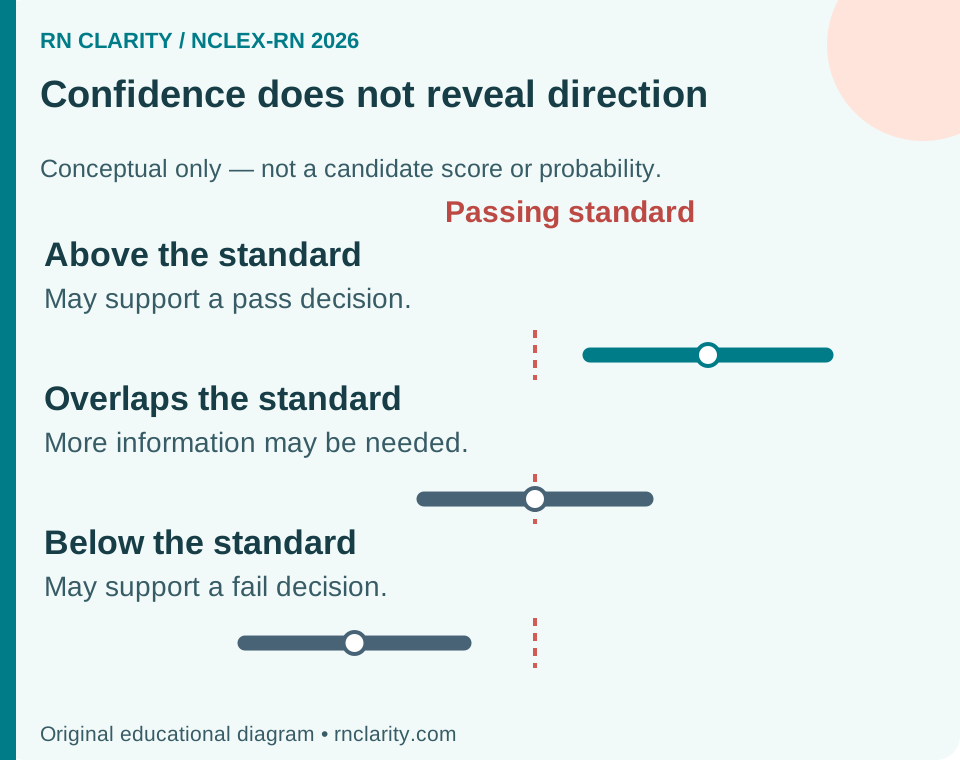
Under the most common CAT stopping rule, the examination stops when it has sufficient statistical certainty that the candidate’s ability lies above or below the passing standard. The official description uses 95 percent certainty. That number describes the measurement decision. It does not mean that you answered 95 percent correctly.
It also does not mean that 95 percent of people who stop at 85 pass. Those are different statements with different denominators. One concerns confidence in an individual measurement relative to a standard; the other would concern an observed group’s pass rate. A guide should not convert the first into the second.
For an intuitive illustration, imagine an estimate with an uncertainty band around it. If the entire relevant band is above a decision line, that supports one decision. If it is entirely below the line, that supports the other. If the band overlaps the line, more information may be needed. This picture is a teaching model, not an image of your actual score calculation.
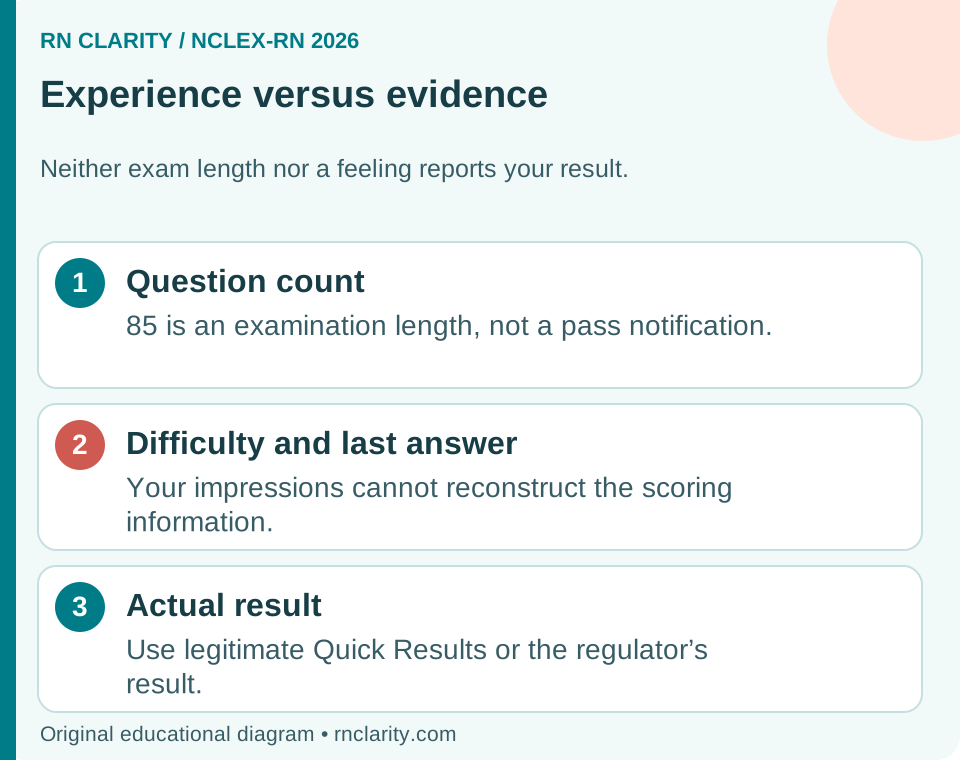
The exam does not display your ability estimate or uncertainty band to you during testing. You cannot recreate them from the number of questions, the apparent difficulty of the last question or whether you felt confident. A personal impression of difficulty is not the calibrated measurement information used by CAT.
Source: NCLEX computerized adaptive testing. Use the official explanation to understand the decision rule, and resist attaching a numerical personal pass probability to an examination length when you do not have the underlying data.
4. Why “Extreme Competence” Is an Overstatement
An early result determination does not establish that you are one of the strongest candidates in your cohort. It likewise does not establish that you are an exceptionally weak nurse. These descriptions add claims that question count cannot support.
The examination asks whether a candidate meets an entry-level standard. It is not designed as a public ranking of everyone who tested that day. Even when a decision is made efficiently, you should not turn the efficiency of measurement into a global judgment about professional identity.
Consider a thermometer that gives a stable reading quickly. That speed may help you trust that the reading is sufficiently determined, but it does not tell you whether the temperature is high or low without seeing the reading. Nor does a quick reading automatically mean the temperature is extreme. The analogy has limits, but it highlights the error in treating speed as direction and magnitude.
For candidates who pass, this distinction supports appropriate confidence: you met the examination requirement, and you can continue the licensing process. For candidates who do not pass, it supports an actionable response: use the official performance information to build remediation rather than accepting a label such as “extremely low competence.”
Words matter in the waiting period. A frightening label may make you feel that one examination has defined your whole career. A flattering label may make you announce an outcome you have not verified. Neither is necessary. The accurate statement is that minimum-length stopping alone does not identify your result or rank your ability.
5. Why the Examination Can Continue Past 85
If the examination continues, it is gathering additional information under its administration and scoring rules. That is not a punishment for getting a particular question wrong. It is also not proof that a previous passing result has been taken away.
Candidates sometimes treat question 86 as a crisis point. They prepared to stop at 85 because an online story made that seem desirable. When the next question appears, they become discouraged, rush or stop reasoning carefully. The better preparation is to expect that the examination may legitimately continue through the permitted range.
Your task at question 86 is the same as your task at question 20: read the information, identify what is being asked and select the safest supported response. The number on the screen should not change your clinical reasoning strategy. It should help you manage pace, not assign yourself a result.
For future candidates, practise maintaining attention across a longer session. Do not train yourself to emotionally finish at the minimum number. Plan for breaks and pacing within the official time limit, and keep each item separate from the outcome you hope the system is approaching.
For someone whose examination already ended at 85, another candidate’s longer examination offers no comparison score. A friend who answered 150 may pass; a friend who answered 85 may fail. Each candidate’s outcome depends on their own administered examination and the applicable stopping rule, not on a race to the earliest endpoint.
Go deeper: Learn the exam structure and pacing context in the complete NCLEX-RN 2026 guide.
6. The Maximum-Length and Time-Expiration Rules
The confidence rule is not the only way an examination can end. The official CAT page also describes decisions at maximum length and when time expires. These alternatives are important because a screen ending after a certain number of questions should not be interpreted without considering how the examination ended.
At maximum length, the final ability estimate determines the outcome relative to the passing standard. If time expires, the minimum-item requirement and final ability estimate matter under the published rule. These are different pathways from a normal early stopping decision.
If you answered 85 questions because time ran out rather than because the examination normally ended at that point, do not describe the event as proof that the confidence rule stopped your exam. The same item count can arise in different circumstances. Only the actual result resolves the outcome.
This is another reason social-media comparisons are unreliable. Two people may both write “85” while describing different events: one completed a minimum-length examination normally, while another reached that count near the end of the available time. A short post may omit the distinction that matters most.
During preparation, work on pace without racing. The goal is to give thoughtful responses within the examination’s requirements. After testing, avoid constructing a mathematical score from elapsed time. A fast or slow finish is not an individual diagnostic test of pass or fail.
7. Why a Percentage From a Question Bank Is Not Your NCLEX Score
Practice percentages are useful for directing study, but they belong to the practice system in which they were produced. Different banks have different questions, difficulty distributions, scoring methods and ways of selecting sets. Their percentages do not become a universal NCLEX cut score.
A repeated set can also inflate your percentage through memory. If you remember an answer but cannot explain the reasoning, the score may overstate what you would do with a fresh case. Conversely, a challenging unfamiliar set may expose useful learning needs without proving that you will fail the licensure examination.
Use your practice data to ask better questions. Are errors concentrated in medication safety, prioritization or a particular system? Are you missing the same cue repeatedly? Do you change correct answers because of unsupported assumptions? Do you review why distractors are wrong, or only read the correct option?
Those questions lead to actions. A single readiness label may feel simpler, but it cannot remove uncertainty. A practice platform can support learning; it should not claim that a certain dashboard percentage guarantees the outcome of a different examination.
After an exam that stopped at 85, your old practice average does not combine with the item count to produce a reliable personal probability. It may remind you that you completed substantial preparation. It may also identify future work if remediation is needed. Neither use requires pretending it is the score you are waiting to receive.
8. Why Difficult Questions Can Feel Like Bad News
Difficulty is experienced through your knowledge, fatigue, stress and familiarity with the topic. A question can feel hard because you have not recently studied the content, because two options are close or because you are uncertain about the exact task. That experience is not the calibrated difficulty used by the examination.
Adaptive testing is intended to present informative items rather than keep giving you questions you find easy. Therefore, feeling challenged is not itself a negative sign. It is also not a positive sign that can be converted into a pass guarantee. Both interpretations go beyond what you can observe.
After testing, memory often favors the uncomfortable moments. You may remember a medication you could not identify but forget many questions you worked through calmly. Reconstructing the examination from the most vivid difficult items can produce a distorted impression of the whole session.
Try replacing “I did not know anything” with a more accurate description: “Some items were unfamiliar, and I do not know my result yet.” This is not forced positivity. It is a correction of a statement that claims more than your memory supports.
For future study, separate content unfamiliarity from reasoning difficulty. If you do not know a mechanism or normal assessment, review it. If you know the content but miss the task word or prioritize the wrong cue, practise that reasoning step. A specific learning need is more useful than the global label “hard questions.”
9. Why Easy Questions and the Last Question Are Not a Verdict
An item that seems easy to you might be easy because you studied that subject carefully. It might also have a subtle task or distractor that you did not notice. You do not know its calibrated role simply from how comfortable you felt answering it.
The final question is especially tempting to overinterpret. Candidates may say that a simple last question means failure or a difficult last question means success. Those conclusions are not justified. CAT considers responses across the examination under its scoring rules, not a candidate’s retrospective label for the final item.
Remembering that you chose a wrong answer at the end does not mean that answer independently caused the result. You also may not accurately recall every detail necessary to determine whether your answer was wrong. Avoid searching for actual examination content or posting it to have others adjudicate it.
A safer reflection concerns process rather than protected content. Did you read the stem carefully? Did fatigue change your pace? Did you identify what the question asked before reviewing the choices? Those observations can guide future learning without pretending to calculate an outcome.
If you notice that your mind keeps returning to the last item, set a boundary: you will not use an uncertain memory to overturn the whole examination. Wait for the actual result. The feeling that one moment must explain everything is understandable, but it is not an evidence-based scoring method.
10. NGN Item Types and Other Popular “Signs”
The presence of a case study, multiple-response item or unfamiliar format does not serve as an unofficial pass signal. Item format and candidate outcome are different kinds of information. You cannot count a particular type and infer that the system has classified you as successful.
Some candidates try to count clinical-judgment items during testing. That diverts attention from the case itself. The useful task is to recognize and analyze patient cues, choose a priority, identify an appropriate solution, act and evaluate the response. Treat the item as a nursing decision, not a clue about your statistical status.
Similarly, the number of medication, delegation or maternity questions you remember is not a personal scoring report. Your memory is not a complete inventory, and the examination is organized around its test plan rather than a social-media code that candidates can decode after leaving.
The 2026 RN Test Plan describes the examination framework, including clinical judgment. It does not instruct candidates to interpret item formats as pass or fail messages. Align preparation with that framework rather than myths about what a “passing exam” must look like.
The same boundary applies to survey screens, completion emails and routine account notifications. They can confirm administrative steps, but they should not be assigned a result meaning unless the official instructions explicitly give them one. A document that reports a result should be interpreted as a result; everything else should be interpreted according to its actual purpose.
11. Can We Estimate the Pass Rate for Exams Ending at 85?
This guide does not provide a pass percentage for candidates whose examinations ended at 85 because it does not have a suitable official dataset establishing that percentage. A general NCLEX pass rate is not the same as a pass rate conditional on examination length.
Published rates can also differ by candidate group, time period, first attempt or repeat attempt and education location. Applying a rate from one group to an individual in another group can be misleading. Even a correctly reported group rate is not a result for one person.
If you see a claim that nearly everyone who stops at 85 passes, ask for the source, year, population and denominator. Was the figure calculated from all examinations ending at 85, or from people who voluntarily answered a poll? Were failures recorded? Did the author distinguish normal stopping from time expiration?
The questions are not meant to make you more worried. They protect you from false precision. An unsupported high percentage can provide brief relief but can also make an unfavorable result feel impossible or shameful. An unsupported low percentage can create needless fear before reliable information is available.
You can take encouragement from the work you did without attaching an invented probability to it. You completed the examination. You now have a clear route to the actual result. That is a stronger basis for the next decision than a number that looks scientific but has no identifiable data behind it.
12. The First Hours After Leaving the Testing Centre
Your first useful action is recovery, not score reconstruction. Arrange safe transport, have something to eat and give yourself time to decompress. If you are too distracted to drive safely, use another option. The examination is finished; continuing to mentally test yourself does not change your submitted responses.
Choose one person to tell that the exam is complete. You can say the result is pending without discussing every difficult moment. Ask that person to avoid forwarding prediction videos or demanding an immediate verdict. Support is more helpful when it respects the uncertainty you are actually experiencing.
Secure your account and appointment records. Do not publish your candidate number, payment details or identity documents. Avoid sharing actual exam questions. You can discuss preparation habits or emotional reactions without disclosing protected examination content.
If you want to write a reflection, keep it short and focused on process. Note whether you managed breaks, maintained attention or found a certain reasoning task challenging. Put the note away. Do not build an answer key from memory or spend hours asking strangers to grade fragments of the examination.
Finally, choose when you will check legitimate results. A plan made now can prevent an evening of repeated refreshing. Your goal is not to suppress all emotion. It is to avoid actions that add financial, privacy or administrative problems while you wait for information.
13. A Realistic Two-Business-Day Waiting Plan
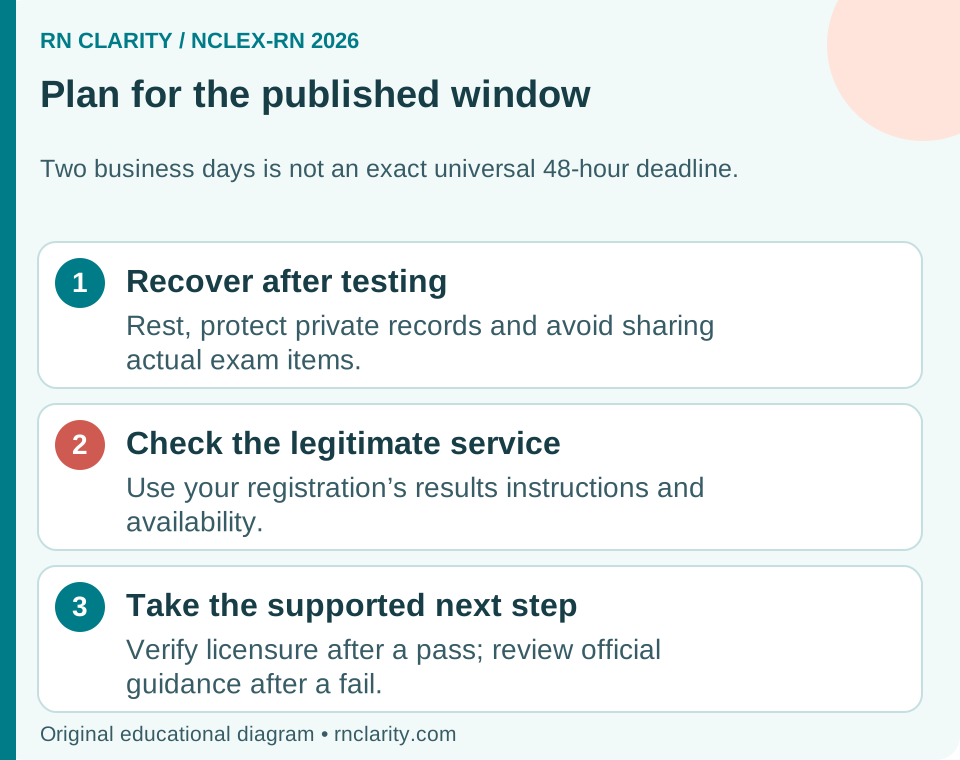
The popular “48-hour window” is shorthand, not a universal deadline. The official Quick Results service describes availability after two business days for eligible candidates associated with participating US regulators. Do not interpret every extra hour as evidence of failure.
Before the expected window, keep a normal routine as much as possible. Set aside one short period for checking messages and leave the rest of the day for sleep, meals, movement, caregiving or ordinary work. A routine gives your attention somewhere useful to go without pretending that waiting is effortless.
At your chosen time, check the correct account and actual results option. If results are unavailable, record that status neutrally. Do not begin another examination purchase as a substitute. If there is a specific account error, follow the appropriate support route for that error.
After a result appears, pause before broadcasting it widely. Read what it says and whether it is unofficial. Confirm the next regulatory step. A short pause helps prevent a joyful or distressed reaction from turning into an inaccurate claim about licensure or retake eligibility.
If waiting is causing significant distress, seek support from someone who can help you manage it. A guide cannot diagnose anxiety or provide treatment. It can encourage practical limits on unhelpful checking and remind you that uncertainty is a temporary lack of information, not proof of a negative outcome.
14. A Reassurance Checklist That Does Not Invent a Result
Useful reassurance acknowledges uncertainty while identifying what is true. You completed a challenging step. The examination has a defined results process. A short examination does not prove failure. Your feelings do not constitute a score report. These statements can remain true even before the outcome is known.
Ask yourself five questions: Have I identified the correct results pathway? Have I avoided paying for a new exam merely to test a prediction? Have I kept account information private? Have I chosen a reasonable checking routine? Do I have someone to contact if the waiting period becomes overwhelming?
If the answer to one question is no, make one concrete correction. Find the results instructions. Stop the payment experiment. Remove a private screenshot from a public post. Set a checking time. Contact a supportive person. Those actions improve your situation regardless of the examination outcome.
Avoid reassurance that requires a claim you cannot verify, such as “the computer would never stop at 85 if you failed.” That sentence may sound comforting, but it is incorrect. Better reassurance is: “Both outcomes are possible at 85, and the result will tell you which one occurred.”
The distinction helps friends and tutors too. They do not need to promise a pass to be supportive. They can offer to stay with you when results appear, help you understand the next steps or make sure you take a break from prediction threads. Practical support does not need to pretend that uncertainty has already been resolved.
15. Worked Scenario: A Normal Stop at 85 and a Difficult Final Item
Priya’s examination ends normally at 85. She remembers finding the final item very difficult and cannot stop thinking about it. A classmate says that difficult final items always mean a pass. Priya wants to believe the statement, but she is also afraid it might be wrong.
The observation is that the examination ended at its minimum item count and the last item felt difficult. Neither observation reports the result. Priya does not know the calibrated difficulty, the full ability estimate or the role of that item in the final decision. A classmate’s interpretation cannot fill those gaps.
A better response is to keep the observation and remove the unsupported conclusion. Priya writes, “The exam is complete; the result is pending.” She checks whether Quick Results is available for her regulator and plans a sensible checking time. She avoids posting the actual item to ask others whether it was difficult enough to indicate a pass.
If she later receives a pass, the legitimate result supports that conclusion. It does not retrospectively validate the classmate’s universal rule. If she receives a fail, the earlier difficulty impression was still only an impression. Either outcome shows why the real result, rather than the final-item story, should guide her next step.
The transferable lesson is to avoid confusing an event that happened before a result with a cause or reliable predictor of that result. This is the same reasoning habit that helps a nurse avoid drawing a diagnosis from one isolated cue without considering the whole patient situation.
16. Worked Scenario: Several Remembered Mistakes
Noah leaves after 85 questions and remembers three answers he now believes were wrong. He concludes that stopping early must mean the computer quickly recognized failure. He begins planning to buy another registration before seeing his result.
Noah has incomplete retrospective information. He does not know the full scoring information, may not remember every relevant detail and cannot calculate the outcome from a few recalled responses. The number of mistakes he can remember is not the same as the number or significance of mistakes across his administered examination.
His useful next action is to wait for the real result and avoid a duplicate purchase. He can write down a general learning observation without reproducing exam content: for example, he sometimes rushes when two options seem similar. That observation could inform future preparation if needed, but it does not establish failure.
A supportive friend can help by separating emotion from evidence. “You are worried about several items, but we still do not know the result” is accurate. “Those items do not matter at all” would be another unsupported claim. The goal is balanced reasoning, not replacing one extreme interpretation with another.
If remediation becomes necessary, Noah can investigate the official performance report and review broad reasoning patterns. If he passes, he can still strengthen a habit he noticed. In both cases, a process-focused reflection is useful. A self-assigned fail based on memory is not.
17. Worked Scenario: Two Friends With Different Exam Lengths
Elena stops at 85 while her friend continues to 150. They compare the experience and conclude that Elena must have done much better. Later, both are anxious because they have treated examination length as a ranking.
The comparison is unsupported. Each examination is administered and scored for its own candidate. Length does not provide a common classroom score that the friends can use to order their performance. The system may determine an outcome at minimum length or use a different rule at maximum length.
The friends can support each other without comparing scores they do not have. They agree to check legitimate results independently, avoid asking each other for recalled exam items and share only the status each can document. Their conversations become less about who received the “better exam” and more about what each person needs while waiting.
For future preparation, they can compare learning processes instead. Did each review rationales thoroughly? Could each explain prioritization choices? Did each practise sustained attention? These comparisons can lead to improvements because they concern observable study behavior, not hidden scoring information.
The lesson extends to social-media timelines. Reading many posts from people who stopped at a different count can create a false sense that there is a desirable exam length. A candidate’s job is to respond safely and carefully to the examination administered to them, not to achieve a particular stopping number.
18. Worked Scenario: Time Expired at 85
Amir reaches 85 questions close to the end of the examination time and the session ends because time expires. A friend tells him that anyone who reaches 85 automatically passes. Another says a timed-out examination automatically fails regardless of count. Neither blanket statement reflects the published distinction.
The CAT guidance explains that time expiration involves its own criteria, including whether the minimum item requirement was met and the final ability estimate. Amir cannot determine the outcome from count alone, and he should not describe his ending as a normal confidence-rule stop without that information.
He obtains the actual result through the legitimate pathway. If further preparation is required, pacing is one process he can examine. Did he spend disproportionate time on certain formats? Did he reread repeatedly without gaining information? Did he have a strategy for moving forward after making the best supported choice?
Pacing review should not become advice to rush blindly. A nursing decision still requires attention to the stem and cues. The learning goal is to recognize when additional deliberation is productive and when it is only repetition. Practice can help him make that distinction in a lower-stakes setting.
This scenario demonstrates why precise descriptions matter. “The exam ended at 85” is incomplete when discussing stopping rules. “Time expired after I reached 85” gives a more accurate account, while still leaving the outcome to the result document rather than an informal prediction.
19. If You Receive an Unofficial Pass
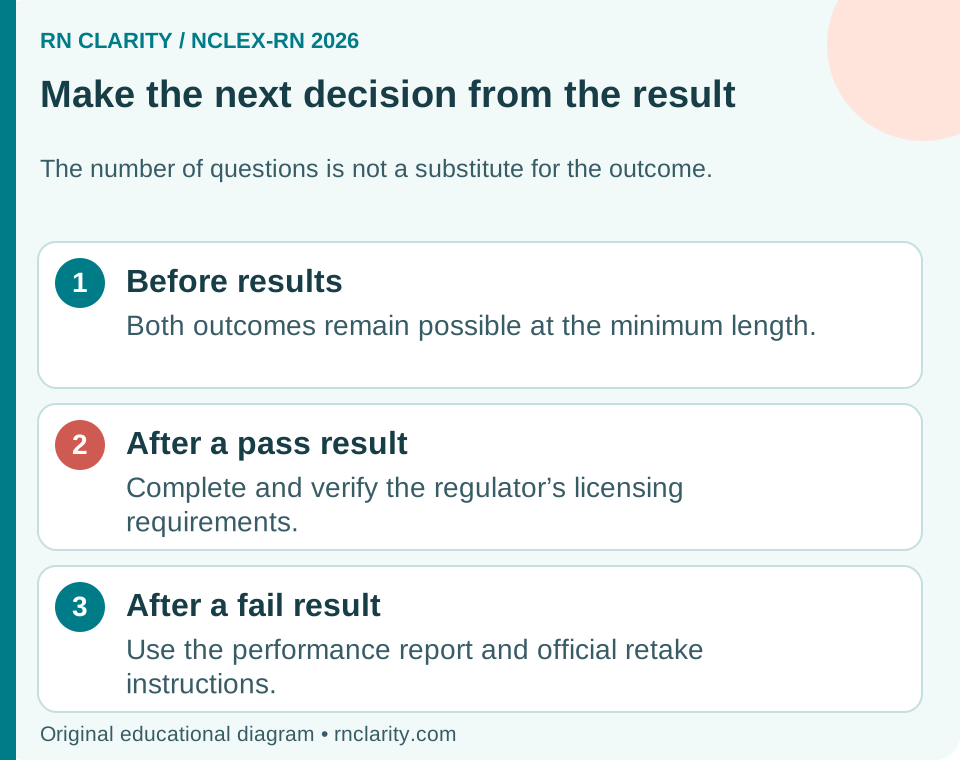
Read the result carefully and understand its status. A legitimate unofficial pass is useful information about the examination, but it is not itself permission to practise. Confirm the regulator’s licensing steps and the requirements of any employer before representing yourself as authorized in a nursing role.
Check for outstanding application requirements. Education records, identity information or required coursework can be separate from the exam. Do not assume that a missing licence record means the unofficial pass is false; first determine what the regulator says about the application process and verification.
You can celebrate the exam achievement while keeping your professional statements accurate. “I passed the NCLEX and am completing licence verification” communicates both the success and the remaining step. It is clearer than announcing a licence number or start date that has not yet been confirmed.
Reflect on preparation in a way that could help others without creating new myths. Describe the habits you found useful: reviewing every option, practising clinical judgment, managing breaks or using a study plan. Avoid saying that your question count or final item proves a rule for everyone else.
If you support a future candidate, share the distinction you learned. A minimum-length examination can have either outcome. A strong preparation process is worth discussing; a stopping-number superstition is not. Your experience becomes more useful when it helps another person make sensible decisions rather than promises the same result.
20. If You Receive an Official Fail
An unfavorable result is important information, but it is not a verdict on your worth or the entire future of your nursing career. Give yourself time to absorb it before buying several products or changing every part of your study plan. The next plan should respond to evidence.
Read the Candidate Performance Report and the regulator’s retake instructions. Identify broad areas needing work and connect them to specific learning behaviors. A report category can point you toward content review, but the way you reason through questions also matters.
Treat the report’s performance descriptions as starting points for investigation. They are not a transcript of your examination or a list of the exact questions you missed. A category described as near the passing standard still deserves attention; it should not automatically be placed in a “finished” column. Likewise, a stronger category is worth maintaining through mixed practice while you work on weaker areas.
For each priority area, choose a small, observable goal. Instead of writing “improve safety,” write “identify which patient cue requires immediate assessment and explain why each alternative can wait.” Instead of “learn medications,” write “recognize the assessment finding that changes whether a medication can be safely administered in this practice scenario.” These goals connect a broad report category to a reasoning behavior you can actually practise.
Then review the goal using unfamiliar educational questions. Record whether you recognized the important cue before reading the rationale and whether you can explain your choice afterward. Repeating a remembered answer can make a score rise without showing that the underlying skill improved. If the same reasoning error continues, slow down and revisit the concept before adding more questions. This is a practical remediation method, not a claim that the report predicts a particular retake result.
Create an error log with four fields: the cue you missed, the assumption you made, the reason the correct action is safer and the practice step you will take. Do not fill it with actual protected exam items. Use new practice questions and original learning cases to explore the same reasoning skill.
Balance targeted review with broader coverage. Spending all your time on the most disappointing topic can leave other needs unattended. Use the current test plan to keep the preparation organized, and check whether improvement transfers to fresh questions rather than only repeated ones.
Before paying for a retake, confirm eligibility, waiting requirements and the correct registration process with the regulator. The fact that your previous examination ended at 85 does not make the retake process different by itself. Your next steps should follow the official result and regulatory instructions.
21. A Better Preparation Plan for a Future Attempt
Start with a baseline that measures something useful. A mixed set can reveal whether errors are spread across topics or concentrated in a particular reasoning step. The baseline is a study tool, not a personal guarantee. Keep notes about why an answer was chosen, not only whether it was correct.
Next, alternate focused review with mixed practice. Focused review helps you repair a gap; mixed practice asks whether you can recognize that gap when the topic is not announced. For example, learning airway signs is different from selecting the airway-threat patient among four unrelated patient reports.
Review correct answers too. Sometimes a correct choice was a guess or was selected for the wrong reason. If you cannot explain why it is safer than each alternative, there is still learning to do. Conversely, an incorrect answer can become valuable when you identify the exact reasoning error and apply the correction to a new case.
Practise clinical judgment across an unfolding situation. Initial assessment is not the endpoint. Ask what information would change the priority, what response you expect after an intervention and what would require escalation. That approach connects preparation with entry-level nursing decisions under the 2026 framework.
Build stamina and pacing gradually. Include sessions long enough to practise sustained attention, while using shorter sessions for specific remediation. Do not organize the entire plan around trying to force a minimum-length exam. The aim is safe, transferable reasoning across whatever legitimate length the examination requires.
Go deeper: Explore who the nurse should see first and the NCLEX study-plan overview.
22. Frequently Asked Questions
Can you fail the NCLEX at 85 questions?
Yes. A normal minimum-length stopping decision can occur on either side of the passing standard. The number 85 does not tell you which side applies. Obtain the actual result through the legitimate service or regulator rather than treating a short examination as a guaranteed pass.
Does stopping at 85 usually mean I passed?
This guide does not have an official length-specific dataset that supports a personal probability or a “vast majority” claim. General pass rates and social-media polls do not answer that question for your examination. The reliable next step is to wait for your result, not to assign a percentage.
Does the 95 percent rule mean I got 95 percent correct?
No. It concerns statistical certainty about ability relative to the passing standard, not a required percentage of correct answers. It also does not mean 95 percent of people who stop at the minimum pass. Those are different concepts and should not be combined.
Did one wrong final answer make me fail?
You cannot determine that from a remembered answer. Scoring uses the administered examination under the published rules, and your recollection may be incomplete. Avoid reconstructing or sharing actual exam items. A process reflection can support learning, but it is not a replacement for the result.
Does a difficult last question mean I passed?
No supported conclusion follows from how difficult it felt. Your experience of an item is not its calibrated difficulty or your final ability estimate. Some items may feel unfamiliar even after strong preparation. Use the actual result rather than the apparent difficulty of the last question.
Does continuing past 85 mean I am failing?
No. The examination may continue to gather information under its scoring and administration rules. Maintain the same careful reasoning on the next item. Candidates should prepare for the permitted range rather than expect that a desirable examination must end at the minimum count.
If time expired at 85, is that the same as a normal stop?
No. Time expiration has its own published criteria. The minimum item count matters, but the final ability estimate is also relevant. Do not infer the result from count alone or assume that the confidence rule produced the ending. Obtain the actual examination outcome.
Will I know in exactly 48 hours?
The official Quick Results description uses two business days where the service is available. That is not a guaranteed universal forty-eight-hour release deadline. Follow your registration’s service instructions. Unavailability or delay is not evidence of failure.
Should I try the Pearson VUE Trick?
RN Clarity does not recommend buying another registration to infer a result. Payment and registration events are not validated score reports and can create financial problems. Read the PVT guide for the distinction between pop-up labels, payment events and legitimate results.
Can I start nursing work when Quick Results says pass?
An unofficial result does not authorize practice. Verify the licence or other authorization required by the regulator for your role and jurisdiction. Passing the examination and completing all licensing requirements are separate checkpoints. Communicate the status you can document to an employer.
What should I study if I failed after 85 questions?
Use the official performance report, the regulator’s retake instructions and the current RN test plan. Identify both content gaps and reasoning patterns. Practise fresh cases, explain why alternatives are less safe and track whether improvement transfers. Do not build remediation solely from the final question or examination length.
23. References and Source Notes
Official examination and results information was checked on October 4, 2026. The conceptual diagrams, candidate scenarios and study methods are original educational explanations. They do not reproduce a candidate’s score, actual examination questions or a validated individual prediction model.
- NCSBN: Current NCLEX format and item types — minimum and maximum item counts.
- NCLEX: Computerized Adaptive Testing — confidence, maximum-length and time-expiration rules.
- NCSBN: 2026 NCLEX-RN Test Plan — current content and clinical-judgment framework.
- NCLEX: Quick Results — legitimate unofficial results availability.
- NCLEX: Results — official regulatory results pathway.
- NCLEX: Candidate Performance Report — performance information after an unsuccessful attempt.
- NCLEX: Frequently Asked Questions — administrative and candidate questions.
For related preparation, use the clinical-judgment hub and exam-day guide. Build confidence from clear reasoning and verified information, not a stopping-number prediction.