NCLEX-RN® 2026 Guide: Test Plan, Scoring and Study Strategy
Understand the April 2026 NCLEX-RN® Test Plan, Client Needs categories, question formats, CAT scoring, clinical judgment, exam-day rules and practical study plans.
1. Quick Answer and Essential Facts
The NCLEX-RN® is a computerized adaptive licensure examination. Its purpose is to help nursing regulatory bodies determine whether a candidate has the knowledge, skills, abilities and clinical judgment required for safe and effective entry-level registered nursing practice. It is not designed mainly as a memory test. Most items require the candidate to apply nursing knowledge, recognize risk, establish priorities and choose safe actions.
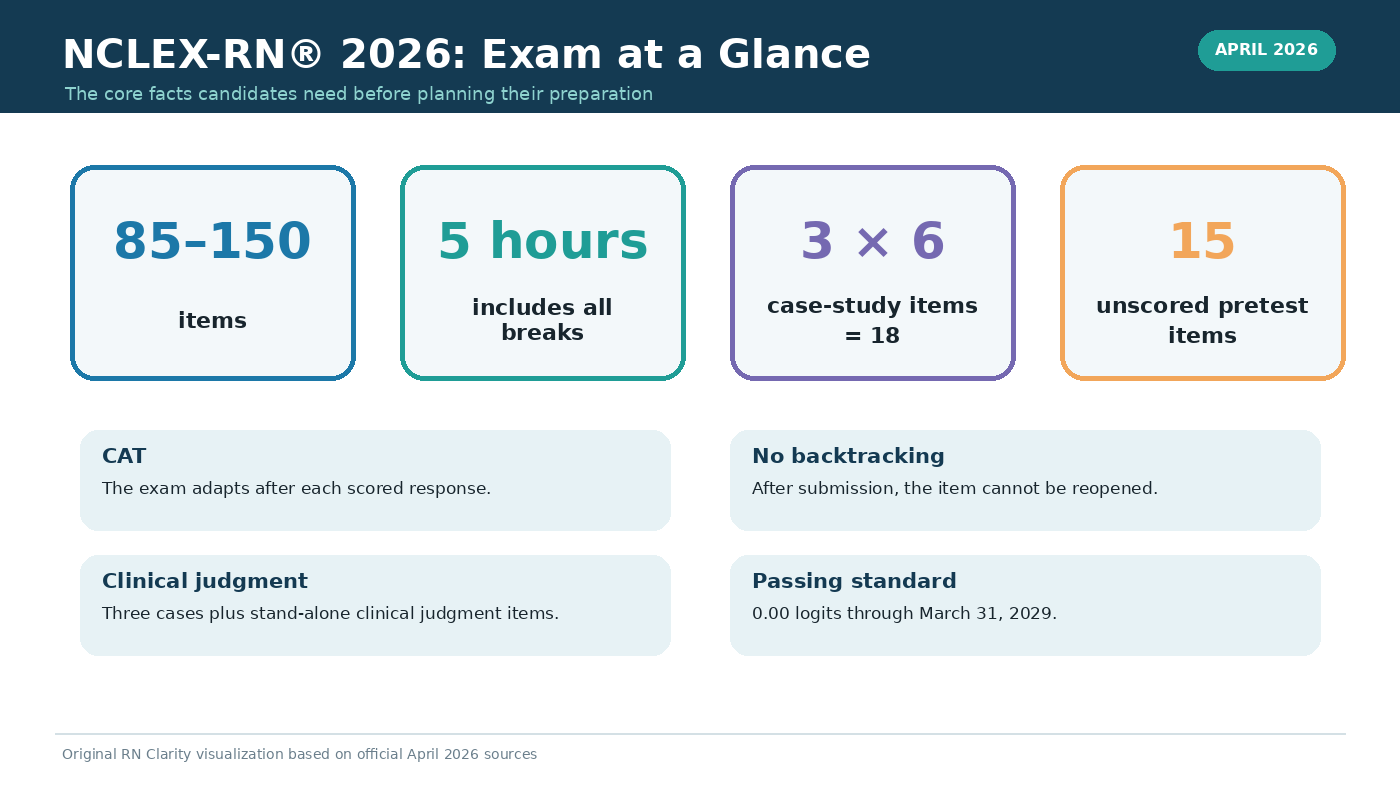
- The examination contains a minimum of 85 items and a maximum of 150 items.
- Candidates have up to five hours. The time includes the introductory screen and every scheduled or unscheduled break.
- Every candidate receives three clinical judgment case studies. Each case contains six items, for a total of 18 case-study items.
- At the minimum length, 15 items are unscored pretest items. Candidates cannot identify them.
- The examination uses computerized adaptive testing.
- A candidate must answer the current item before moving forward and cannot return after submitting it.
- There is no universal percentage-correct score that guarantees a pass.
- The NCLEX-RN® passing standard is 0.00 logits for the April 2026 test plan.
- The number of items received does not reveal whether a candidate passed or failed.
Remember: The central examination question is not “How many facts can the candidate remember?” It is “Can this candidate make safe entry-level nursing decisions?”
2. What the NCLEX-RN® Is Designed to Measure
The NCLEX-RN® supports licensure or registration decisions. Nursing regulatory bodies use the result as one part of deciding whether a candidate can enter registered nursing practice. The examination focuses on the level of competence expected from a newly licensed RN, not from an advanced-practice nurse or a specialist with years of experience.
A candidate is expected to combine nursing knowledge with judgment. For example, it is useful to know the definition of respiratory acidosis, but the examination is more interested in whether the candidate can recognize relevant findings, identify a likely cause, determine the urgency, select a safe action and evaluate the client’s response.
2.1 The entry-level perspective
When choosing an answer, use the perspective of a safe, reasonably prepared entry-level RN. Do not assume access to a unique hospital policy, a specialist standing beside the bed or information that is not presented. Use broadly accepted nursing principles and the facts in the item.
-
Is the action within the RN’s legal and professional scope?
-
Is it safe for this client at this time?
-
Does it address the most urgent supported need?
-
Is further assessment required before acting?
-
Would delay create immediate danger?
-
Can the task be delegated safely, or does it require RN judgment?
-
Does the action respect the client’s rights, preferences and informed choices?
2.2 Application is more important than simple recall
The 2026 test plan states that most items are written at the application level or higher. This means a candidate should expect to interpret a situation rather than merely identify a definition. Strong preparation therefore includes pathophysiology, assessment, nursing priorities, medication safety, procedures, communication and outcome evaluation.
3. Who Develops the Examination and How the 2026 Plan Was Built
The examination and its official test plan are developed by the National Council of State Boards of Nursing, Inc., or NCSBN®. The test plan is reviewed on a three-year cycle. It guides content classification, item development and candidate preparation.
The April 2026 plan was informed by the 2024 RN practice analysis. Nearly 24,000 newly licensed RNs provided information about how frequently they performed nursing activities, how important those activities were for client safety and how strongly the activities involved clinical judgment. Expert review and regulatory input were also used.
3.1 What changed for April 2026
The overall structure continues to use four major Client Needs categories and eight scored content areas. Clinical judgment continues to be explicitly measured through three six-item case studies and approximately 10% of eligible stand-alone items, depending on examination length. Candidates and publishers should use the exact 2026 subcategory title “Safety and Infection Prevention and Control.”
3.2 Copyright and trademark boundaries
- Use NCLEX® and NCLEX-RN® with the registered trademark symbol in visible text.
- Do not use official NCSBN® or NCLEX® logos without permission.
- Do not reproduce copyrighted sample items, proprietary screens, official charts or secure examination content.
- Create original explanations, practice scenarios and diagrams.
- Do not claim that RN Clarity is approved, endorsed or sponsored by NCSBN®.
- Use official public sources as hyperlinks and keep a visible non-affiliation statement.
4. Registration, Eligibility and Authorization to Test
The NCLEX-RN® registration process has two connected parts: the candidate works with a nursing regulatory body and also registers with Pearson. The regulatory body decides eligibility; Pearson manages examination registration and scheduling.
-
Apply for licensure or registration to the nursing regulatory body in the jurisdiction where you want to be licensed or registered.
-
Meet that regulatory body’s education, documentation and eligibility requirements.
-
Register for the NCLEX-RN® with Pearson using the exact first and last name that will appear on acceptable identification.
-
Receive registration acknowledgement from Pearson.
-
Wait for the regulatory body to make you eligible in the Pearson system.
-
Receive an Authorization to Test, commonly called an ATT.
-
Schedule the examination within the ATT validity period.
Go deeper: For a step-by-step walkthrough of applications, ATT timing and scheduling, see the NCLEX-RN® registration guide.
4.1 Testing accommodations
Requests for testing accommodations or exceptions are handled through the nursing regulatory body. Candidates should begin that process when applying for licensure or registration, not after arriving at the test centre. Approval and scheduling instructions can differ by jurisdiction.
4.2 Name and identification accuracy
The first and last names in the Pearson registration record must match the first and last names on the identification presented at the examination. A mismatch can prevent testing and may require a new registration and fee. Candidates should review the current acceptable-identification rules well before the appointment.
Practical check: As soon as the ATT arrives, confirm the spelling of the name, the validity period and the jurisdiction. Then schedule early enough to preserve reasonable date and location choices.
5. Examination Format and Computerized Adaptive Testing
Feature | April 2026 format |
|---|---|
Delivery | Computerized adaptive testing |
Minimum items | 85 |
Maximum items | 150 |
Maximum time | Five hours, including all breaks |
Required case studies | Three |
Items per case | Six |
Total case-study items | 18 |
Unscored pretest items at minimum length | 15 |
Can an item be skipped? | No |
Can a submitted item be reopened? | No |
On-screen calculator | Yes |
Paper or oral option | No |
Passing standard | 0.00 logits for the April 2026 test plan |
5.1 What happens at the 85-item minimum
At the minimum examination length, 52 items come from the eight Client Needs areas according to the blueprint, 18 items form the three required clinical judgment case studies and 15 items are unscored pretest items. As the examination becomes longer, additional scored items are selected while the system continues to satisfy the blueprint and estimate candidate ability.
5.2 Five hours includes all breaks
The five-hour limit includes the introduction, the examination, scheduled breaks, unscheduled breaks and time away from the workstation. Scheduled break opportunities are normally offered after approximately two hours and again after approximately three and a half hours. The examination clock continues during breaks.
5.3 No skipping and no backtracking
A candidate must answer the item on screen before continuing. The answer can be changed while the item remains open. Once the candidate confirms the answer and proceeds, the item cannot be reopened. This rule makes careful reading important, but it does not mean a candidate should spend excessive time seeking complete certainty.
5.4 How the engine selects items
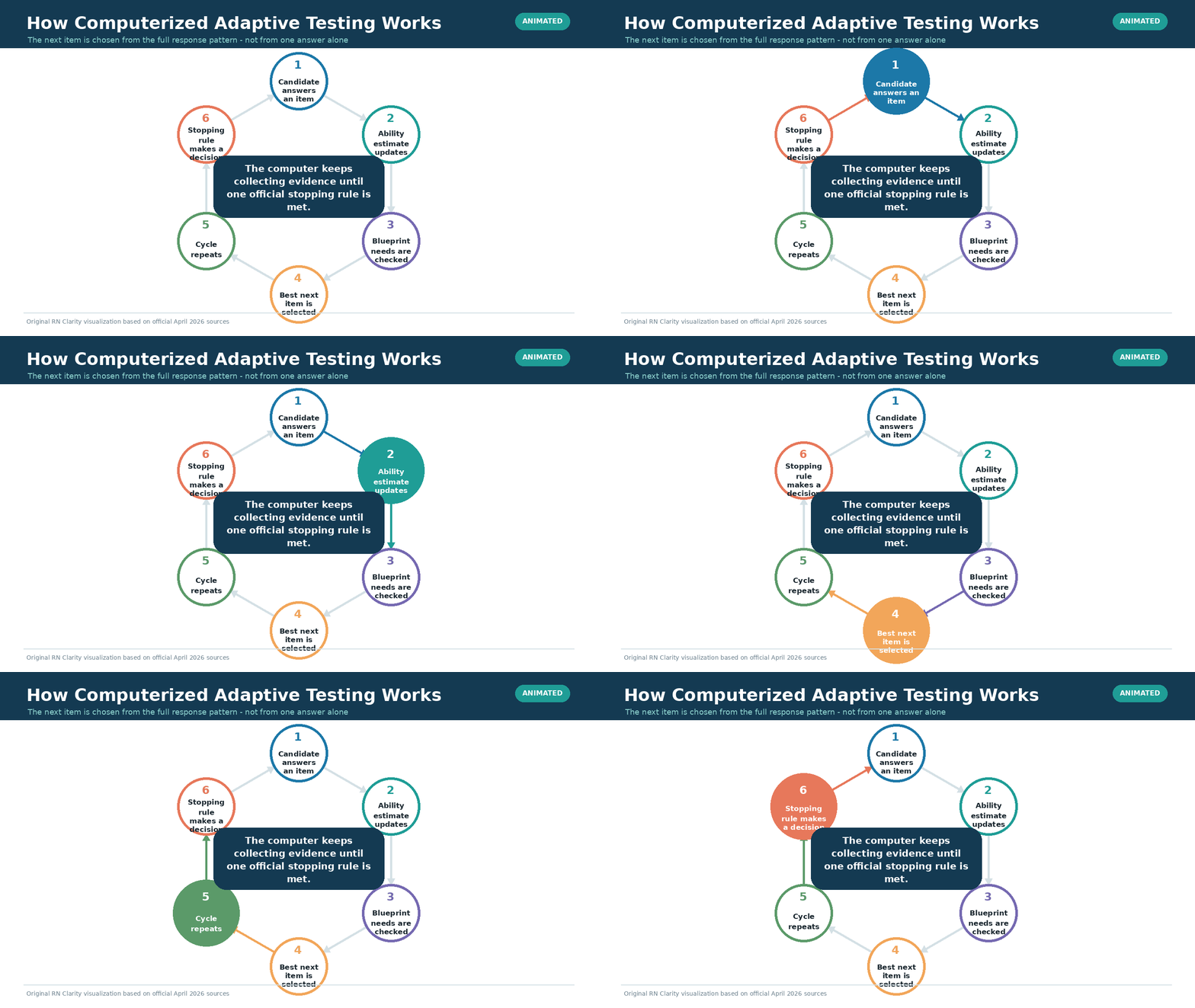
In adaptive testing, each candidate receives a unique examination. After a scored response, the computer updates its estimate of the candidate’s nursing ability using the full pattern of responses and the calibrated difficulty of the items. The next item is selected because it is useful for measuring ability and because the examination must continue to meet content and clinical judgment requirements.
The process is often described as a ladder. The passing standard is a level on the ladder, and the system is collecting evidence about whether the candidate’s ability is above or below that level. Correct and incorrect responses affect the estimate, but the final decision is not a simple count of correct answers.
5.5 Why a percentage-correct rule does not work
Candidates receive different items at different difficulty levels. Therefore, a statement such as “75% is required” or “only 20 questions can be missed” is not an official scoring rule. The examination estimates ability relative to the passing standard. Two candidates can have different raw numbers of correct responses and still receive different outcomes because their items and response patterns differ.
Go deeper: For a full breakdown of the 2026 blueprint, adaptive rules and scoring, see the NCLEX-RN® test plan explained.
6. The Eight Client Needs Content Areas
The official blueprint contains four major Client Needs categories. Safe and Effective Care Environment has two subcategories, and Physiological Integrity has four subcategories. Together, this creates eight scored content areas. Clinical judgment is integrated across them rather than treated as a ninth Client Needs category.
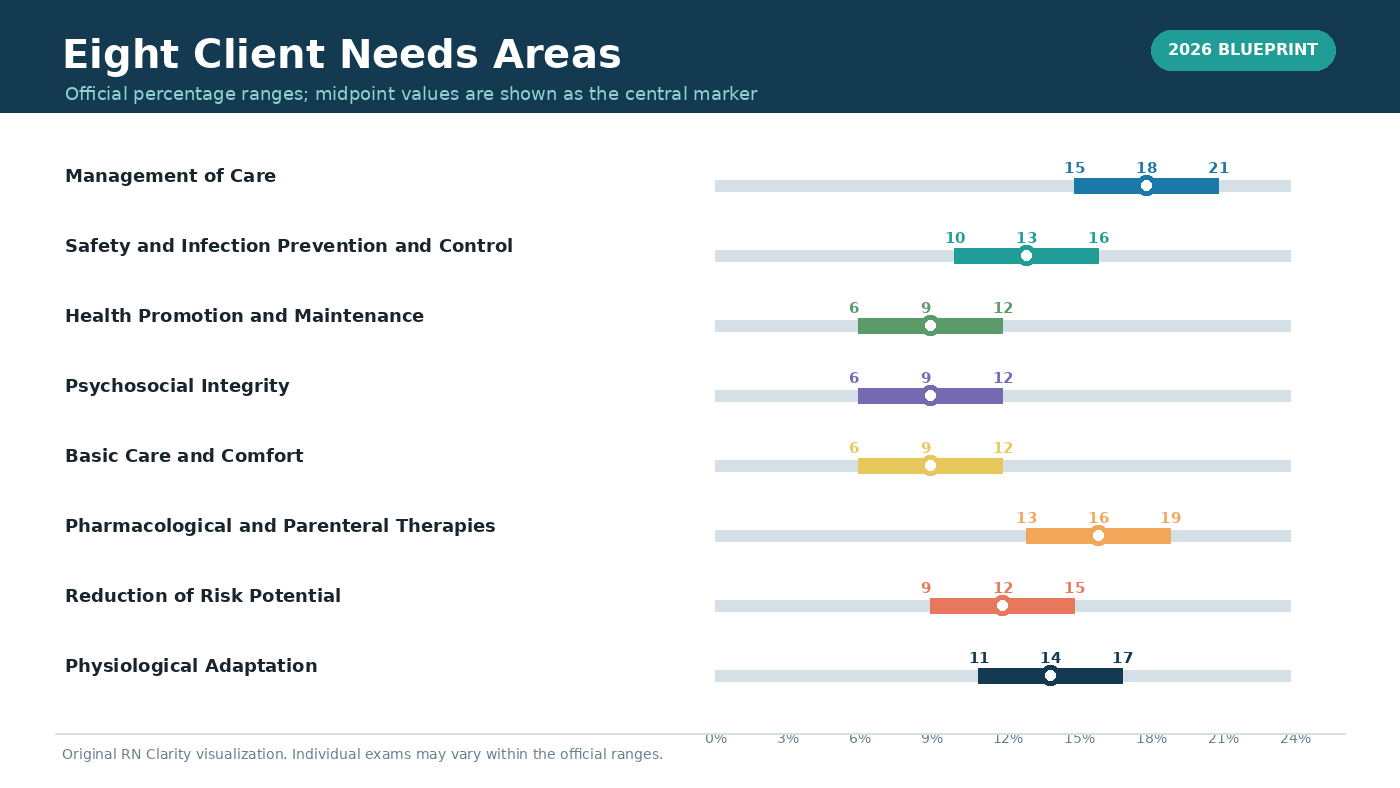
Content area | Official range | Midpoint |
|---|---|---|
Management of Care | 15-21% | 18% |
Safety and Infection Prevention and Control | 10-16% | 13% |
Health Promotion and Maintenance | 6-12% | 9% |
Psychosocial Integrity | 6-12% | 9% |
Basic Care and Comfort | 6-12% | 9% |
Pharmacological and Parenteral Therapies | 13-19% | 16% |
Reduction of Risk Potential | 9-15% | 12% |
Physiological Adaptation | 11-17% | 14% |
Individual adaptive examinations may differ from the midpoint distribution and can vary within the official ranges. The blueprint should guide study time, but a candidate should not ignore a lower-percentage area. Safety depends on competence across the examination.
6.1 Management of Care: 15-21%
Management of Care is the largest content range. It measures the RN’s ability to provide, direct and coordinate nursing care while protecting clients and health care personnel.
Go deeper: For how to turn prioritization frameworks into written priorities, outcomes and interventions, see the nursing care plans guide.
- Prioritization, assignment, delegation and supervision.
- Client rights, advocacy, informed consent, privacy and confidentiality.
- Advance directives, ethical responsibilities and legal scope of practice.
- Continuity of care, discharge planning, referrals and interdisciplinary collaboration.
- Handoff communication, documentation, quality improvement and incident reporting.
- Time management, resource use, conflict management and chain-of-command decisions.
Stable and predictable versus unstable and unpredictable
Delegation commonly depends on the stability of the client, the predictability of the outcome, the complexity of the task and the training of the person receiving it. Routine noninvasive care for a stable client may be delegated when permitted, while assessment, interpretation, initial teaching, care planning, evaluation and care of unstable clients generally require RN judgment.
How Management of Care appears in questions
- Which client should the nurse assess first?
- Which task can be assigned to trained assistive personnel?
- Which client is appropriate for an LPN/VN assignment within the stated scope?
- Which action by a staff member requires immediate intervention?
- Which information is essential in the handoff or discharge plan?
- What should the nurse do when a client refuses treatment?
6.2 Safety and Infection Prevention and Control: 10-16%
This area focuses on protecting clients, health care personnel and others from biological, physical and environmental hazards. Candidates should understand standard precautions, transmission-based precautions, aseptic and sterile technique, safe identification, equipment safety, fall prevention, restraints, emergency response and reporting of unsafe practice.
- Hand hygiene and appropriate personal protective equipment.
- Contact, droplet and airborne precautions.
- Specimen handling and disposal of contaminated material.
- Medication-error prevention and allergy verification.
- Client identification and procedure verification.
- Restraint alternatives, monitoring and legal requirements.
- Fire, disaster and environmental hazard response.
- Removing malfunctioning equipment and escalating unsafe practice.
Safety decision sequence
-
Control or remove the immediate hazard when possible.
-
Protect the client and other people from harm.
-
Call for assistance or initiate emergency response when required.
-
Complete focused assessment and necessary intervention.
-
Notify the appropriate person or team.
-
Document objective facts and complete required reporting.
This order changes when an immediate life threat requires treatment before routine assessment or reporting.
6.3 Health Promotion and Maintenance: 6-12%
Health Promotion and Maintenance covers expected growth and development, preventive care, early detection, health teaching and support for optimal wellness across the lifespan.
- Prenatal, antepartum, intrapartum, postpartum and newborn education.
- Developmental milestones and age-appropriate communication.
- Screening, prevention and immunization concepts.
- Nutrition, physical activity and lifestyle risk reduction.
- Readiness to learn, language needs, health literacy and teaching barriers.
- Home-care readiness, family risk and community resources.
A useful study method is to organize the material by life stage: prenatal, newborn, infant, toddler, preschool, school age, adolescent, adult and older adult. For each stage, study expected findings, major safety risks, screening priorities, communication and preventive teaching.
6.4 Psychosocial Integrity: 6-12%
Psychosocial Integrity measures care that promotes emotional, mental and social well-being. It includes therapeutic communication, acute and chronic mental illness, crisis, abuse, grief, coping, violence risk, substance use and support systems.
Therapeutic communication
Helpful responses focus on the client, acknowledge feelings, encourage expression, clarify meaning and assess safety directly. Unhelpful responses give false reassurance, minimize the concern, offer personal advice, ask accusatory “why” questions or argue with a delusion.
Suicide and violence risk
When risk is suspected, the nurse should ask direct and clear questions about thoughts, plan, access, intent, timing, prior attempts, substance use, protective factors and available support. Immediate safety takes priority over routine conversation.
6.5 Basic Care and Comfort: 6-12%
Basic Care and Comfort includes activities of daily living and interventions that preserve function, dignity and comfort. Topics include mobility, positioning, hygiene, nutrition, elimination, skin integrity, pain, sleep, assistive devices, intake and output, tube feeding and nonpharmacological comfort measures.
The word “basic” does not mean low risk. Incorrect positioning can worsen breathing, poor feeding technique can cause aspiration, immobility can contribute to thrombosis and pneumonia, and inadequate skin care can lead to pressure injury and infection.
6.6 Pharmacological and Parenteral Therapies: 13-19%
This is one of the largest content areas. It measures safe medication administration, calculation, monitoring, teaching, IV therapy, central venous access, blood products, parenteral nutrition and evaluation of therapeutic or adverse responses.
- Medication rights, allergies, contraindications and reconciliation.
- Dosage calculations and unit conversions.
- Relevant vital signs, laboratory values and drug interactions.
- High-alert medication safeguards and independent verification.
- IV fluids, infusion pumps, line complications and titration within an order.
- Blood administration and recognition of transfusion reactions.
- Pain medication, controlled substances and safe disposal.
- Client teaching and evaluation of therapeutic effect.
Study medications by class
-
Reason for use and general mechanism.
-
Common examples and route considerations.
-
Expected therapeutic response.
-
Important common and life-threatening adverse effects.
-
Relevant assessments and laboratory monitoring.
-
When to hold, clarify or escalate.
-
Essential client teaching and available reversal strategy.
NCSBN® does not publish a fixed list of drugs that will appear. Candidates should build strong class-based safety knowledge rather than attempting to memorize every uncommon medication fact.
6.7 Reduction of Risk Potential: 9-15%
Reduction of Risk Potential focuses on preventing complications related to existing conditions, diagnostic tests, treatments and procedures. It includes trend recognition, focused assessment, preoperative and postoperative care, specimen collection, moderate sedation, tubes, drains, catheters, peripheral IV lines and client preparation.
Trend thinking
A single value may be less important than the direction of change. A blood pressure of 102/66 mm Hg may be acceptable for one client but dangerous for another whose pressure was much higher and who is now pale, confused and producing very little urine. Always ask what changed, how quickly it changed, whether the client is symptomatic and whether the change followed a treatment or procedure.
6.8 Physiological Adaptation: 11-17%
Physiological Adaptation covers acute, chronic and life-threatening physical conditions. It includes emergencies, shock, sepsis, oxygenation failure, ventilation, chest tubes, hemodynamic instability, dysrhythmias, dialysis, fluid and electrolyte imbalance, wound and drain management, suctioning, postoperative complications, pacing devices and recognition of unexpected responses to therapy.
Study by physiological pattern
- Airway obstruction and impaired ventilation.
- Impaired oxygenation and respiratory failure.
- Reduced cardiac output and poor tissue perfusion.
- Fluid deficit, fluid overload and electrolyte disturbance.
- Infection, systemic inflammation and shock.
- Bleeding, clotting and organ failure.
- Increased intracranial pressure and neurologic deterioration.
- Endocrine crisis and acute worsening of chronic disease.
Understanding these patterns helps candidates reason through an unfamiliar diagnosis because the nursing priorities follow the underlying threat to airway, breathing, circulation, neurologic function or organ perfusion.
7. The Six Integrated Nursing Processes
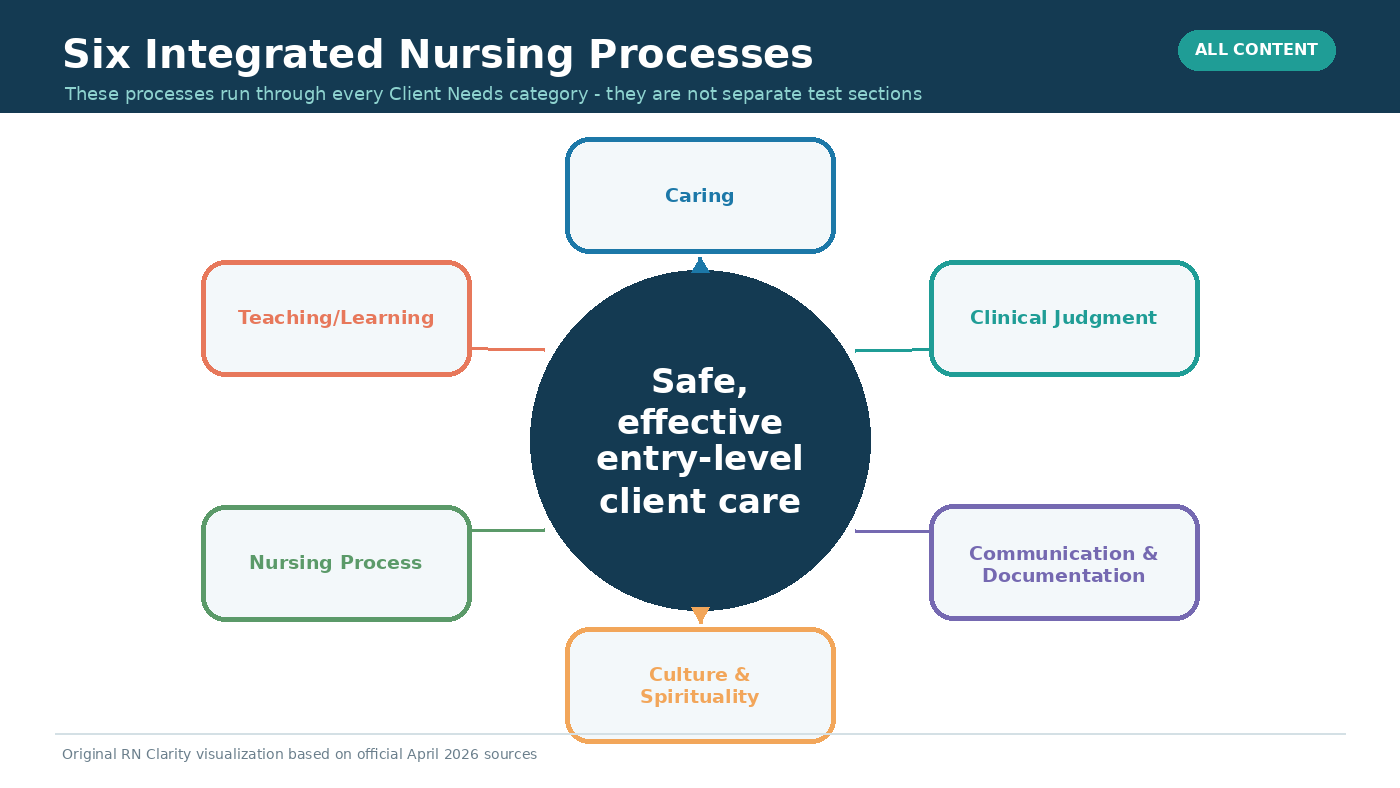
The six integrated processes are fundamental to nursing and are present throughout the Client Needs blueprint. They are not separately scored content areas. One medication question can also measure communication, teaching, culture, documentation and clinical judgment.
7.1 Caring
Caring is reflected in respect, trust, compassion, privacy, dignity and support. In an item, a caring response recognizes the client as a person rather than a diagnosis and avoids stigmatizing or dismissive language.
7.2 Clinical Judgment
Clinical judgment is the observable result of critical thinking and decision-making. It requires recognition of relevant information, interpretation of the situation, prioritization, action and evaluation.
7.3 Communication and Documentation
Communication includes verbal and nonverbal interactions with the client, significant others and the health care team. Documentation should be timely, objective, accurate and relevant. Urgent information should be communicated promptly, while the record should show assessments, actions and responses without judgmental wording.
7.4 Culture and Spirituality
The 2026 plan emphasizes client-reported and self-identified preferences. Do not assume a person’s values from appearance, name, religion, ethnicity, gender or background. Ask respectfully what matters to the individual while maintaining the applicable standard of safe care.
7.5 Nursing Process
The test plan describes assessment, analysis, planning, implementation and evaluation. Candidates may know this as ADPIE. Questions often test the process indirectly by asking what the nurse should do first, what action follows an assessment or how effectiveness should be evaluated.
Go deeper: For a step-by-step walkthrough of every phase — assessment, diagnosis, outcomes, interventions, rationales and evaluation — see the nursing care plans guide.
7.6 Teaching/Learning
Teaching begins with readiness, prior knowledge, language, health literacy and learning barriers. The nurse should select an understandable method and verify learning through teach-back, demonstration or return demonstration rather than assuming that information was understood because it was spoken.
8. Clinical Judgment and the Six CJMM Steps
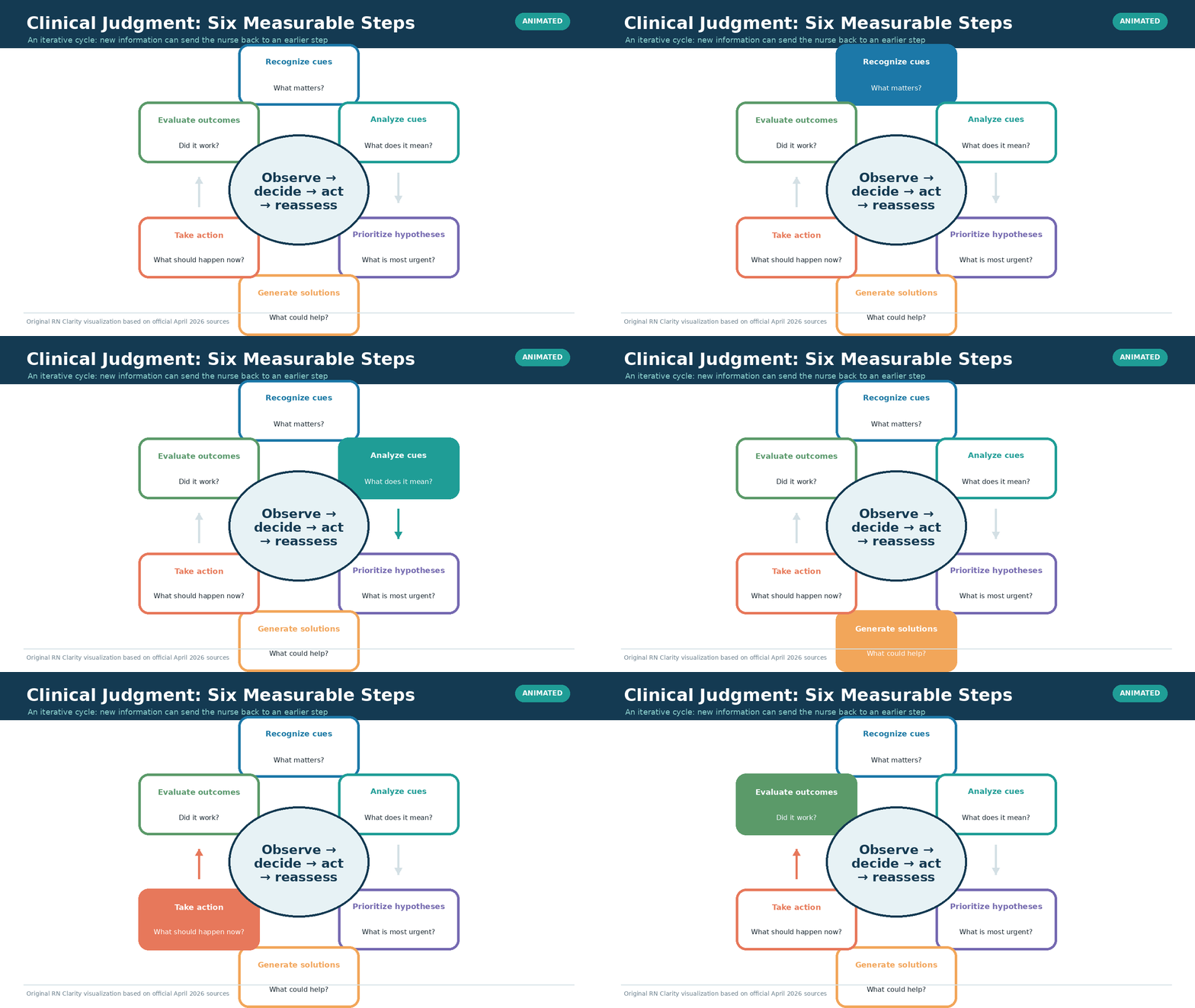
The NCSBN® Clinical Judgment Measurement Model, or CJMM, is a framework for measuring clinical judgment on a standardized high-stakes examination. It does not replace the nursing process or every reasoning model used in nursing education. It identifies six measurable steps that can be represented in case studies and stand-alone items.
8.1 Recognize cues
Recognizing cues means identifying information that is relevant and important. Cues may come from history, vital signs, laboratory results, medication records, physical assessment, client statements, family observations, intake and output, monitoring, imaging or previous documentation.
Example: A postoperative client has a heart rate of 122/min, blood pressure of 88/54 mm Hg, increasing abdominal pain, cool skin and urine output of 15 mL in one hour. Recognizing cues means selecting these findings as important rather than treating each number as unrelated.
8.2 Analyze cues
Analyzing cues means organizing and connecting the relevant information. In the postoperative example, tachycardia, hypotension, cool skin, low urine output and increasing pain form a pattern suggesting reduced circulating volume and possible internal bleeding.
- Which findings belong together?
- What pathophysiological process can explain the pattern?
- Is the client improving, worsening or unchanged?
- Which finding does not fit the leading explanation?
- What additional data would be most useful?
8.3 Prioritize hypotheses
A hypothesis is a possible explanation for the client’s condition. The candidate should compare hypotheses by urgency, likelihood, risk of harm, time sensitivity and support from the available cues. The most familiar diagnosis is not automatically the priority diagnosis.
8.4 Generate solutions
Generating solutions means identifying expected outcomes and reasonable interventions. The candidate must distinguish actions that are useful from actions that are necessary now, unsafe, delayed, outside independent RN authority or unsupported by the case.
Go deeper: For how to write SMART expected outcomes and choose individualized interventions with evidence-based rationales, see the nursing care plans guide.
8.5 Take action
Taking action means implementing the solution that addresses the highest priority. Assessment often comes before intervention when more information is needed. However, immediate action comes first when delay is clearly dangerous, such as absent pulse, airway obstruction, active seizure, suspected transfusion reaction, severe hypoglycemia or an immediate suicide attempt.
8.6 Evaluate outcomes
Evaluation compares observed results with expected results. The nurse should not assume an intervention worked. Improvement may be shown by better blood pressure, lower heart rate, warmer skin, improved mental status, increased urine output, reduced symptoms or a stabilizing trend. New deterioration can require a revised plan and another cycle of cue recognition.
Go deeper: Practise applying all six CJMM steps with worked examples in the clinical judgment guide.
9. How Clinical Judgment Case Studies Work
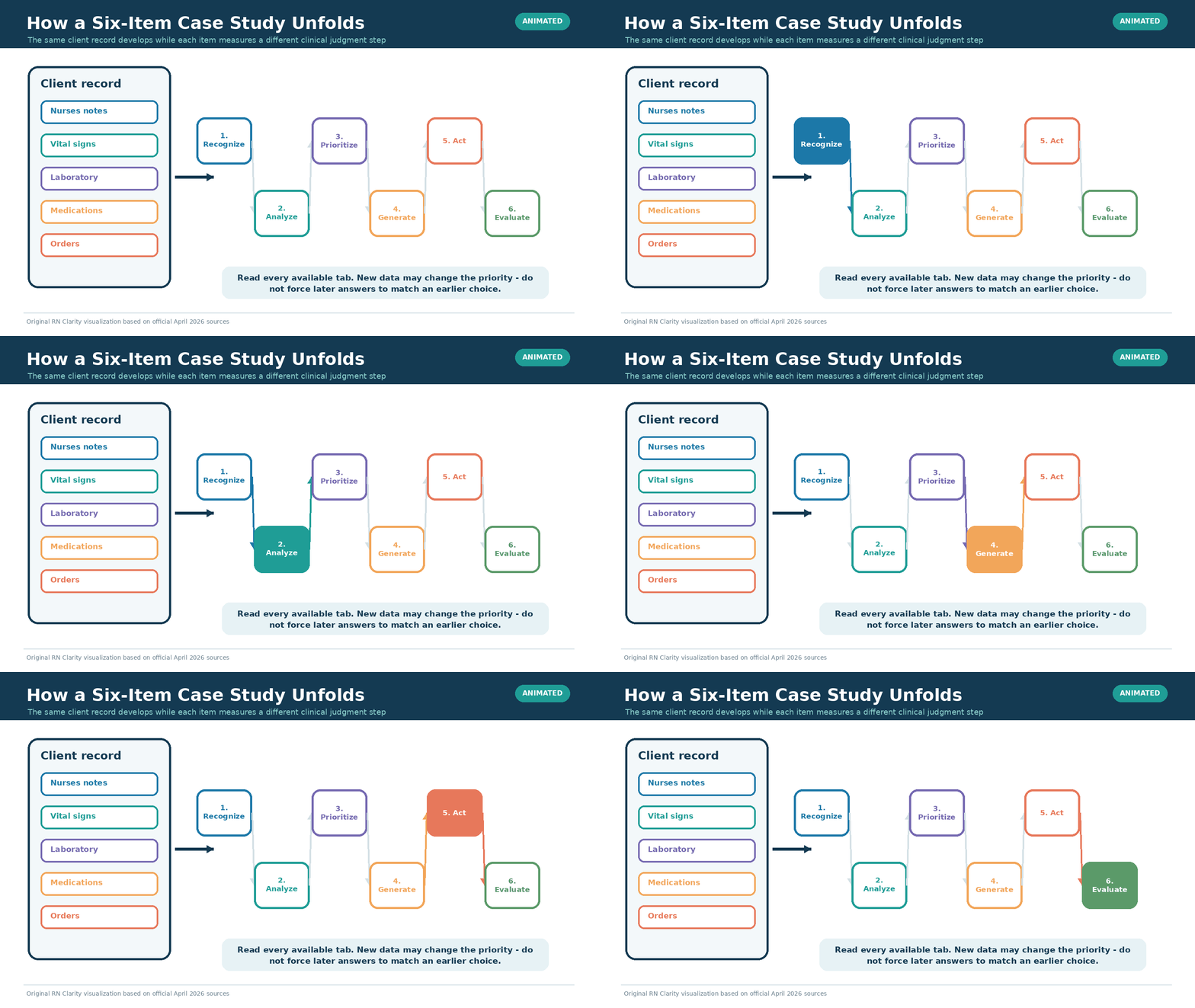
Every candidate receives three case-study sets. Each case has six items connected to one unfolding client presentation. The six items address recognize cues, analyze cues, prioritize hypotheses, generate solutions, take action and evaluate outcomes.
9.1 Unfolding information
A case can present information through tabs such as nurses’ notes, history and physical, vital signs, laboratory results, medication record, diagnostic findings, orders or flow sheets. New information may appear as the case develops. An earlier clue can become more important after a later laboratory or assessment finding appears.
9.2 Read every relevant tab
The examination interface may allow a candidate to move forward without opening every exhibit. Candidates should intentionally review the available tabs and note the time sequence. Missing one panel can remove the cue that makes the correct answer clear.
9.3 Do not force later answers to match an earlier response
Each item should be answered from the information currently available. A previous response may have been wrong, or new data may change the leading hypothesis. The goal is not to maintain consistency with an earlier click; it is to make the best current clinical decision.
9.4 Build a timeline
- Baseline condition and reason for care.
- First unexpected change.
- Intervention or new order.
- Observed response.
- New complication or additional cue.
- Current priority and expected outcome.
Six-step internal script: What matters? What does it mean? What is most urgent? What could help? What should happen now? Did it work?
Go deeper: See how unfolding cases are built — and how to work through them tab by tab — in the NGN case studies guide.
10. Question and Item Formats
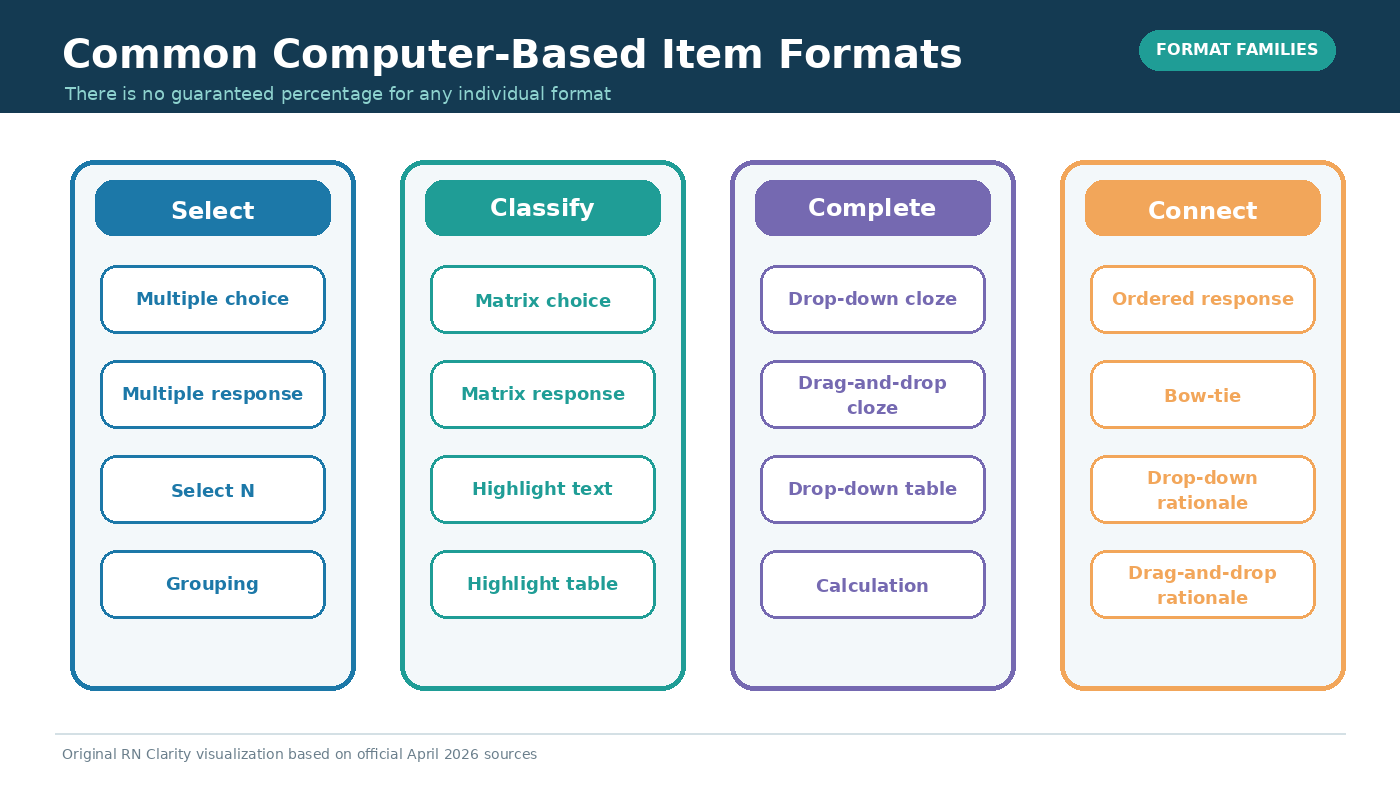
The examination uses multiple computer-based item formats. Any format can include charts, tables or graphic information, and there is no official guaranteed percentage for any single format. Candidates should practise the official tutorial and sample pack rather than trying to predict how many bow-tie, matrix or multiple-response items will appear.
10.1 Multiple choice
Select one best answer. Read the stem, identify exactly what is being asked, eliminate unsafe or irrelevant options and choose the best supported response rather than an answer that is merely possible.
10.2 Multiple response
Treat each option as an independent true-or-false decision. Do not select an option because it is loosely related. Select it only when it directly answers the question and is supported by the scenario.
10.3 Select N
The item states the number of responses required. Identify all plausible answers, compare their strength and then select exactly the requested number.
10.4 Multiple-response grouping
The item contains more than one response group. Evaluate each group separately. Do not assume that each group needs the same number of selections.
10.5 Matrix multiple choice
Choose one classification for each row. Read the column headings carefully and treat every row as a separate clinical judgment.
10.6 Matrix multiple response
More than one cell may be correct in a row. Evaluate each relationship rather than assuming one answer per row.
10.7 Ordered response
Arrange actions or steps in the correct sequence. Look for the immediate safety action, prerequisites, actions that depend on earlier steps and the final evaluation or documentation step.
10.8 Calculation
Identify the order, the amount available and the units. Convert when needed, calculate, round only at the end and check whether the result is clinically reasonable.
10.9 Drop-down cloze
Complete a sentence or paragraph by selecting choices from menus. Read the complete sentence after filling every blank to confirm clinical and grammatical sense.
10.10 Drag-and-drop cloze
Place choices into blank spaces. Confirm whether choices can be used once or more than once and verify the relationship among all blanks.
10.11 Drop-down table
Select a response in each table row. Pay attention to dates, times, units and trends.
10.12 Highlight text
Highlight only the requested phrases. If the item asks for findings requiring follow-up, do not highlight normal information simply because it is medically interesting.
10.13 Highlight table
Select relevant cells in a table. Check the headers and time points because the trend may be more important than one value.
10.14 Bow-tie
Identify the most likely condition first, then select actions that address that condition and parameters that show response or deterioration. Every part should tell one coherent clinical story.
10.15 Drop-down rationale
Complete a linked statement in which an action and reason must both be correct and logically connected.
10.16 Drag-and-drop rationale
Place linked clinical elements into a statement. Test whether the action is appropriate specifically because of the selected finding or reason.
Go deeper: Learn how to practise every one of these formats effectively in the practice questions guide.
11. Partial-Credit Scoring
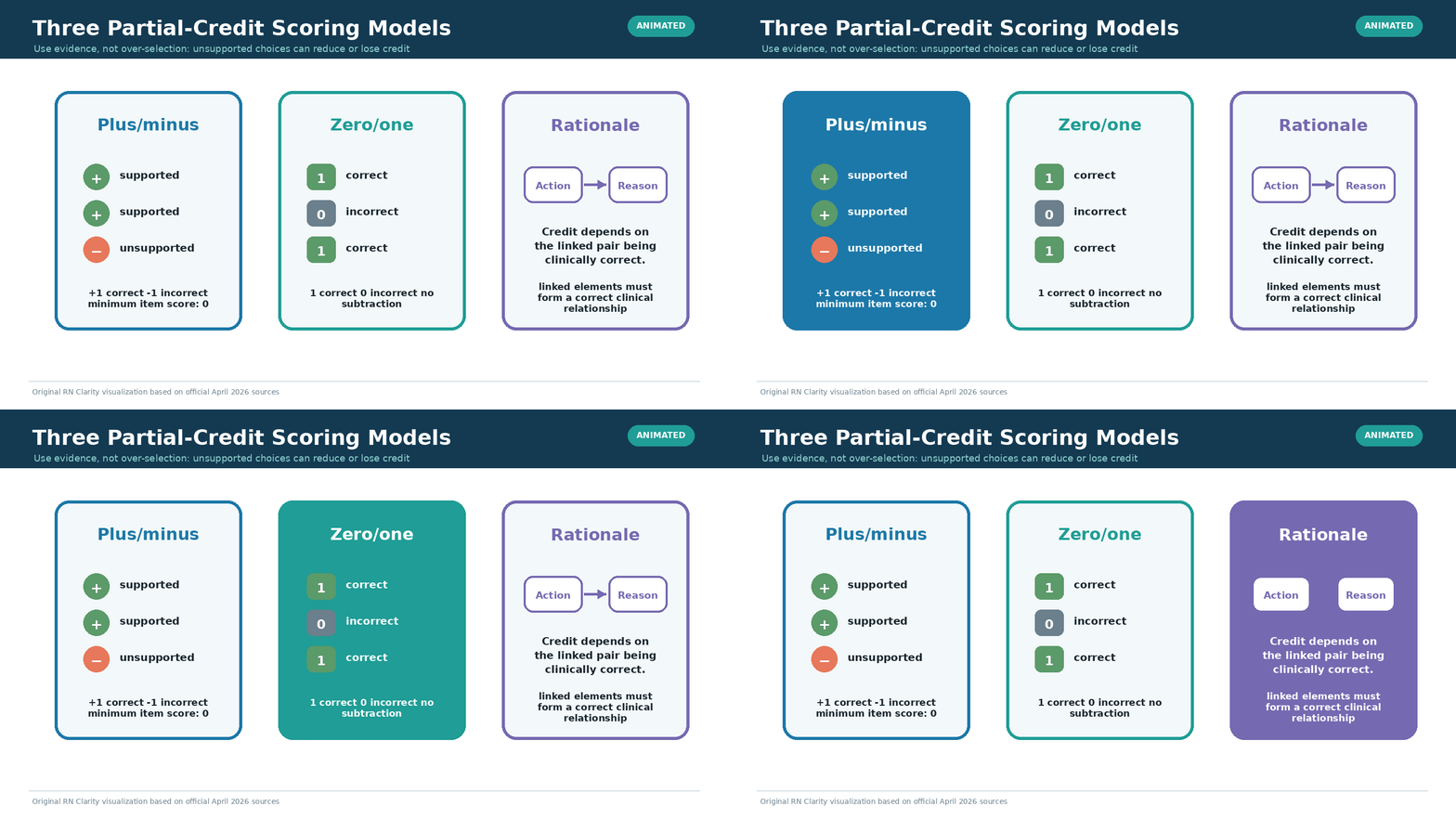
Some items contain more than one correct response element. The examination can award partial credit through plus/minus, zero/one and rationale scoring. The scoring model used depends on the item design.
11.1 Plus/minus scoring
A correct response element adds credit and an incorrect response element subtracts credit. The item score does not fall below zero. This discourages selecting many unsupported options simply because they might be related.
Simplified example: if an item has several correct options and the candidate selects three correct and one incorrect option, the candidate may receive three positive points and one negative point, for a net of two raw points on that item. The examination’s psychometric calculation is more complex, but this illustrates the principle.
11.2 Zero/one scoring
Each response element is scored independently. A correct element receives credit and an incorrect element receives no credit. An incorrect choice does not subtract credit already earned on another independent element.
11.3 Rationale scoring
Rationale scoring is used when response elements are linked. For example, an action may need to be paired with the correct reason. Both parts must form a correct clinical relationship to earn the available credit for that linked group.
Best strategy: Do not over-select. Choose each response because it is supported by the information and answers the exact question.
12. How the Pass-or-Fail Decision Is Made
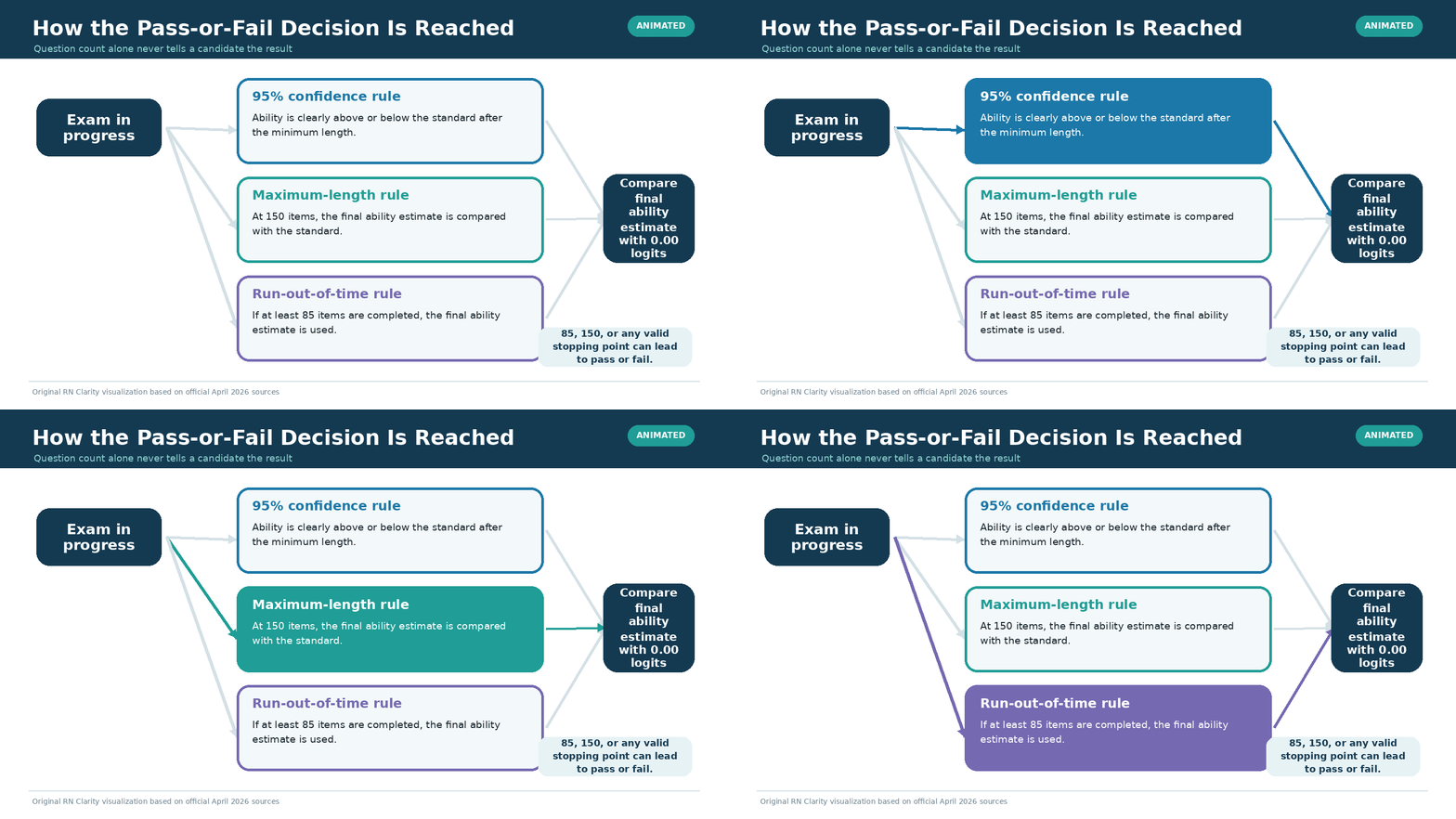
The NCLEX-RN® uses three official stopping rules. The examination ends when one of them can make a decision. The length alone cannot reveal the result.
12.1 The 95% confidence rule
After the minimum number of items has been completed, the examination can stop when it is at least 95% confident that the candidate’s ability is clearly above or clearly below the passing standard. This is the most common stopping rule.
12.2 The maximum-length rule
If the candidate’s estimated ability remains close to the passing standard, the examination can continue to 150 items. At that point, the final ability estimate is compared with the standard. At or above the standard results in a pass; below the standard results in a fail.
12.3 The run-out-of-time rule
If time ends before the maximum length, a candidate who has not completed the minimum required number of items fails. If at least the minimum has been completed, the final ability estimate based on the completed scored responses is compared with the passing standard.
12.4 What 0.00 logits means
A logit is a measurement unit used to compare candidate ability and item difficulty. It is not a percentage. A passing standard of 0.00 logits does not mean zero mistakes, 50% correct or any other fixed percentage.
12.5 What the number of items means
- A candidate can pass at 85 items.
- A candidate can fail at 85 items.
- A candidate can pass at 150 items.
- A candidate can fail at 150 items.
- A valid stopping point between 85 and 150 can also lead to either result.
The final item’s topic, format or perceived difficulty also does not reliably predict the result. Candidates do not know whether an item was scored or pretest, its calibrated difficulty or how the full response pattern affected the ability estimate.
13. Practical Question-Answering Strategies
13.1 Priority questions
Priority questions ask who or what requires attention first. Use a flexible safety hierarchy rather than one rigid mnemonic.
-
Immediate threats to airway, breathing, circulation or severe neurologic function.
-
Acute and unexpected changes such as new confusion, sudden chest pain, stridor, rapid hypotension, uncontrolled bleeding or new unilateral weakness.
-
Unstable and rapidly changing clients before stable and predictable clients.
-
Actual severe problems before potential problems, unless the potential risk is immediate and catastrophic.
-
Time-sensitive treatment where delay changes the outcome, such as severe hypoglycemia, anaphylaxis, stroke signs, hyperkalemia, sepsis or a transfusion reaction.
Do not prioritize a client simply because the diagnosis sounds serious, the client is older or a single vital sign is outside a memorized range. Compare the complete presentations and the direction of change.
13.2 Delegation and assignment
-
Is the task appropriate to delegate?
-
Is the client stable and the outcome predictable?
-
Is the person trained, competent and authorized?
-
Are instructions and reporting expectations clear?
-
Can the RN supervise and evaluate the result?
The RN generally retains initial assessment, interpretation, nursing diagnosis, care planning, evaluation, triage, new or complex teaching and decisions involving unstable clients. Assistive personnel may collect and report routine data, but the RN interprets the meaning and decides what should happen next.
13.3 Medication questions
Medication questions should be approached as safety questions. Before administration, check the correct client, drug, dose, route, time, indication, allergies, contraindications, relevant laboratory values, vital signs, interactions, swallowing ability, IV site and required verification.
When to hold and clarify
- A documented allergy or serious contraindication is present.
- The dose appears unsafe or incomplete.
- A relevant vital sign or laboratory value creates a significant risk.
- The order conflicts with the client’s current condition.
- The route is inappropriate or the prescription is unclear.
- A dangerous interaction or duplicate therapy is identified.
Do not hold every medication because of a mildly abnormal finding. Determine whether the finding is clinically relevant to the medication and whether the order contains specific parameters.
13.4 A consistent calculation workflow
-
Identify the ordered dose.
-
Identify the available concentration or supply.
-
Confirm the units and convert when necessary.
-
Set up one familiar method, such as dimensional analysis or ordered divided by available multiplied by quantity.
-
Calculate and round only at the end according to the item instruction.
-
Check that the result is clinically plausible for the client, route and situation.
13.5 Case-study strategy
-
Establish the baseline and reason for care.
-
Identify what changed and when it changed.
-
Cluster cues by possible physiological or psychosocial process.
-
State the priority concern in simple language.
-
Choose actions that directly match that concern.
-
Identify measurable findings that would show improvement, failure or deterioration.
14. A Complete Study Method
A strong preparation program combines content review, active recall, practice questions, case studies, spaced review and error analysis. One activity should not replace all the others.
14.1 Content review
Review pathophysiology, assessment findings, nursing priorities, medications, procedures, complications, client education and expected outcomes. After a section, close the source and explain the topic in plain language without looking. Passive rereading can create familiarity without reliable recall.
14.2 Active recall
- Write the signs of hypocalcemia from memory.
- Explain the difference between DKA and HHS without notes.
- List the first actions for a suspected transfusion reaction.
- Draw the six clinical judgment steps.
- State which nursing decisions cannot be delegated.
14.3 Spaced review
Revisit material at increasing intervals. A simple sequence is the same day, the next day, three days later, one week later and two weeks later. Topics that remain weak should return more frequently.
14.4 Practice questions
Practice questions become valuable when every rationale is reviewed. For each question, explain why the correct answer is correct, why each distractor is wrong, which cue mattered most and whether the error came from content, reasoning, scope, calculation, reading or rushing.
14.5 Error log
Date | Topic | Error type | Incorrect thought | Correct principle | Review date |
|---|---|---|---|---|---|
May 1 | Delegation | Scope | Delegated initial teaching | Initial teaching requires RN judgment | May 3 |
May 1 | Insulin | Knowledge | Confused onset patterns | Review rapid and short-acting insulin | May 2 |
May 2 | Sepsis | Missed cue | Ignored falling urine output | Trend suggested impaired perfusion | May 5 |
Useful error categories include knowledge gap, misread stem, missed cue, true-but-not-priority answer, unsupported assumption, scope error, medication-safety error, calculation error, rushing and changing a correct answer without evidence.
14.6 How to review a practice question properly
The learning value of a practice question begins after the answer is submitted. A candidate who completes hundreds of questions but reads only the score may repeat the same thinking errors for weeks. A candidate who studies a smaller set carefully can improve faster because every question becomes a short lesson in content, safety and clinical judgment.
Use the following review sequence for every missed question and for every question answered correctly by guessing:
- Restate the question in plain language. Identify whether it asks for a priority, an assessment, an intervention, a finding that requires follow-up, a delegated task, an expected outcome or evidence of deterioration.
- Name the decisive cue. Identify the single word, trend, symptom, laboratory result, medication or timing detail that most strongly changes the answer.
- Explain the correct response without copying the rationale. Use one or two sentences that connect the client information to the nursing action.
- Explain why each alternative is weaker. An option may be generally true yet wrong because it is delayed, outside scope, unrelated, incomplete or less urgent.
- Classify the error. Decide whether it was caused by missing knowledge, incorrect prioritization, a scope mistake, a calculation mistake, misreading, rushing, overthinking or adding facts that were not provided.
- Create one transferable rule. Write a principle that can help with a different client, such as “a new change in mental status is an urgent cue” rather than memorizing the wording of one question.
- Schedule the topic for review. Revisit it after one day, several days and one week until the rule can be recalled and applied without help.
A correct answer should also be reviewed when the reasoning was uncertain. Guessing correctly does not prove readiness. Mark the question as uncertain, identify the missing concept and review it in the same way as an incorrect response. This prevents an inflated sense of confidence.
14.7 Build a personal decision-rule library
A decision-rule library is a short collection of principles repeatedly used in safe entry-level nursing care. It should not become a list of rigid slogans. Each rule should include an exception or a reminder to use the client data.
- Airway, breathing and circulation are powerful priorities, but the exact situation matters. A protected airway may not outrank an active safety threat or uncontrolled bleeding.
- Assess before intervening when more information is needed; intervene immediately when the danger is already clear and delay could cause harm.
- An acute, unexpected change usually deserves more attention than an expected chronic finding.
- The RN retains assessment, interpretation, care planning, evaluation and care of unstable clients; routine data collection may be delegated when the client and task are appropriate.
- A trend can be more important than a single value. Compare the current finding with the client’s baseline and recent treatment.
- For medication questions, connect the medication to the assessment, relevant laboratory result, adverse effect, therapeutic response and required teaching.
- For teaching questions, evaluate learning through teach-back, demonstration or return demonstration rather than assuming that information delivered was understood.
- For case studies, update the hypothesis when new information appears. Do not protect an earlier conclusion when later cues no longer support it.
Keep the library short enough to review regularly. Remove rules that are vague, duplicated or misleading. The goal is flexible reasoning, not automatic answer selection.
14.8 Measure readiness with more than one number
No single practice percentage can guarantee success because commercial question banks differ in difficulty, scoring and design. Readiness should be judged through a pattern of evidence collected over time.
A stronger readiness picture includes:
- Consistent performance across several mixed, timed sessions rather than one unusually high result.
- Reasonable performance across all eight Client Needs content areas, with no major area repeatedly ignored.
- Ability to explain the six clinical judgment steps and apply them to unfamiliar cases.
- Improvement in the personal error log, especially fewer repeated safety, delegation and prioritization mistakes.
- Comfort with multiple-choice, multiple-response, matrix, highlight, cloze, bow-tie, calculation and rationale formats.
- Ability to complete long practice sessions without severe rushing, loss of concentration or repeated careless errors.
- A stable sleep routine, realistic examination-day plan and an anxiety-management strategy that can be used without interfering with judgment.
A candidate who has one weak content area should use focused review while continuing mixed practice. A candidate whose errors occur across many subjects may need to return to core pathophysiology, pharmacology, assessment and safety principles before increasing question volume. A candidate who knows the content but repeatedly misreads stems should slow down, identify the task word and summarize the question before reviewing options.
Readiness is not the absence of anxiety or uncertainty. It is the ability to make safe, supported decisions even when the diagnosis, wording or item format is unfamiliar.
Go deeper: The techniques in this section — active recall, spaced review and error analysis — are covered in depth in the active learning guide.
15. Twelve-Week Study Plan
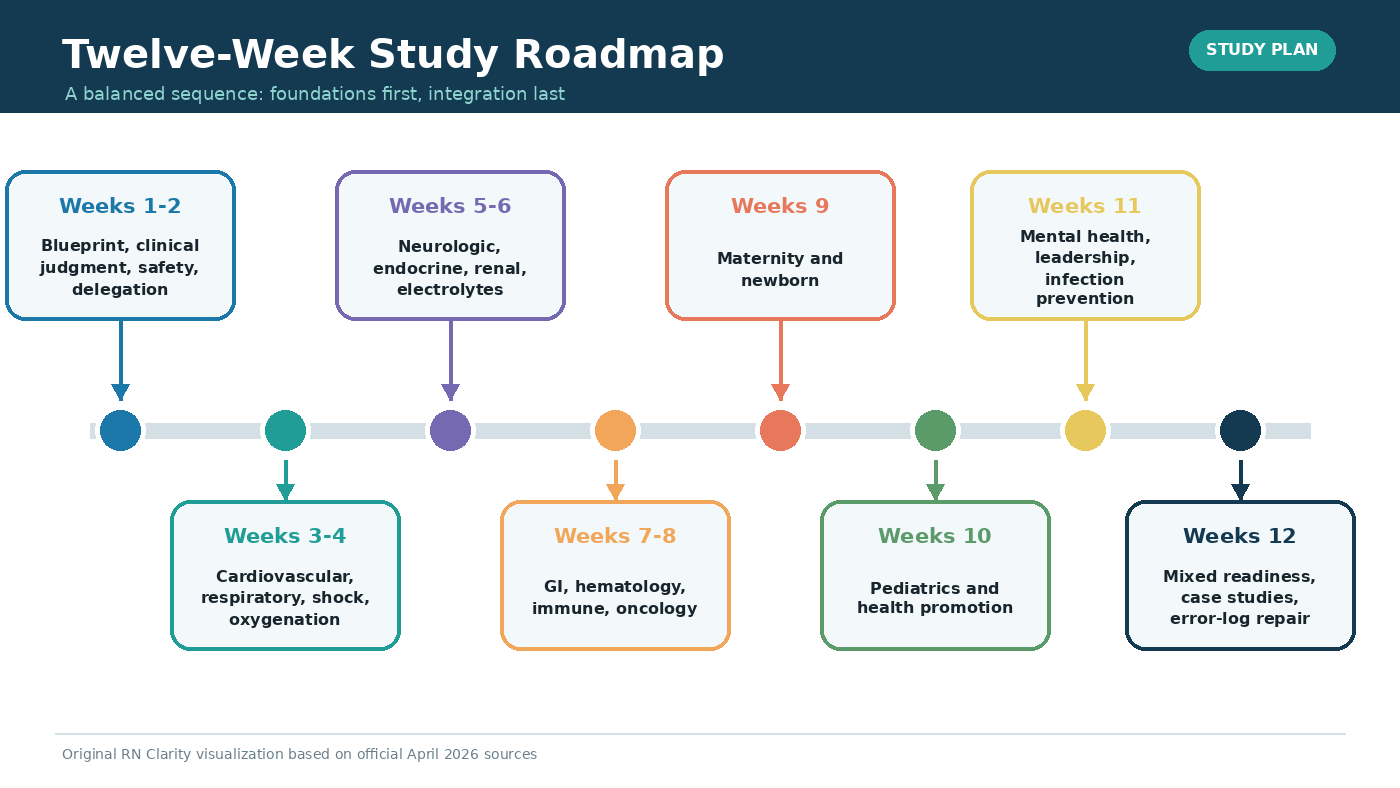
Weeks 1-2: Foundations and baseline
- Read the official blueprint and understand the eight Client Needs areas.
- Complete a baseline assessment and start an error log.
- Learn the six clinical judgment steps.
- Review prioritization, delegation, safety and infection prevention.
- Begin daily medication-class review and mixed questions.
Weeks 3-4: Cardiovascular and respiratory
- Acute coronary syndrome, heart failure, dysrhythmias, hypertension and shock.
- Asthma, COPD, pneumonia, pulmonary embolism and respiratory failure.
- Oxygen delivery, mechanical ventilation, chest tubes and acid-base balance.
- Complete clinical judgment cases from both systems.
Weeks 5-6: Neurologic, endocrine and renal
- Stroke, seizure, increased intracranial pressure and spinal cord injury.
- Diabetes, hypoglycemia, DKA, HHS, thyroid and adrenal disorders.
- Acute kidney injury, chronic kidney disease, dialysis, fluid balance and electrolytes.
Weeks 7-8: Gastrointestinal, hematologic and immune
- GI bleeding, liver failure, pancreatitis, bowel obstruction and ostomy care.
- Anemia, sickle cell disease, coagulation disorders and DIC.
- Neutropenia, cancer therapies, infection risk and treatment complications.
- Continue cumulative mixed questions so earlier systems remain active.
Week 9: Maternity and newborn
- Prenatal care and pregnancy complications.
- Labor stages and fetal heart-rate interpretation.
- Preeclampsia, eclampsia, postpartum hemorrhage and infection.
- Newborn assessment, complications and obstetric medications.
Week 10: Pediatrics and health promotion
- Growth and development, milestones and age-based vital signs.
- Pediatric respiratory disorders, dehydration and medication calculations.
- Family-centred care, injury prevention and age-appropriate communication.
Week 11: Mental health, leadership and safety
- Therapeutic communication, suicide assessment, psychosis, mania and anxiety.
- Substance withdrawal, abuse, neglect and crisis intervention.
- Delegation, scope, ethics, infection prevention and emergency response.
Week 12: Integration and readiness
- Complete realistic timed examinations and case-study sets.
- Review the error log and repair recurring reasoning patterns.
- Practise every computer-based format.
- Adjust sleep and reduce last-minute overload.
16. Six-Week Accelerated Plan
Week | Primary focus |
|---|---|
1 | Blueprint, baseline, clinical judgment, prioritization, delegation, safety and infection prevention. |
2 | Cardiovascular, respiratory, shock, oxygenation, fluids and electrolytes. |
3 | Neurologic, endocrine, renal and gastrointestinal systems. |
4 | Pharmacology, dosage calculation, IV therapy, blood products and laboratory interpretation. |
5 | Maternity, newborn, pediatrics, health promotion and mental health. |
6 | Mixed adaptive practice, case studies, error-log repair and exam-day preparation. |
An accelerated plan requires longer daily sessions, but sleep and recovery remain necessary. Exhaustion reduces attention, memory and clinical judgment.
Go deeper: Want a week-by-week schedule you can adapt to your own timeline? Use the NCLEX-RN® study plan builder.
17. The Final Seven Days
Day | Recommended focus |
|---|---|
7 days before | Complete the last full readiness assessment and identify no more than three priority weaknesses. |
6 days before | Review the weakest content area and complete targeted questions. |
5 days before | Review medication safety, adverse effects, antidotes and monitoring. |
4 days before | Review prioritization, delegation, infection prevention and emergency responses. |
3 days before | Complete case studies and rehearse the six clinical judgment steps. |
2 days before | Use light mixed practice and verify identification, appointment and travel details. |
1 day before | Stop intensive testing early, prepare clothing and identification, and protect sleep. |
Exam day | Arrive rested. Read carefully, maintain a reasonable pace and avoid trying to infer performance from question type or difficulty. |
18. Examination-Day Preparation
18.1 Acceptable identification
Identification must be physical, current, government-issued and include the required name, recent photograph and signature information. The first and last names must match the Pearson registration record. Domestic and international requirements differ, so candidates should verify the current official identification page before travelling.
18.2 Arrival and check-in
Plan to arrive at least 30 minutes before the appointment. Testing-centre security procedures can include identity verification, storage of personal items and examination rules. Late arrival can result in loss of the appointment and registration fee.
18.3 Electronic devices and personal items
Phones, smart watches, smart glasses, smart rings, fitness bands, cameras and other electronic devices must be powered off and stored according to Pearson instructions. Candidates must not access prohibited devices or study materials during the examination or breaks.
18.4 Breaks and pacing
Scheduled break opportunities are offered at approximately two hours and three and a half hours. Breaks are optional and count against the five-hour limit. Use a deliberate pace: do not race, but do not spend excessive time trying to create certainty that the examination does not require.
Confidentiality: Candidates must not disclose, reconstruct, photograph, discuss or distribute secure examination items before, during or after the examination. Violations can lead to withheld or cancelled results and regulatory or legal consequences.
Go deeper: For a complete checklist of what to bring, what to expect at the test centre and how to pace the day, see the exam day guide.
19. Results, Candidate Performance Reports and Retakes
Only the nursing regulatory body releases official results. Timing varies and can take up to six weeks. Testing-centre staff do not provide a score or result.
19.1 Quick Results
Unofficial Quick Results may be available after two business days for some candidates seeking U.S. licensure when their regulatory body participates. Quick Results do not authorize practice. They are not available for candidates seeking registration in Canada or Australia.
19.2 Candidate Performance Report
Candidates who do not pass receive a Candidate Performance Report, or CPR. The CPR gives performance indicators for the Client Needs content areas and clinical judgment. It is a study guide, not a section-by-section pass or fail report, because the overall examination determines the result.
- Below the Passing Standard.
- Near the Passing Standard.
- Above the Passing Standard.
19.3 Retake policy
The general NCSBN® retake policy allows candidates to test up to eight times in a year with at least 45 test-free days between examinations. A jurisdiction may impose stricter limits or a longer waiting period. Candidates must confirm the rules of their nursing regulatory body and obtain a new ATT before rescheduling.
A retake plan should not simply repeat the same preparation. Use the CPR and the error log to decide whether the main need is content repair, clinical judgment, pacing, anxiety management, medication safety, delegation or careful reading.
20. Common Myths
Myth: A fixed percentage is needed to pass.
Fact: The examination estimates ability relative to the passing standard; there is no universal percentage-correct rule.
Myth: Stopping at 85 means a pass.
Fact: A candidate can pass or fail at the minimum length.
Myth: Receiving 150 questions means failure.
Fact: A maximum-length examination can result in either outcome.
Myth: The final question determines the result.
Fact: The decision uses the complete scored response pattern and the applicable stopping rule.
Myth: Many multiple-response items mean the candidate is doing well.
Fact: Item format does not reliably reveal difficulty or performance.
Myth: The examination becomes harder after every correct answer.
Fact: Ability estimation matters, but blueprint and clinical judgment requirements also guide item selection.
Myth: The nurse should always assess before acting.
Fact: Immediate life threats can require action before routine assessment.
Myth: Memorizing every medication is required.
Fact: There is no fixed official drug list; class-based safety knowledge is more useful.
Myth: More study hours always equal better readiness.
Fact: Active recall, error correction, sleep and quality practice matter more than raw hours.
Myth: A course can guarantee a pass.
Fact: No legitimate provider can guarantee the result of a high-stakes adaptive examination.
21. Frequently Asked Questions
How many items are on the NCLEX-RN® in 2026?
Between 85 and 150 items. The exact number depends on the adaptive engine and the stopping rule.
How much time is allowed?
Up to five hours, including the introduction and all breaks.
How many clinical judgment case studies are included?
Three six-item cases, for a total of 18 case-study items.
Are all 85 minimum-length items scored?
No. At the minimum length, 15 items are unscored pretest items.
Can candidates identify pretest items?
No. They resemble scored items, so every item should be answered carefully.
Can a candidate skip an item?
No. The current item must be answered before moving forward.
Can a candidate return to a previous item?
No. An answer can be changed only while the item is still open.
Is an on-screen calculator available?
Yes. Personal calculators are not permitted.
Are laboratory reference ranges provided?
When a numeric laboratory value is presented, a reference range is provided. The candidate must still interpret the result in context.
What percentage is needed to pass?
There is no fixed percentage-correct requirement.
What is the passing standard?
0.00 logits for the NCLEX-RN® under the April 2026 test plan.
Does stopping at 85 mean the candidate passed?
No. The minimum length can produce either a pass or fail.
Can a candidate pass at 150 items?
Yes. At maximum length, the final ability estimate determines the result.
What happens if time runs out?
Fewer than 85 completed items results in failure. With at least 85 completed, the final ability estimate from completed scored responses is used.
Do eligible multiple-response items receive partial credit?
Yes. Plus/minus, zero/one or rationale scoring may be used depending on the item.
Is there a fixed percentage of bow-tie or matrix items?
No. There is no established percentage for individual item formats.
Is clinical judgment a ninth content category?
No. It is an integrated process measured across the Client Needs areas.
Does the CJMM replace the nursing process?
No. It is a measurement framework for clinical judgment and can coexist with the nursing process.
When are official results available?
Only the nursing regulatory body releases official results, and the official process may take up to six weeks.
Are Quick Results available in Canada?
No. The service applies only to eligible candidates seeking U.S. licensure.
How soon can a candidate retake?
The general rule is at least 45 test-free days, subject to the jurisdiction’s policy.
Can candidates discuss examination questions afterward?
No. Secure examination content is confidential.
How many practice questions should be completed each day?
There is no official target. Choose a number that allows full rationale review and error correction.
How can a candidate judge readiness?
Look for stable performance across mixed content, strong rationale explanations, case-study reasoning, reasonable pacing and fewer repeated errors.
22. Official Public References
2. 2026 NCLEX® Examination Candidate Bulletin
4. Computerized adaptive testing explanation
5. Clinical Judgment Measurement Model overview
6. Official passing-standard page
7. Official preparation resources and sample materials
8. Official frequently asked questions
9. Acceptable identification requirements
10. Results, CPR and retake information
11. 2026 NCSBN® Examination Candidate Rules
23. Educational, Non-Affiliation and Trademark Disclaimer
Educational disclaimer: This guide is provided by RN Clarity for general educational and informational purposes only. It is not a substitute for the official 2026 NCLEX-RN® Test Plan, the current Candidate Bulletin, nursing-school instruction, guidance from a nursing regulatory body, institutional policy, professional clinical judgment or individualized medical advice. Examination policies, registration requirements and regulatory rules may change. Candidates should confirm current requirements through their nursing regulatory body and official public examination resources. Use of this guide does not guarantee a passing result.
Non-affiliation statement: RN Clarity is an independent educational resource. RN Clarity is not affiliated with, endorsed by, sponsored by, approved by or officially connected with the National Council of State Boards of Nursing, Inc.
Trademark notice: NCLEX®, NCLEX-RN®, NCLEX®-PN® and NCSBN® are registered trademarks of the National Council of State Boards of Nursing, Inc. All trademarks belong to their respective owner. Their use in this guide is solely for identification, commentary and educational reference. RN Clarity does not claim ownership of these trademarks, official examination content, NCSBN® logos or proprietary examination materials.